Sanyo RD-10: The Forgotten Portable Pioneer of the Early 1980s
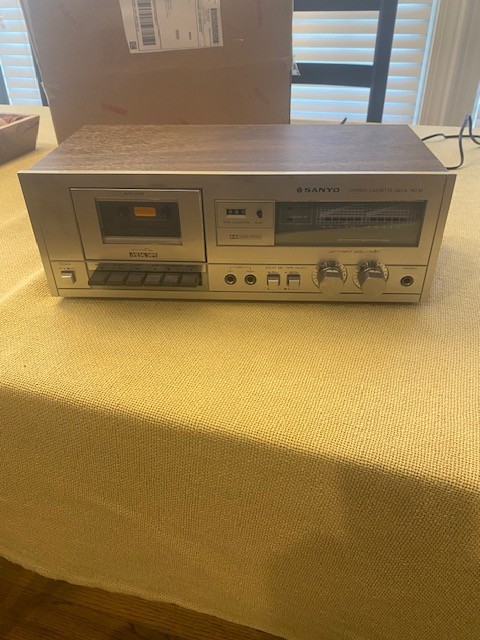
In the early 1980s, Japanese electronics giant Sanyo was riding high on a wave of innovation in consumer audio, producing everything from high-fidelity receivers to compact portable systems. Among their more obscure but fascinating offerings was the Sanyo RD-10, a compact, all-in-one portable audio system that blended radio, cassette playback, and a unique speaker design into a sleek, transportable package. While not as widely recognized as the Sony Walkman or the boombox giants of the era, the RD-10 occupies a special niche in vintage audio history as a forward-thinking hybrid that anticipated the demand for mobile, high-quality sound in a minimalist form.
Though detailed documentation on the RD-10 is scarce—making it a true "hidden gem" among collectors—the available evidence suggests it was marketed as a premium portable system aimed at urban professionals and audiophiles who valued both convenience and sonic clarity. Released around 1980, the RD-10 emerged during a transitional period in audio technology, when cassette tapes were becoming the dominant medium for personal listening, and portable radios were evolving beyond simple AM/FM receivers into multifunctional entertainment units.
Technical Specifications
The Sanyo RD-10 was engineered with a focus on portability without sacrificing too much in sound quality. It combined several audio technologies into a single, compact chassis, making it ideal for use at home, in the office, or on the go (with optional battery power or AC adapter). While exact technical details are limited due to the model's obscurity, surviving units and user reports allow us to reconstruct its core specifications.
| Specification | Detail |
| Model | Sanyo RD-10 |
| Year of Release | 1980 |
| Category | Portable Audio System |
| Tuner | AM/FM with analog tuning dial |
| Cassette Function | Playback only (no recording) |
| Speaker Configuration | Dual dynamic full-range drivers |
| Amplifier Output | Approx. 2W + 2W (estimated) |
| Power Source | AC adapter (12V) or 6x D-cell batteries |
| Dimensions | ~30 cm (W) × 15 cm (H) × 12 cm (D) |
| Weight | ~3.5 kg (without batteries) |
| Inputs/Outputs | Stereo headphone jack (3.5mm) |
| Special Features | Bass reflex enclosure, carry handle |
Notably, the RD-10 featured a bass reflex enclosure design, uncommon in portables of its size at the time, which enhanced low-frequency response and gave it a fuller sound than typical tabletop radios. The dual dynamic speakers were front-firing and housed behind a metal grille, contributing to a surprisingly wide soundstage for such a compact unit.
Sound Characteristics and Performance
Despite its modest power rating, the Sanyo RD-10 delivers a remarkably balanced and engaging listening experience. The cassette playback section uses a standard rubber pinch roller and capstan drive system, providing stable tape speed and decent frequency response—typical of mid-tier Sanyo mechanisms of the era. While not Hi-Fi by modern standards, the audio quality is clean, with a warm midrange and a surprising amount of bass presence thanks to the reflex port design.
The FM tuner is sensitive and capable of receiving strong local stations with good stereo separation, though it lacks the precision of higher-end tuners. The analog tuning dial, complete with a luminous frequency window, offers a tactile and nostalgic experience that many modern users find charming. The AM band is functional but naturally limited by the small internal ferrite antenna.
One of the RD-10’s standout qualities is its headphone performance. The 3.5mm output drives standard headphones with clarity and sufficient volume, making it a capable personal listening device—essentially a proto-Walkman system in a stationary form. Users have noted that when paired with good-quality dynamic headphones, the RD-10 reveals a level of detail that belies its age and category.
Notable Features and Innovations
The RD-10 stands out for its thoughtful integration of form and function. Its modular design—with clearly separated controls for radio and cassette—reflects Sanyo’s engineering philosophy of user-friendly operation. The front panel features large, tactile knobs for volume, tuning, and power, while the cassette compartment is top-loading with a flip-down lid, a design choice that saves space and adds to the unit’s sleek profile.
Another innovation is the dual power option. While many portables of the time relied solely on batteries or AC, the RD-10 could switch seamlessly between power sources, making it versatile for both indoor and outdoor use. The battery compartment, designed for six D-cell batteries, suggests Sanyo intended the RD-10 to be truly portable—capable of hours of continuous playback.
The inclusion of a stereo headphone jack was also forward-thinking. At a time when many portable radios still used mono output or required adapters, the RD-10 embraced stereo personal listening, aligning with the growing popularity of private audio consumption.
Common Issues and Maintenance
As with any vintage electronics from the early 1980s, the Sanyo RD-10 is prone to age-related wear. The most common issues include:
- Deteriorated rubber components: The cassette pinch roller and drive belt (if present in the transport mechanism) may have hardened or cracked. These should be replaced with modern equivalents for reliable tape playback.
- Capacitor aging: The power supply and audio coupling capacitors may have dried out, leading to hum, low output, or no sound. A full recapping is recommended for units that have been stored for decades.
- Tuner misalignment: The FM/AM tuner may require realignment if reception is weak or distorted, especially if the unit has been moved frequently.
- Battery corrosion: If stored with batteries, the spring contacts may be corroded. These can usually be cleaned with isopropyl alcohol and a wire brush.
Regular cleaning of the tape head and capstan with demineralized water or head cleaner is essential for maintaining cassette performance. Using a demagnetizer is also advisable, especially if tapes sound dull or muffled.
Current Market Value and Collectibility
The Sanyo RD-10 is a rare find on the vintage market, with few units appearing on auction sites or collector forums. Its obscurity works in its favor—enthusiasts of obscure Japanese audio gear often seek out models like the RD-10 for their uniqueness and historical curiosity.
Units with original packaging or manuals can command higher prices, especially among completist collectors.
While not yet a "blue-chip" vintage item like a Nakamichi cassette deck or a Revox reel-to-reel, the RD-10’s blend of design, functionality, and rarity makes it a compelling addition to any collection of portable audio history.
Conclusion and Legacy
The Sanyo RD-10 may not have achieved the fame of its contemporaries, but it represents an important moment in the evolution of personal audio—a time when manufacturers were experimenting with how to deliver quality sound in increasingly compact and mobile formats. It bridges the gap between the bulky stereos of the 1970s and the ultra-portable devices of the 1980s, offering a glimpse into Sanyo’s vision of accessible, high-performance audio for everyday life.
Today, the RD-10 is more than just a nostalgic artifact—it’s a testament to thoughtful engineering and understated design. For the vintage audio enthusiast, restoring and enjoying an RD-10 is not just about the sound, but about reconnecting with a moment in time when innovation was measured not in gigabytes or streaming quality, but in the warmth of a cassette tape playing through a well-designed speaker in a living room, office, or park bench.
If you’re lucky enough to find one, give it a listen. You might just discover that the future of portable audio was invented decades ago—and it came from Sanyo.
eBay Listings


As an eBay Partner, we earn from qualifying purchases. This helps support our independent vintage technology research.
Related Models
- Sanyo DCX-8000 (1982)
- Sanyo SX-635 (1975)
- Sanyo JCX-2400K (1978)
- Sanyo DCA-100 (1978)
- Sanyo DCX-1970K (1975)
- Akai AM-2850 (1975)
- Akai AP-206 (1975)
- Nakamichi BX-1 (1985)
- Acoustic Research research-ar-17 (1978)
- Acoustic Research AR-19 (1994)