Sanyo M-7700: The Forgotten All-in-One Audio Console of the 1970s
In the mid-1970s, when home audio was transitioning from bulky separates to more integrated and furniture-friendly systems, Japanese electronics giant Sanyo introduced the M-7700—a striking, self-contained audio console that epitomized the era’s fascination with convenience, style, and technological optimism. Though not as widely remembered as the separates from brands like Pioneer or Sony, the Sanyo M-7700 stands today as a charming artifact of 1970s audio design, blending form and function in a way that resonates with collectors and retro enthusiasts.
Unlike traditional receivers or amplifiers, the M-7700 belongs to the "all-in-one" or "console" category—a complete audio system housed in a single wooden cabinet, often designed to double as living room furniture. These units were immensely popular in the 1970s, especially in North America and Europe, where consumers sought elegant, space-saving solutions for home entertainment. The M-7700, with its warm walnut finish, sweeping control panel, and integrated speakers, was built to impress both visually and sonically.
Technical Specifications
While detailed service manuals and schematics for the M-7700 are scarce today, surviving units and user reports suggest the following typical configuration for this era of Sanyo consoles:
| Feature | Specification |
| Model | Sanyo M-7700 |
| Year Introduced | 1975 |
| Category | All-in-one audio console |
| Tuner | AM/FM with analog tuning dial and signal meter |
| Playback Sources | Dual cassette decks (standard speed, NAB equalization) |
| Speakers | 2 x Full-range drivers (approx. 6" woofers + tweeters) |
| Amplifier | Solid-state, integrated stereo amplifier |
| Output Power | Estimated 15–20W total (combined RMS) |
| Inputs | Auxiliary input (likely 3.5mm or RCA) |
| Outputs | None (self-contained system) |
| Power Supply | AC 120V / 60Hz (North American version) |
| Dimensions (approx.) | 50 cm (W) × 40 cm (H) × 30 cm (D) |
| Weight | ~15 kg |
| Finish | Walnut wood veneer with brushed metal accents |
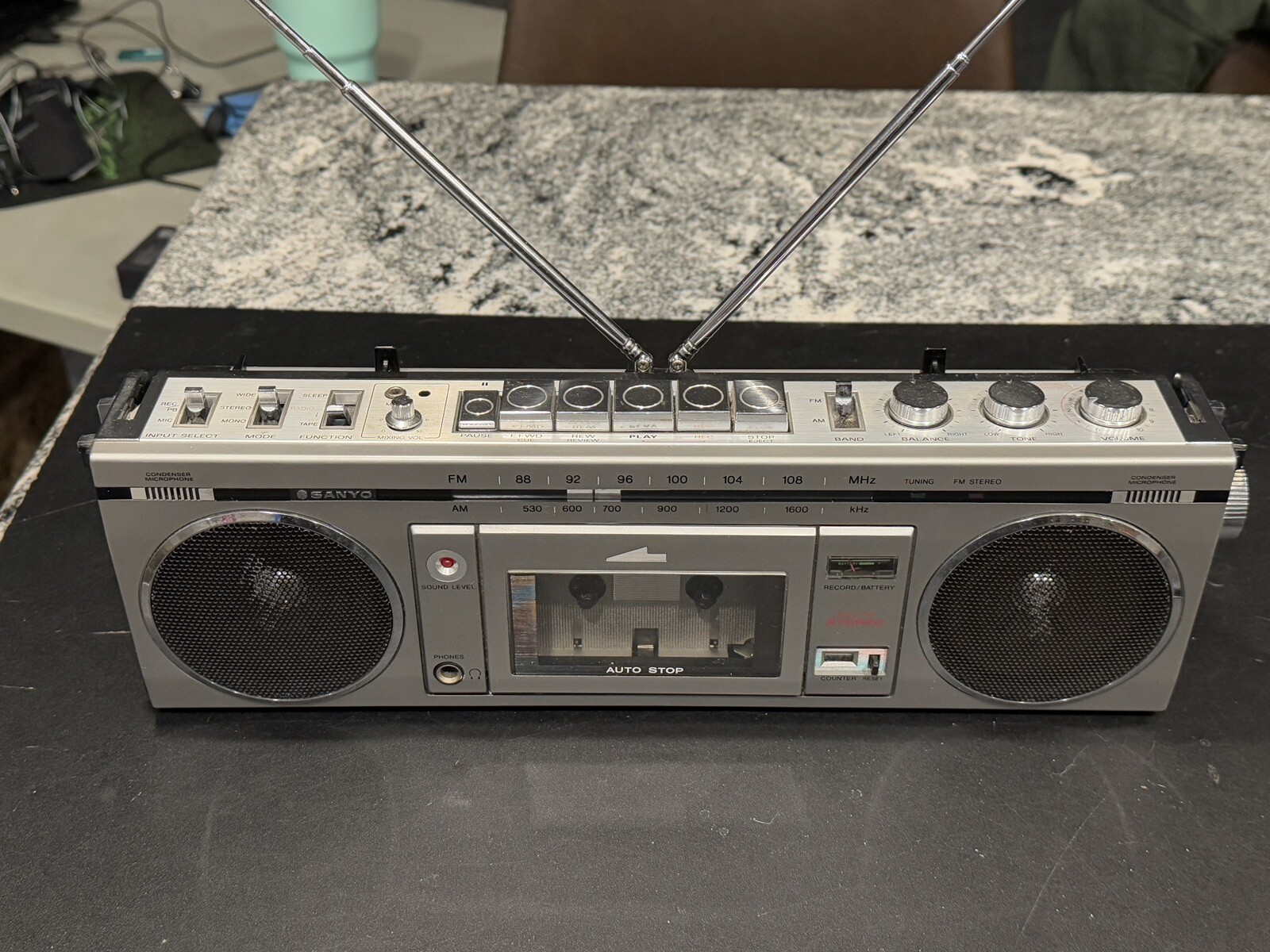
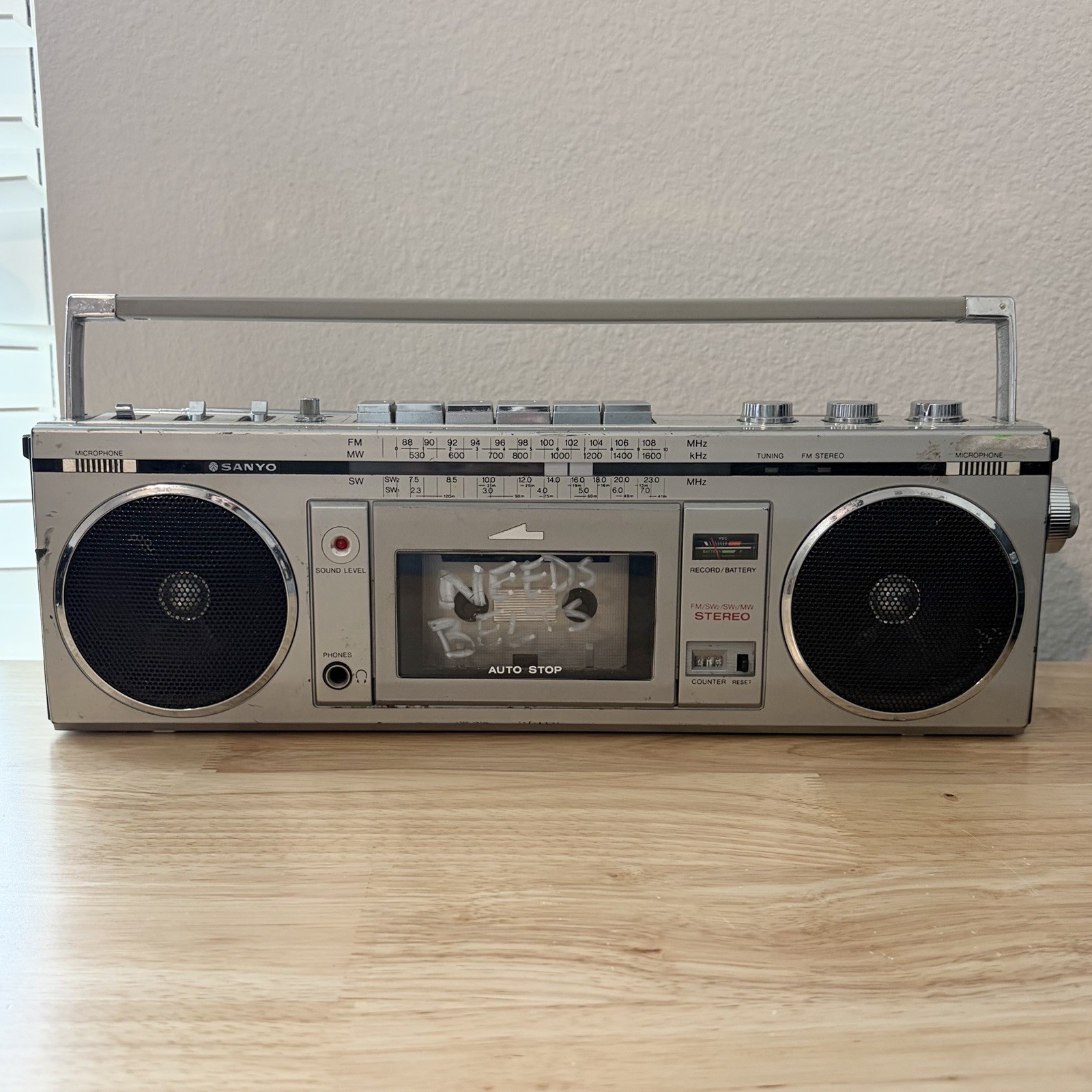
The M-7700 typically featured a symmetrical layout: the left and right sides housed the speakers, while the center section contained the dual cassette decks, tuner, and control interface. The front panel was minimalist yet functional, with large tuning and volume knobs, a flip-up door protecting the cassette mechanisms, and a prominent analog VU meter that added a touch of hi-fi flair.
Sound Characteristics and Performance
As with most all-in-one consoles of its time, the Sanyo M-7700 prioritized convenience and aesthetic integration over audiophile-grade performance. That said, it delivered a warm, full-bodied sound that was well-suited to the popular music of the 1970s—think soul, soft rock, and FM radio broadcasts.
The built-in speakers provided a surprisingly balanced frequency response for their size, with decent midrange clarity and modest bass extension. The dual cassette decks allowed for basic home dubbing—ideal for making mixtapes from the radio or LPs—though they lacked the speed stability and noise reduction of higher-end decks. The AM/FM tuner offered solid reception with manual tuning, and the analog meter helped users fine-tune stations for optimal clarity.
While the M-7700 couldn’t match the dynamic range or channel separation of separates systems, its sound was cohesive and pleasing in a domestic setting. It was designed to fill a room with music effortlessly, not to dissect every nuance of a recording.
Notable Features and Innovations
The Sanyo M-7700 stood out for several reasons:
- Furniture-Grade Cabinet: Crafted with real wood veneer and designed to sit atop a credenza or in a dedicated entertainment center, the M-7700 blurred the line between electronics and home decor.
- Dual Cassette Functionality: At a time when cassette recording was still a novelty, having two decks allowed users to copy tapes—a feature that would become standard in the 1980s.
- Integrated Design: Everything from power supply to speakers was built in, reducing clutter and setup complexity—perfect for non-technical users.
- Analog Aesthetic: The VU meter, large knobs, and sweeping front panel gave the unit a sophisticated, hi-fi look that appealed to image-conscious buyers.
Sanyo was known during this period for building reliable, value-oriented electronics, and the M-7700 reflected that philosophy: solid construction, user-friendly operation, and a polished appearance.
Common Issues and Maintenance
Like all vintage electronics from the 1970s, the Sanyo M-7700 is prone to age-related wear and component degradation. Common issues include:
- Capacitor Failure: Electrolytic capacitors in the power supply and audio circuits often dry out, leading to hum, low output, or complete failure. Replacing these is usually the first step in restoration.
- Tape Mechanism Wear: Rubber drive belts and idler wheels harden or crack over time. A full cleaning and belt replacement are typically required for the cassette decks to function properly.
- Tuner Misalignment: The AM/FM tuner may drift or lose sensitivity and may need realignment by a technician with proper equipment.
- Dusty Controls: Pots and switches can become scratchy due to oxidation. Contact cleaner can help, but some components may need replacement.
- Speaker Foam Decay: The foam surrounds on the speakers often deteriorate, causing distorted bass or rattling. Re-foaming or reconing is recommended for optimal sound.
Despite these challenges, the M-7700 is generally considered repairable, especially given the widespread availability of generic replacement parts for cassette mechanisms and power supplies from that era.
Current Market Value and Collectibility
The Sanyo M-7700 is not a high-profile collector’s item like a Marantz receiver or a Nakamichi cassette deck, but it has gained a quiet following among enthusiasts of retro audio furniture and 1970s design. Complete, working units in good cosmetic condition typically sell for $150–$300 on platforms like eBay, Etsy, or specialized vintage audio forums.
Rarity plays a role—few M-7700 units were preserved, and many were discarded as tastes shifted toward component systems in the 1980s. Those that survive are often found in attics or secondhand stores, sometimes still functional with minor servicing.
Its appeal lies not in technical superiority, but in nostalgia, craftsmanship, and the charm of a bygone era when audio equipment was meant to be seen and admired as much as heard.
Conclusion and Legacy
The Sanyo M-7700 may not have changed the course of audio history, but it captures a moment when technology, design, and lifestyle converged in a uniquely 1970s way. It represents a time when families gathered around a single, elegant console to listen to the radio, record their favorite songs, or play back home recordings.
Today, the M-7700 is more than just a relic—it’s a conversation piece, a statement of retro style, and a testament to Sanyo’s role in bringing quality audio to the mass market. For collectors of vintage consoles, or anyone charmed by the warm glow of analog dials and woodgrain finishes, the Sanyo M-7700 offers a delightful slice of audio history.
If you’re lucky enough to find one in good condition, don’t overlook it. With a little care, the M-7700 can still bring music—and memories—to life.
eBay Listings


As an eBay Partner, we earn from qualifying purchases. This helps support our independent vintage technology research.
Related Models
- Sanyo DCX-8000 (1982)
- Sanyo RD-10 (1980)
- Sanyo SX-635 (1975)
- Sanyo JCX-2400K (1978)
- Sanyo DCA-100 (1978)
- Akai AM-2850 (1975)
- Akai AP-206 (1975)
- Nakamichi BX-1 (1985)
- Acoustic Research research-ar-17 (1978)
- Acoustic Research AR-19 (1994)