Sansui TU-9500 (1973)
At 9.5 kg, it lands on the rack heavy and solid.
Overview
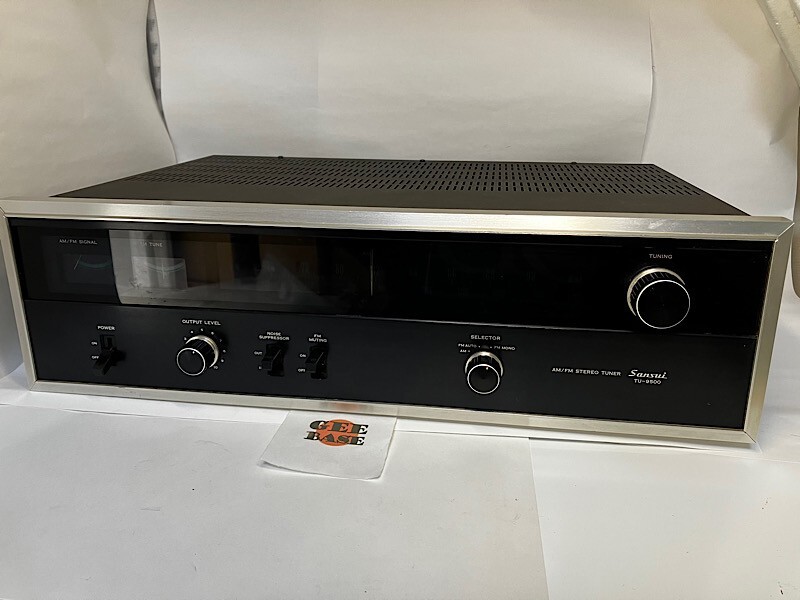
The Sansui TU-9500 doesn't ask for your attention — it earns it the moment you lift it. Nine and a half kilograms of transformer, shielding, and machined front panel, spread across a chassis 500 mm wide, 140 mm tall, and 347 mm deep. That's not a tuner you tuck into a shelf; that's a tuner you build a system around. It arrived in late 1973 as the matching FM/AM front end to Sansui's AU-9500 integrated amplifier, and the company's own advertising treated the pair as a single statement: Audio (November 1973, p.31) ran the AU-9500 at $519.95 and the TU-9500 at $299.95 in the same spread, under the line "can you match a Sansui tuner?"
The $299.95 in 1973 bought a front end built around three dual-gated MOS FETs - two in the RF amplification stages, one in the mixer - feeding a frequency-linear five-gang tuning capacitor. Sansui's literature describes the arrangement as a way to keep noise low and strong-signal handling high, and the headline number is a claimed input capacity of 130 dB. That matters in cities, where a 50 kW station a few blocks away can fold up a lesser tuner. The IHF sensitivity rating of 1.7 µV is the other half, and it's the number Sansui put in the ads - Audio (October 1973, p.57) printed 1.7 µV for the TU-9500 against 1.9 µV for the cheaper TU-7500.
Downstream of the front end, the IF strip uses four uni-wafer bi-resonator ceramic filters and three ICs. Sansui took unusual care with phase linearity, which shows up as stereo imaging that holds together on busy material instead of smearing. The multiplex section is where the real engineering is.
The DDC Circuit and Why It Mattered
Every FM stereo tuner of the era had to deal with SCA subcarriers, the subsidiary signals broadcast alongside the main program for background music services and similar. The conventional fix was an SCA filter built from coils and capacitors. It worked, but it introduced phase shift and information loss in the subcarrier region, and that degraded high-frequency stereo separation as a side effect.
Sansui's answer was the Differential Demodulator Circuit, filed with patents pending and marketed as exclusive. Rather than filtering the SCA beat passively, the DDC cancels it electronically. The claimed result is stereo separation of better than 40 dB across a wide frequency range. The published spec is better than 40 dB at 400 Hz and better than 30 dB at 10 kHz, without the top-end dulling that coil-and-cap SCA filters caused. Whether the DDC delivered everything the brochure promised is a question only measurement answers.
The rest of the tuner is built to the same standard. Mono total harmonic distortion is rated below 0.2%, stereo below 0.3%. Signal-to-noise is better than 75 dB. Selectivity is better than 80 dB, capture ratio 1.5 dB, and image, IF and spurious rejection all clear 100 dB. On the AM side, the bar-antenna sensitivity is 46 dB/m and selectivity is better than 25 dB, with image and IF rejection both past 100 dB/m at 1,000 kHz. Sansui clearly didn't treat AM as an afterthought.
Living With It
The front panel has a wide, evenly graduated FM scale marked in 250 kHz steps, lit against a black dial, with a large flywheel driving the tuning mechanism. That makes slow, deliberate tuning easy. Two meters sit above the dial: one for signal strength, one for center-of-channel tuning. The second is the one to watch when landing on a weak station without distortion creeping in.
There's a muting switch on the front panel, but the depth control lives on the rear. That lets you set the mute threshold to your local signal conditions and leave it. If the weak stations near you are the ones you care about, you can dial the muting back so it doesn't swallow them. The noise suppressor switch does double duty. On FM stereo it engages an MPX noise canceler that removes hiss without rolling off the highs, and on AM it switches in a whistle filter to kill beat noise above 7 kHz.
There are two rear-panel outputs worth knowing about. A discriminator output terminal is provided for adding a four-channel demodulator, which was forward-looking in 1973, when discrete quad broadcasts were still anticipated rather than real. A multi-path output lets you connect an oscilloscope and watch the received waveform directly, which turns antenna positioning from guesswork into measurement. Most owners never touch either terminal.
Power comes from a constant-voltage supply using transistors and a Zener diode, which Sansui specified to keep ripple and line-voltage fluctuation out of the signal path. Consumption is modest - 20 W rated, 25 VA maximum. The tuner was offered in 100, 117, 220, and 240 V versions at 50/60 Hz, so multi-voltage examples exist and are worth checking before you plug one in.
Pairing and Placement
The TU-9500 was designed as the other half of a partnership with the AU-9500, and Sansui's advertising leaned hard on that framing - Studio Sound (December 1973, p.12) ran the two together under the headline "From Sansui a touch of genius. Twice." The amplifier itself was rated at 80 watts RMS per channel into 8 ohms, and the visual and electrical match is the reason most surviving TU-9500s turn up alongside one. It's not a hard requirement, since the tuner stands on its own.
Condition, Maintenance, and What to Look For
These are fifty-year-old machines now, and most examples need work. Electrolytic capacitors in the power supply and signal path are the usual first job, and a recap is close to mandatory on any unit that's been sitting. Dial lamps burn out, and the meters can drift.
Alignment matters more on a tuner than on almost any other component. A TU-9500 that's been recapped but never realigned will often underperform a well-aligned original, so budget for a proper RF alignment if you're buying a project unit. Schematics and service literature exist, and the layout is serviceable despite the weight.
eBay Listings
As an eBay Partner, we earn from qualifying purchases. This helps support our independent vintage technology research.
Related Models
- Sansui 2000 (1967-1969)
- Sansui 9090DB (1976-1979)
- Sansui 7700-AM
- Sansui TC-505 (1968)
- Sansui tu-555 (1968-1970)
- Kenwood KR 3200 (1973-1975)
- Kenwood KR 3400 (1977-1979)
- Kenwood KR 4070 (1977-1979)
- Kenwood KR 4200 (1975-1977)
- Marantz 1515 (1976-1978)