Sansui 5000A (1969)
That warm, open Sansui sound—55 watts of analog richness in a brushed-aluminum-and-wood case that still turns heads.
Overview
Turn the volume knob on a Sansui 5000A and you’re not just adjusting level—you’re tuning into a moment in Japanese audio history when solid-state amplification was shedding its clinical reputation and learning how to sing. This receiver, launched in 1969, wasn’t just Sansui’s flagship—it was a statement. With 55 watts per channel into 8 ohms, it delivered more power than most contemporaries dared claim, and it did so with a lush, forgiving tonality that made even second-rate recordings feel like events. It wasn’t sterile or hyper-detailed; it was *present*, like someone had quietly turned up the emotional volume on your music. The moment you hear a well-restored 5000A drive a pair of vintage AR or KLH speakers, you understand why so many collectors treat these like heirlooms.
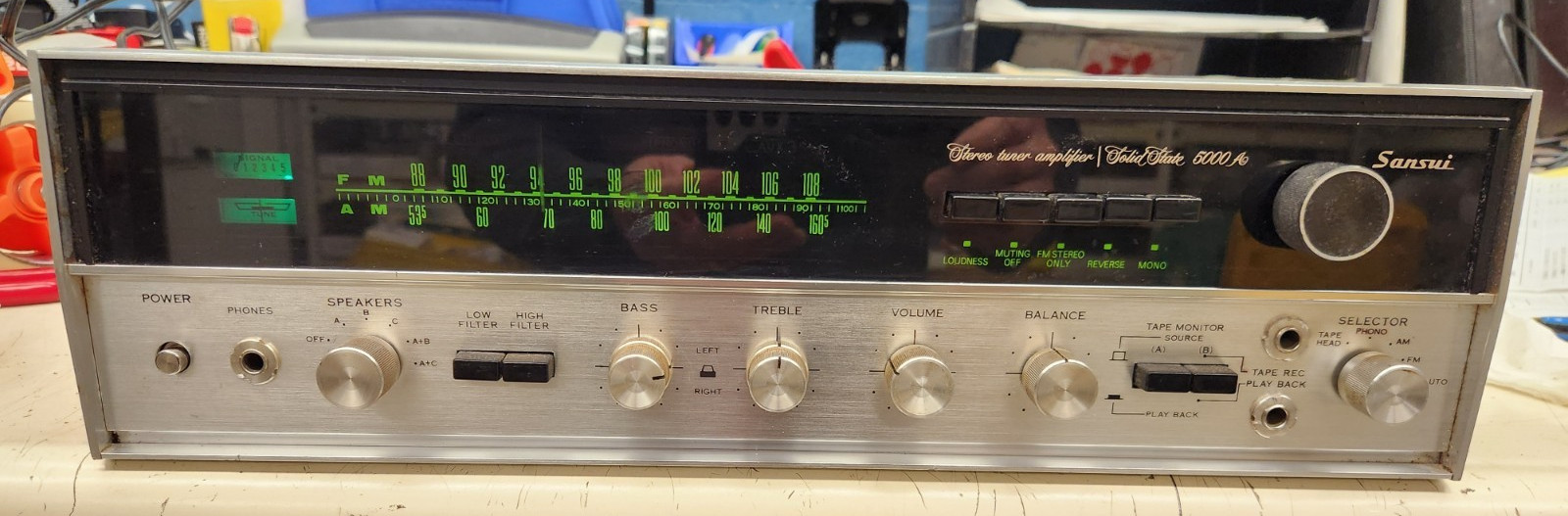
But this isn’t a piece of gear you buy for specs alone. The 5000A sits at the intersection of form and function that defined late-’60s high fidelity: half-brushed aluminum faceplate, a black upper section with amber-lit tuning dial, and green VU meters that sway like pendulums in a dream. The wood case—optional but common—wasn’t an afterthought; it was furniture-grade, meant to live in a living room, not a closet. And when you powered it up, the way the input lights dimmed on AUX or the satisfying click of the reverse switch added a tactile pleasure missing from today’s touchless interfaces. It had everything a serious listener needed: phono (MM), aux, two tape loops, three speaker outputs, and thoughtful touches like FM muting and a loudness contour that actually worked without muddying the mids.
Yet for all its strengths, the 5000A carries a shadow. It was born with a flaw that could turn a prized possession into a smoldering paperweight. The original F-1040 driver boards, mounted vertically behind the power supply caps, had a fatal flaw in their bias circuitry. Without proper thermal regulation, the output transistors could run dangerously hot, leading to catastrophic failure—sometimes taking the speakers with them. Sansui didn’t ignore it; they issued a recall and replaced the F-1040 boards with the improved F-6013, a fix so effective that later models like the 5000X shipped with them from the factory. But that means every 5000A on the market today demands one question before any listening: *What’s on the back wall?* If it still has the F-1040, it’s not a receiver—it’s a project. And even if it’s been upgraded, the modification isn’t always clean; some retrofits require additional circuit changes to work properly, and poorly executed ones can degrade performance or create new instabilities.
Still, when it’s right, the 5000A delivers a sound that’s hard to replicate. It’s not as clinical as a Marantz 2270, not as aggressive as a Pioneer SX-1980. It’s smoother, more forgiving—what some call “warm” but what others experience as *alive*. Bass is full without being bloated, mids are rich without veiling detail, and highs shimmer without etch. It’s the kind of amplifier that makes you reach for vinyl you haven’t played in years, just to hear how good they can sound when the gear gets out of the way.
Specifications
| Manufacturer | Sansui Electric Co., Ltd. |
| Production Years | 1969 |
| Original Price | $400 |
| Power Output | 55 watts per channel into 8Ω (stereo) |
| THD | 0.8% |
| IM Distortion | Not specified |
| Frequency Response | 20Hz to 30kHz |
| S/N Ratio | 65dB (MM), 70dB (line) |
| Input Sensitivity | 2.5mV (MM), 200mV (DIN), 150mV (line) |
| Output | 200mV (line), 40mV (DIN) |
| Load Impedance | 4Ω to 16Ω |
| Damping Factor | 15 |
| Inputs | Phono (MM), DIN, Aux |
| Outputs | Tape Out, Speaker A/B/C, DIN |
| Channel Separation | 50dB (MM), 50dB (line) |
| Speaker Outputs | 3 sets (A, B, C) |
| Tape Loops | 2 (Tape 1, Tape 2) |
| Fuses | 5A (main), 2 x 4A (quick-acting, above antenna) |
| Power Requirements | 120V AC, 60Hz |
| Dimensions | 17-11/32" W × 4-17/32" H × 14-9/16" D |
| Weight | 29.1 lbs |
| Semiconductors | 52 transistors, 3 FETs, 4 ICs, 33 diodes, 3 zener diodes |
| Wood Case | Optional, C7 style |
Key Features
A Design That Earned Its Place on the Shelf
The 5000A didn’t just want to be heard—it wanted to be seen. At a time when receivers were increasingly boxy and utilitarian, Sansui went the opposite direction: a split-face front panel with brushed aluminum below and matte black above, framing an amber-backlit tuning dial and dual green VU meters that responded with theatrical sweep. The layout was intuitive, with large, knurled knobs for volume, balance, and tone, and a row of toggles across the top for functions like FM muting, loudness, and channel reverse. The reverse switch—rare on consumer gear—allowed left and right channels to be swapped, useful for asymmetric room setups or correcting reversed recordings. Even the input selector had personality: switching to AUX killed the tuning meter backlight, a small but elegant touch that reduced glare during late-night listening. The optional wood case wasn’t just cosmetic; it added structural rigidity and dampened resonance, contributing subtly to the unit’s sonic stability.
Signal Path with Character
Sonic signature starts with circuit design, and the 5000A’s topology favored musicality over measurement. The phono stage used discrete transistor circuitry with RIAA equalization, delivering a smooth, slightly rich rendering of vinyl that masked surface noise without dulling transients. The line stage was equally well executed, with low output impedance ensuring compatibility with a wide range of sources. The dual tape loops—bi-directional and switchable via the tape monitor toggle—made it easy to integrate cassette decks for recording or playback. And unlike many receivers of the era, the 5000A didn’t skimp on speaker flexibility: three sets of outputs allowed for multi-room setups or A/B comparisons, and the 4–16Ω load range meant it could handle everything from efficient horns to demanding planars. The damping factor of 15 wasn’t class-leading, but in practice, it provided enough control for tight bass without making the sound overly damped or sterile.
The F-1040 Board: A Flaw That Defined a Legacy
No discussion of the 5000A is complete without addressing the F-1040 driver board. This small circuit board, mounted vertically at the rear, controlled the bias voltage for the output transistors. In early production units, a design flaw caused thermal runaway: as the transistors heated up, the bias increased, which made them hotter, creating a feedback loop that could destroy the amplifier in minutes. Sansui responded by replacing the F-1040 with the F-6013, which included improved bias regulation and thermal compensation. The fix was effective, but it created a split in the collector market: units with the F-6013 are considered safe and desirable; those with the original board are treated as high-risk, even if they appear to work. Some technicians offer conversion kits, but the modification isn’t trivial—it can require changes to surrounding components and careful recalibration. Owners report that improperly converted units can suffer from channel imbalance, distortion, or premature failure. For this reason, the board type isn’t just a technical footnote—it’s the single most important factor in determining whether a 5000A is a ready-to-use classic or a repair bench candidate.
Historical Context
The Sansui 5000A arrived in 1969, a pivotal year for high-fidelity audio. Transistors had finally matured enough to challenge vacuum tubes in both power and fidelity, and Japanese manufacturers were leading the charge. Sansui, already respected for its innovative amplifiers and tuners, used the 5000A to stake a claim at the top of the market. It competed directly with flagships from Marantz, Harman Kardon, and Pioneer, but it did so with a distinct sonic philosophy: less analytical, more immersive. While American brands often emphasized precision and neutrality, Sansui leaned into warmth and dimensionality, appealing to listeners who wanted their music to feel *close*. The 5000A also reflected the era’s shift toward integrated convenience—combining tuner, preamp, and power amp in one chassis—without sacrificing performance. It was aimed at the serious hobbyist, not the casual buyer, evident in its price: $400 in 1969 was the equivalent of over $3,300 today.
It also arrived just before the FM stereo boom of the 1970s, making its high-quality FM section a forward-looking feature. The dual tuning capacitors and muting circuit ensured clean reception, and the FM-only stereo switch allowed users to disable stereo decoding for weak signals, reducing noise. The 5000A was succeeded by the 5000X in 1971, which not only fixed the F-1040 issue but also increased power to 60 watts per channel and refined the tuner section. Yet the 5000A remains significant—not just as a precursor, but as a snapshot of a moment when Japanese engineering was redefining what solid-state audio could be.
Collectibility & Value
The Sansui 5000A occupies a complicated space in the vintage audio market. It’s sought after for its sound and looks, but its reputation is tempered by the F-1040 issue. A fully functional, F-6013-equipped unit in excellent cosmetic condition—with original wood case and working meters—can command $600 to $900. Units without the wood case or with minor cosmetic flaws (scratched faceplate, dimmed meters) typically sell for $400 to $600. But those with original F-1040 boards, even if working, are priced as projects—often $200 to $400, reflecting the cost and risk of conversion. Unconverted units are rarely recommended for daily use; service technicians observe that even seemingly stable F-1040 boards can fail without warning, sometimes taking speakers with them.
Maintenance costs are a real consideration. A full recapping and bias adjustment typically runs $250 to $350, and sourcing an authentic F-6013 board can be difficult—some are newly manufactured, but quality varies. The power supply capacitors, now over 50 years old, should be replaced regardless; failure can lead to hum, distortion, or blown fuses. The front panel switches and potentiometers often need cleaning, and the tape relay contacts can oxidize, causing dropouts. Fuses are another point of failure: the 5000A uses three—main, and two quick-acting fuses above the antenna—and replacements must match specifications exactly.
For buyers, the checklist is clear: open the unit and verify the driver board. If it’s F-1040, assume it needs work. Check that all inputs and tape monitors function, that the meters respond, and that there’s no hum or distortion at idle. Smell for burnt components—especially near the rear heat sinks—and inspect the wood case for warping or veneer lift. A working 5000A is a joy; a broken one is a lesson in vintage electronics repair. But for those willing to do the due diligence, the reward is a receiver that doesn’t just play music—it invites you in.
eBay Listings



As an eBay Partner, we earn from qualifying purchases. This helps support our independent vintage technology research.
Service Manuals & Schematics
- Service Manual — archive.org
Related Models
- Sansui PM C100 (Unknown)
- Sansui 6060 (1975-1977)
- Sansui 551 (1973-1975)
- Sansui AU 555 (1968-1971)
- Sansui CA 3000 (1974-1977)
- Akai AM-2850 (1975)
- Akai AP-206 (1975)
- Nakamichi BX-1 (1985)
- Acoustic Research research-ar-17 (1978)
- Acoustic Research AR-19 (1994)