Sansui 1000A
At 18.6 kilograms, it lands on the rack like a declaration—this is not your living room’s background player.
Overview
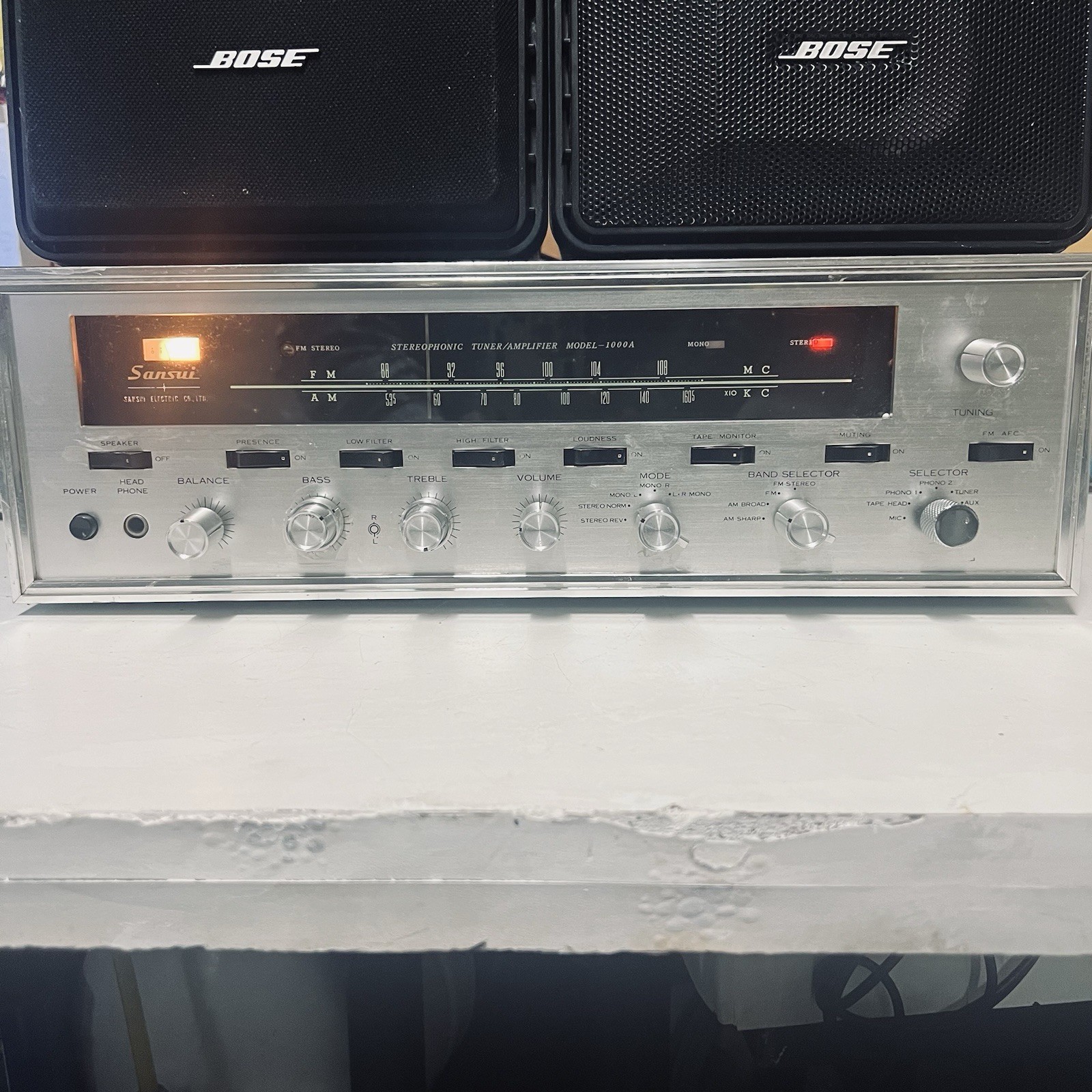
The Sansui 1000A isn't a minimalist statement or a compact solution—it’s a full-scale audio command center from the late 1960s, built when receivers weren't just amplifiers with tuners bolted on, but engineered systems meant to dominate a hi-fi stack. Marketed as a "high-grade stereo comprehensive amplifier," the 1000A integrates tube-based power amplification with solid-state preamp circuitry, FM/AM tuner sections, and a feature set that borders on obsessive. At 454mm wide and nearly 37cm deep, it demands space, and its 18.6kg mass suggests serious iron and copper inside. The original price of ¥78,000 (circa 1965) placed it at the premium end of the Japanese market, aimed at audiophiles who wanted both performance and flexibility in one chassis.
While the exact production years remain debated—some sources cite 1967–1969, others suggest manufacture began as early as 1965 and extended to 1971—the 1000A emerged during a transitional period when tube and transistor technologies coexisted in high-end audio. It reflects that hybrid philosophy: 21 vacuum tubes and 20 semiconductors share the chassis, with transistors deployed in the preamplifier section specifically to reduce hum and noise. The power amp section relies on the GT-type 7591 tubes in a fixed-bias push-pull configuration, paired with an ultra-wide-band output transformer, a design choice meant to deliver both headroom and clarity.
Owners report it delivers on that promise. Described across enthusiast circles as “great sounding,” “big and powerful,” and capable of producing a “sweet” or “beautiful” sound, the 1000A doesn’t just amplify—it shapes. The frequency response on the Aux input stretches from 30 Hz to 20 kHz within ±1.5 dB, suggesting extended highs and solid bass, though the IHFM power bandwidth is rated more conservatively at 35 Hz to 15 kHz. With 33W + 33W of effective power per channel (and a claimed 96W music power), it was built to drive demanding speakers of the era, and its damping factor of 9.5 at 1 kHz indicates moderate control over bass drivers.
Despite its complexity, the 1000A was designed for real-world use. It includes two phono inputs, one of which can be adapted for MC cartridges using the optional Sansui A-603 or A-604 matching transformers—rare flexibility for its time. The inclusion of a center channel output hints at early 3D stereo experimentation, while the tape monitoring system and multiple input routing options (8 input systems, Route 3 terminals) reflect a serious approach to source management.
Specifications
| Manufacturer | Sansui |
| Product type | Integrated amplifier |
| Original price | ¥ 78,000 (around 1965) |
| Music Power (IHFM) | 96W |
| Effective power | 33W + 33W (when both channels are used) |
| Harmonic distortion factor | 1% (at rated output) |
| Power Bandwidth (IHFM) | 35 Hz to 15 kHz |
| Frequency characteristic Aux | 30 Hz to 20 kHz ± 1.5 dB (at normal output) |
| Channel separation Phono | 55dB |
| Hum and Noise (IHFM) Aux | -90dB at rated output |
| Hum and Noise (IHFM) Phono | -70dB at rated output |
| Residual Noise (Tone Control Flat) | 1 mv (8 Ω) |
| Load impedance | 8 Ω, 16 Ω |
| Damping factor | 9.5(1kHz) |
| Input sensitivity Phono 1 | 2 mV (0.06 mV when using Sansui input transformer A-604) |
| Input sensitivity Phono 2 | 2mV |
| Input sensitivity Tape head | 2mV |
| Input sensitivity Mic | 2.3mV |
| Input sensitivity Aux 1 | 65mV |
| Input sensitivity Aux2 | 110 mV |
| Input sensitivity Tape mon (Pin) | 65mV/200k Ω |
| Input sensitivity Tape mon (Din) | 65mV/100k Ω |
| Center channel output | 7.5V/1k Ω (at rated output) |
| Equalizer characteristics Phono MAG | RIAA |
| Equalizer characteristics Tape head | NAB(19cm/sec) |
| Tone control Bass | + 10 dB ~ -15dB (50 Hz) |
| Tone control Treble | + 11 dB ~ -12dB (10 kHz) |
| Loudness control | + 7.5 dB (50 Hz), + 7.5 dB (10 kHz) |
| High-cut filter | 10 kHz, -11dB/oct. |
| Low-cut filter | 50 Hz, -10dB/oct. |
| Presence | 250 Hz (turnover frequency) |
| Other Functions | Tape monitor, Headphone jack |
| FM Tuner Section Receiving frequency | 76 MHz to 90 MHz |
| FM Tuner Section Sensitivity | 2 μ V (S/N30dB, Mod30%) |
| FM Tuner Section IF bandwidth | 230kHz(-3dB) |
| FM Tuner Section Image ratio | 52dB(S/N50dB) |
| FM Tuner Section Total harmonic distortion factor | 0.8% (60 dB input, 30% Mod) |
| FM Tuner Section Frequency characteristic | 30 Hz to 15 kHz ± 1 dB |
| FM Multi Section Separation | 38 dB (1 kHz, 60 dB input) |
| FM Multi Section Total harmonic distortion factor | 1.2% (60 dB input, 30% Mod) |
| FM Multi Section Frequency characteristic | 50 Hz to 15 kHz ± 1.5 dB |
| FM tuner unit included function | FM-AFC, Muting, Stereo indicator, Tuning meter, SCA Filters |
| AM Tuner Section Receiving frequency | 535 kHz to 1,605 kHz |
| AM Tuner Section Sensitivity | 7 μ V (S/N20dB, Mod30%) |
| AM Tuner Section Image ratio | 65dB(1,000kHz) |
| AM Tuner Section Selectivity | Narrow : 30 dB (± 10 kHz) Wide : 24 dB (± 10 kHz) |
| Functions attached to AM tuner part | Tuning meter, Bar antenna |
| Used vacuum tubes, etc. | 7591, etc., 21 vacuum tubes, 20 semiconductors |
| Power | 100 VAC / 117 V, 50Hz/60Hz |
| Power consumption | 180 VA (No Load) 280 VA (full load) |
| External dimensions | Width 454x Height 145x Depth 365 mm |
| Weight | 18.6kg |
Key Features
7591 Tube Push-Pull Power Amplifier with Fixed Bias
The Sansui 1000A uses the GT-type 7591 vacuum tube in its power output stage, configured in a push-pull circuit with fixed bias. This design is more stable and efficient than cathode bias, allowing for higher power output and better thermal control. Combined with an ultra-wide-band output transformer, the amplifier aims for extended frequency response and low distortion—critical for a receiver expected to handle both music and broadcast signals with authority.
Hybrid Preamp with Four Transistors
To reduce hum and noise in the sensitive preamplifier section, Sansui integrated four transistors. This hybrid approach was forward-thinking for the late 1960s, leveraging the low-noise advantages of early solid-state devices while retaining the warmth and drive of tubes in the output stage. The result is a preamp with reportedly low residual noise (1 mV with tone controls flat) and strong signal integrity across its eight input systems.
Dual Phono Inputs with MC Compatibility
The inclusion of two phono inputs is unusual for any receiver, but the 1000A goes further: it supports moving coil (MC) cartridges via the MT9P socket and optional Sansui matching transformers A-603 and A-604. This level of flexibility suggests Sansui anticipated use by serious vinyl enthusiasts, not just casual listeners. The input sensitivity for Phono 1 drops to 0.06 mV when using the A-604 transformer, indicating compatibility with low-output MC designs.
FM Tuner with Cascode RF Stage and Double Limiter
The FM tuner section features a cascode system with two-stage New Vista and three-stage variable capacitor design, along with a single RF amplification stage. This topology enhances sensitivity and stability. A double limiter circuit works to suppress noise across varying signal strengths, while a muting switch (squelch circuit) disconnects the audio stage during weak signal conditions to eliminate inter-station noise. The AFC (Automatic Frequency Control) ensures stable tuning over long listening sessions.
Center Channel Output for 3D Stereo
Long before surround sound became mainstream, the 1000A included a center channel output (7.5V/1kΩ) to support early 3D stereo experiments. This feature, rare in receivers of the era, reflects Sansui’s willingness to explore spatial audio, possibly in response to niche broadcast formats or experimental home setups.
CR-Type Tone Control with Loudness and Filters
The tone control circuit uses a CR (capacitor-resistor) network, offering ±10 to ±15 dB adjustment at 50 Hz and ±11 to ±12 dB at 10 kHz. A dedicated loudness contour adds +7.5 dB at both bass and treble extremes when engaged. Additional filters include a 10 kHz high-cut (-11dB/oct) and a 50 Hz low-cut (-10dB/oct), useful for cleaning up worn records or reducing noise. A presence control with a 250 Hz turnover frequency allows subtle midrange shaping.
Switching Matrix for FM Multiplex Circuit
The FM multiplex section uses a switching matrix method to handle stereo decoding, a design intended to improve channel separation (rated at 38 dB) and reduce crosstalk. The tuner includes a stereo indicator, SCA filters to block Subsidiary Communications Authorization interference, and a tuning meter for precise station alignment.
Historical Context
The Sansui 1000A followed the original Sansui 1000, which reportedly remained in production for only about a year before being revised into the 1000A. This short evolution suggests rapid development in Sansui’s engineering team, possibly in response to early user feedback or component availability.
Collectibility & Value
No official collectibility data exists, but current market listings suggest strong interest. Units have been offered for $799.99 in used condition, while serviced examples have been priced as high as $1000. Enthusiasts frequently discuss restoration projects online, with multiple threads dedicated to recapping, tube replacement, and troubleshooting. Common issues include motorboating (low-frequency oscillation), static popping, and degraded tube sockets—typical ailments for a complex, tube-heavy unit of this age. Recapping and proper biasing are often required for reliable operation. Despite its complexity, the 1000A has a dedicated following, with one user calling it “a piece of HiFi equipment that I have been hankering after,” and others praising its sound decades after purchase.
eBay Listings

As an eBay Partner, we earn from qualifying purchases. This helps support our independent vintage technology research.