Rotel RA-820A: The Refined High-Current Stereo Amplifier
Introduction
The Rotel RA-820A, introduced in 1987 and produced through 1990, stands as a refined evolution of the well-regarded RA-820 integrated amplifier. Positioned in Rotel’s mid-tier lineup during the late 1980s, the RA-820A brought a crucial enhancement to its predecessor: the addition of tone controls. This seemingly simple upgrade significantly broadened the amplifier’s appeal, offering users greater flexibility in tailoring the sound to their room acoustics or speaker characteristics without compromising the clean, dynamic performance Rotel was known for. During a period when many manufacturers were beginning to favor minimalist, no-frills designs, Rotel struck a balance by maintaining high engineering standards while acknowledging that many audiophiles still valued the convenience and utility of tone adjustment. The RA-820A exemplifies the Japanese brand’s philosophy of delivering high performance at a reasonable price, combining solid-state reliability with audiophile-grade sound. Its three-year production run places it firmly in the golden era of analog audio, a time when integrated amplifiers were the heart of most serious two-channel systems.
Technical Specifications
| Specification | Value |
| Model | RA-820A |
| Category | Amplifiers |
| Years Produced | 1987-1990 |
| Power Output | 80W per channel @ 8Ω |
| Impedance | 8 ohms |
| Frequency Response | 20Hz - 20kHz |
| Total Harmonic Distortion | < 0.03% |
| Signal-to-Noise Ratio | 92dB |
| Dimensions | 430x147x340 mm |
| Weight | 10.5 kg |
Design & Engineering
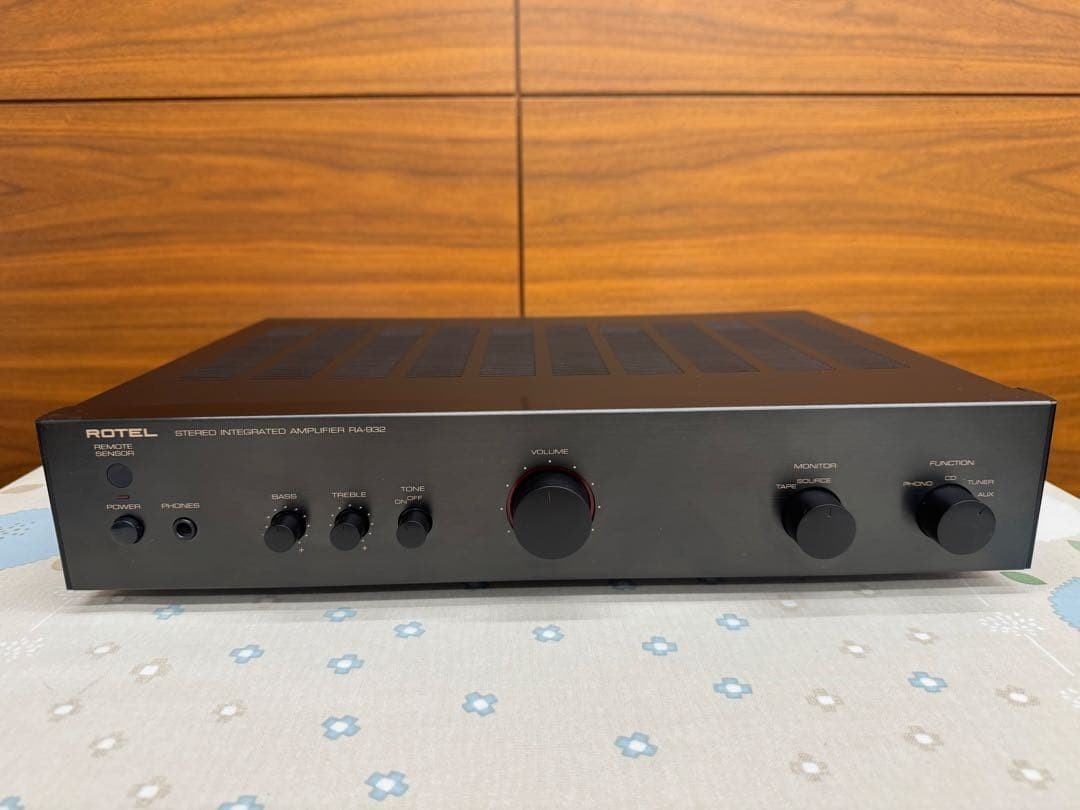
The RA-820A reflects Rotel’s commitment to conservative, well-executed engineering. Housed in a sturdy, non-resonant chassis with a classic black finish and silver control knobs, the amplifier exudes a professional, no-nonsense aesthetic. At its core is a high-current discrete amplifier design, avoiding integrated circuits in favor of individual transistors for greater control over the audio signal path. This approach contributes to the amplifier’s ability to drive a wide range of speakers with authority, particularly those with lower impedance or difficult load characteristics.
A key feature of the RA-820A is its robust power supply, centered around a generously sized toroidal transformer. This component ensures stable voltage delivery during dynamic musical passages, minimizing sag and distortion. The amplifier employs a dual-mono preamp design for the critical input and voltage amplification stages, helping to preserve channel separation and stereo imaging. The inclusion of independent bass and treble controls—adjustable via front-panel knobs—was a thoughtful addition that set it apart from purist designs. These controls are implemented with care, using high-quality potentiometers and circuit layouts that minimize signal degradation when set to flat (0 dB), ensuring that users who prefer a neutral sound aren’t penalized.
The rear panel features four pairs of gold-plated RCA inputs, including a dedicated tape loop, and high-quality binding posts for speaker connections. These terminals accept banana plugs, spades, or bare wire, offering flexibility for various speaker cables. The front panel is dominated by dual analog VU meters, which not only add visual appeal but also provide real-time feedback on output levels—a feature appreciated by both audiophiles and home recording enthusiasts. The overall build quality is excellent for its class, with a heavy chassis that resists vibration and internal layout designed for optimal signal flow and heat dissipation.
Sound Characteristics
The RA-820A delivers a balanced, transparent sound signature that remains highly regarded among vintage audio enthusiasts. With 80 watts per channel into 8 ohms and exceptionally low distortion (under 0.03%), it offers clean, dynamic power that can effortlessly drive bookshelf and floor-standing speakers alike. The bass is tight and well-controlled, thanks to the high-current design, while the midrange is clear and natural, making vocals and acoustic instruments sound lifelike. High frequencies are extended without being harsh or fatiguing, contributing to a listening experience that remains enjoyable over long sessions.
The addition of tone controls allows users to gently shape the sound—boosting bass for older recordings or reducing treble if using bright speakers—without collapsing the soundstage or muddying the detail. When the controls are set flat, the RA-820A performs with the neutrality expected of a high-quality integrated amplifier. It excels with jazz, classical, and rock, where its dynamic range and timing shine. Compared to contemporaries like the Marantz PM-80, the RA-820A offers a slightly more neutral presentation, while still retaining warmth and musicality that avoids clinical sterility.
Market & Collectibility
Today, the Rotel RA-820A is a sought-after model among collectors of late-1980s Japanese audio gear. Its combination of performance, features, and build quality makes it a standout in the vintage integrated amplifier market. Units in good working condition typically sell between $250 and $400, depending on cosmetic condition, functionality of the VU meters, and originality. Fully operational examples with clean faceplates and responsive controls command premium prices.
When purchasing an RA-820A, buyers should check for common age-related issues such as capacitor wear, which can affect power supply stability and audio performance. Re-capping the power supply and signal path capacitors is a common and worthwhile restoration step that can extend the amplifier’s life and restore it to original specifications. Cleaning the potentiometers and switches is also recommended to eliminate crackling or channel dropouts. Originality is highly valued, so retaining the stock feet, knobs, and internal components adds to the unit’s collectibility.
eBay Listings
As an eBay Partner, we earn from qualifying purchases. This helps support our independent vintage technology research.
Related Models
- Rotel RA-820 (1984-1987)
- Rotel RA-840BX (1984-1987)
- Rotel RA-860BX (1986-1990)
- Luxman L-530 (1975)
- Luxman R-404 (1975)
- Luxman RV-371 (1975)
- Luxman SQ-38U (1975)
- Luxman T-14 (1972)
- Luxman T-530 (1975)
- Luxman TX-101 (1975)