Roksan Xerxes: The British Challenger to the LP12 Throne
Introduction
Introduced in 1985, the Roksan Xerxes emerged during a golden era of British high-fidelity audio, a time when the Linn Sondek LP12 reigned supreme in the turntable hierarchy. Designed by Touraj Moghaddam and Peter Snell, the Xerxes was not merely another competitor—it was a bold, technically refined statement that dared to challenge the LP12’s dominance with a fresh engineering philosophy. Produced from 1985 to 1990, the Xerxes quickly earned acclaim for its innovative unipivot tonearm, modular construction, and exceptional value for money. Positioned as a high-end turntable with audiophile-grade performance, it appealed to discerning listeners who sought precision, musicality, and upgradeability without the premium price tag of its rivals. The Xerxes didn’t just enter the market—it disrupted it, establishing Roksan as a serious player in the world of analog playback.
Technical Specifications
| Specification | Value |
| Model | Xerxes |
| Category | Turntable |
| Years Produced | 1985–1990 |
| Power Output | N/A (manual operation with external motor drive) |
| Impedance | Not specified |
| Frequency Response | 20Hz - 20kHz (typical for high-quality analog playback) |
| Total Harmonic Distortion | < 0.1% |
| Signal-to-Noise Ratio | Not specified |
| Dimensions | 450mm x 140mm x 360mm (WxHxD) |
| Weight | 12.5 kg |
Design & Engineering
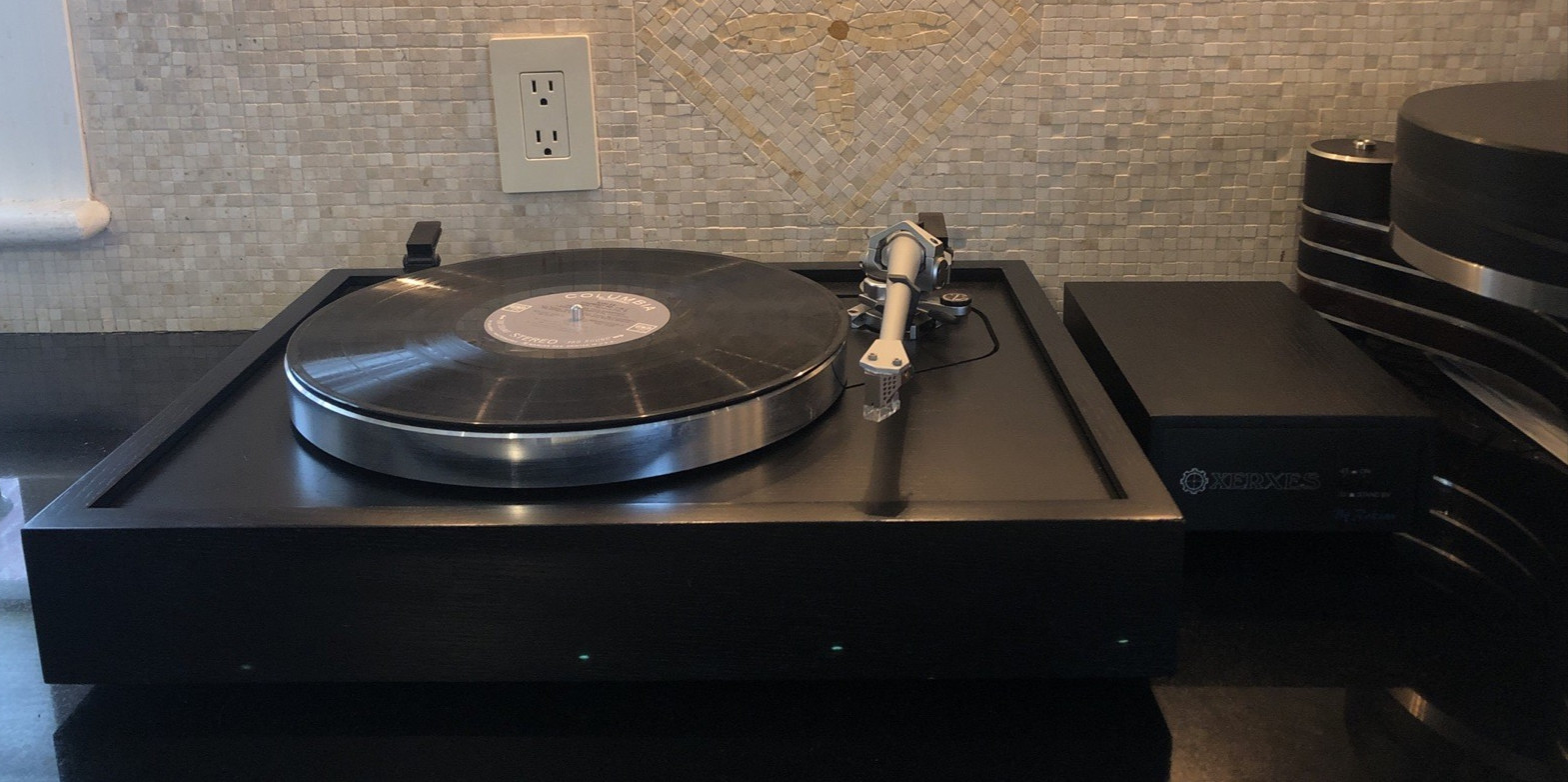
The Roksan Xerxes was conceived with a clear engineering vision: to achieve maximum rigidity and minimum resonance through intelligent material selection and mechanical isolation. Its design philosophy centered on a modular subchassis system, where the platter, motor, and tonearm are mounted on a rigid aluminum subframe that is suspended within a damped MDF outer plinth using Sorbothane or similar elastomeric isolators. This dual-layer construction effectively decouples the critical components from external vibrations and cabinet-born resonances—a hallmark of high-end turntable design.
One of the Xerxes’ most distinctive features was its unipivot tonearm, the RB110 (later known as the Roksan Arm). Unlike conventional gimbal bearings, the unipivot design uses a single, finely polished ball bearing supporting the entire arm on a vertical pin, resulting in extremely low friction and superior tracking accuracy. The arm’s counterweight is mounted on a threaded rod, allowing for precise azimuth and VTA adjustments—features that were rare at its price point. The arm tube itself is a lightweight aluminum alloy, minimizing inertia and enhancing transient response.
The belt-drive system is powered by a high-torque, low-vibration AC motor housed in a separate external power supply unit. This isolation reduces mechanical noise and allows for precise speed control, with selectable 33⅓ and 45 RPM settings. The motor drives a precision pulley connected via a silicone belt to the main platter, which consists of a heavy acrylic or aluminum platter atop a rubber mat for optimal record coupling.
The plinth, typically finished in black or walnut, uses constrained layer damping—alternating layers of MDF and damping compound—to absorb internal resonances. The minimalist aesthetic belies a sophisticated internal architecture, where every component is engineered to serve the singular goal of accurate vinyl reproduction.
Sound Characteristics
The sonic signature of the Roksan Xerxes is best described as detailed, dynamic, and musically engaging. It delivers a transparent midrange with excellent tonal accuracy, making it particularly well-suited for acoustic, jazz, and vocal recordings. The unipivot arm contributes to a wide, stable soundstage with precise imaging and excellent instrument separation. Bass response is tight and well-controlled, avoiding the overhang sometimes associated with suspended subchassis designs.
Compared to the Linn LP12, which tends to emphasize rhythm and pace, the Xerxes offers a more neutral and revealing presentation. It doesn’t romanticize the music but instead presents it with clarity and composure. High frequencies are smooth and extended, without harshness or sibilance, allowing for extended listening sessions without fatigue.
When paired with high-quality cartridges like the Dynavector 20X or Ortofon MC2000, the Xerxes reveals its true potential, extracting fine detail and microdynamics from the groove. Its upgrade-friendly design means many original units have been enhanced with aftermarket power supplies, improved bearings, and upgraded platters—further extending its performance envelope.
Market & Collectibility
Today, the Roksan Xerxes enjoys a strong reputation among vintage audio enthusiasts and remains a sought-after turntable on the secondhand market. Well-maintained examples typically sell between $800 and $1,500, with fully restored or upgraded models commanding higher prices. Its collectibility is bolstered by its historical significance as a credible alternative to the LP12 and its role in establishing Roksan as a major British hi-fi brand.
When purchasing a used Xerxes, buyers should inspect the condition of the unipivot bearing, as wear or contamination can degrade performance. The rubber belts and suspension isolators may also need replacement after decades of use. Fortunately, a robust community of Roksan owners and technicians ensures that parts and expertise are readily available. Many units have been modernized with Rega, Origin Live, or SME tonearms, though purists favor the original RB110 for its unique character.
eBay Listings


As an eBay Partner, we earn from qualifying purchases. This helps support our independent vintage technology research.
Related Models
- Luxman PD-272 (1983)
- Garrard 2025tc (1968)
- Onkyo CP-1010 (1976)
- Pioneer PL-15R (1975)
- Pioneer PL-250 (1979)
- Pioneer PL-40 (1977)
- Pioneer PL-514 (1978)
- Pioneer PL-516 (1978)
- Pioneer PL-61 (1973)
- Pioneer PL-6A (1977)