Rogers Cadet II (1962–1964)
Warm, hummy, and built like a bank vault—this unassuming British valve system punches way above its weight, even if it never quite got the credit it deserved.
Overview
Don’t let the modest name fool you: the Rogers Cadet II isn’t some entry-level curiosity. It’s a full-blooded, dual-chassis valve amplifier system from the golden age of British hi-fi, built during a time when “integrated” meant thoughtful engineering, not digital menus. Introduced in 1962 as the stereo successor to the original 1958 Cadet, the Cadet II arrived at a moment when stereo was still novel, and valve technology was peaking in refinement. It wasn’t flashy, but it was serious—so serious that it earned the nickname “a poor man’s Leak,” a backhanded compliment that says more about its performance than its price.
The Cadet II wasn’t a single box. It was a two-piece system: a control unit and a separate power amplifier, linked by an umbilical cord. This modular design wasn’t just for show—it kept high-voltage, high-heat components away from delicate preamp stages, reducing noise and crosstalk. The control unit handled source selection, tone, and volume, while the power amp delivered a claimed 12 watts per channel (with peaks up to 18W), all through six valves: two ECC83s in the preamp and four ECL86s in the output stage. For its time, that was respectable power, especially considering how efficiently it drove speakers. Owners still report being surprised at how loud it can play, even with modest-rated speakers.
It was never meant to be a showstopper, but the Cadet II had presence. The control unit wore a smart combo of brushed brass and matt black, with ivory and brass knobs that felt solid under the fingers. The power amp, painted in Rogers’ signature maroon, featured a hammered silver transformer cover that looked both industrial and elegant. Everything about it—right down to the pillar-mounted internal wiring—screamed “built to last.” And it did. Many units still surface in working condition, though they almost always need some attention after 60 years of shelf time.
Specifications
| Manufacturer | Rogers |
| Model | Cadet II |
| Production Years | 1962–1964 |
| Type | Valve amplifier system (separate control unit and power amplifier) |
| Number of Tubes/Valves | 6 (2x ECC83, 4x ECL86) |
| Power Output | 12 W (18 W max.) |
| Total Harmonic Distortion | Approximately 0.2% at 4 watts |
| Frequency Response | 20Hz to 20kHz |
| Speaker Load Impedance | 3Ω to 16Ω |
| Power Supply | Alternating Current (AC) |
| Loudspeaker | Requires external speaker(s) |
| Material | Metal case |
| Shape | Book-shelf unit |
| Dimensions | 305 x 273 x 140mm |
| Rectifier | Selenium rectifier |
Key Features
Dual-Chassis Design: Separation for Purity
The Cadet II’s split architecture wasn’t just a design quirk—it was a deliberate move to isolate sensitive preamp circuits from the heat and electromagnetic noise of the power stage. The control unit and amplifier connect via a multi-pin umbilical cable, a setup more commonly seen in high-end separates. This separation helped maintain signal integrity, and it also made servicing easier. If one section failed, you didn’t have to pull the whole system apart. It’s a smart, practical approach that feels ahead of its time, especially for a unit marketed as accessible.
Hand-Wired, No PCB: Craftsmanship You Can See
Open the chassis, and you’re greeted with a sight that modern engineers might find charmingly archaic: no printed circuit board. Instead, components are strung between metal pillars mounted directly to the chassis, a technique known as “point-to-point” or “chassis wiring.” It’s labor-intensive, but it results in a clean, serviceable layout. Everything is visible, everything is replaceable. There’s no hiding behind layers of epoxy or micro-traces. This kind of construction wasn’t just about reliability—it was a statement. Rogers wasn’t cutting corners.
Controls and Inputs: Simple, But Thoughtful
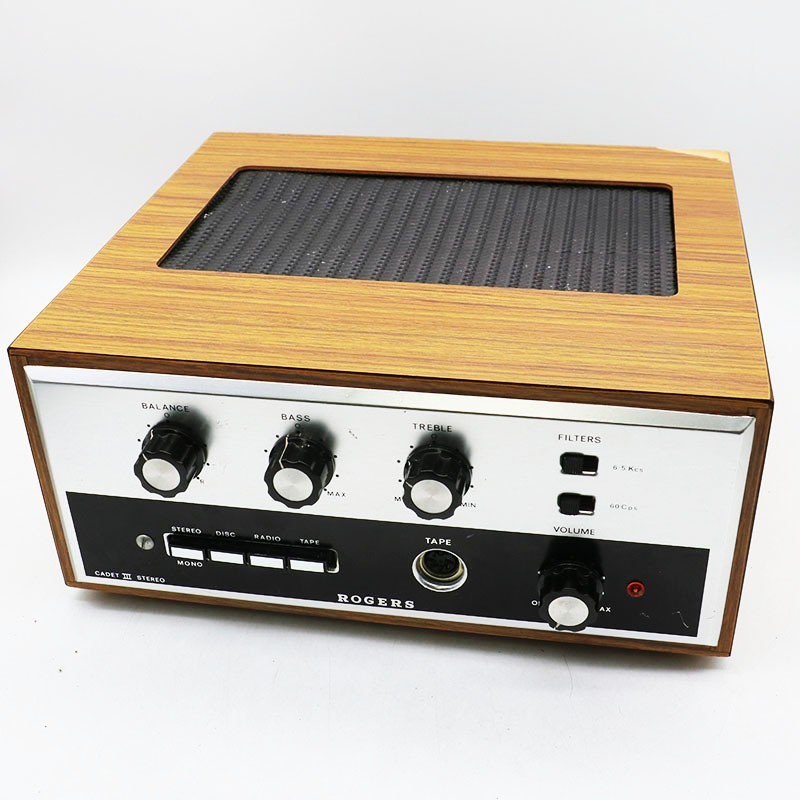
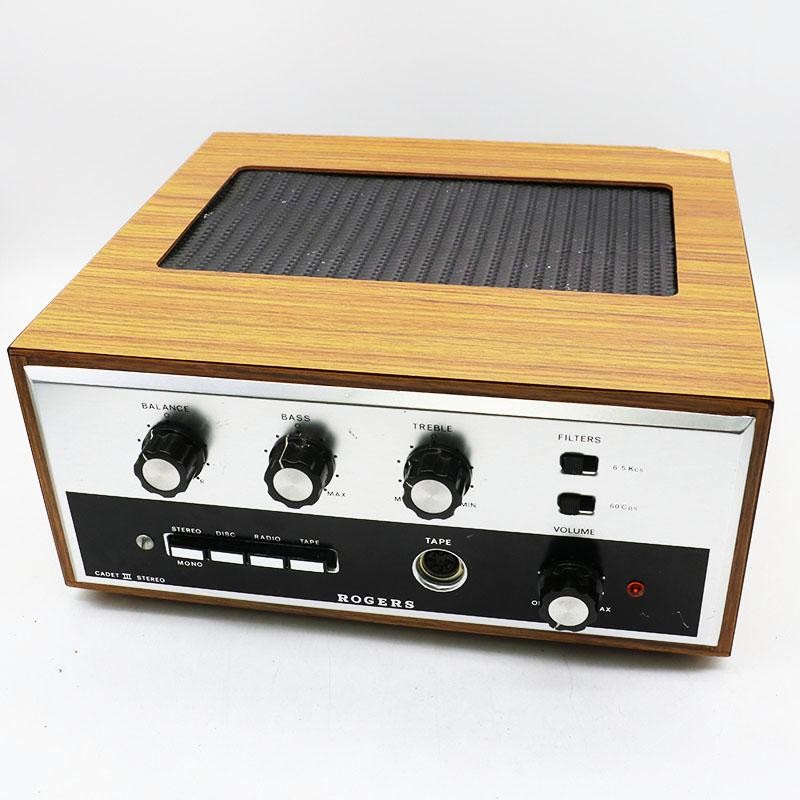
The front panel is straightforward: volume, balance, bass, treble, mono/stereo switch, and input selector buttons for radio, disc (ceramic cartridges only), and tape. No fancy VU meters, no remote control—just the essentials. The phono stage is limited to ceramic cartridges, which were common in the early ‘60s but are considered low-output and high-mass by today’s standards. That means if you want to use a modern moving magnet cartridge, you’ll need an external preamp. But for period-correct setups, it works just fine. Input selection is handled via push buttons, a common design at the time, though owners note that the front panel light sometimes needs a tap to come on—a small quirk, but one that adds character.
Styling That Stands Out
The control unit’s brushed brass and matt black finish, paired with ivory and brass knobs, gives it a refined, almost jewelry-like appearance. It doesn’t scream “hi-fi,” but it doesn’t need to. It looks like something that belongs on a mid-century sideboard, not hidden in a rack. The power amplifier, meanwhile, wears Rogers maroon with a hammered silver transformer cover—a subtle contrast that ties the pair together without matching too closely. It’s cohesive, not cookie-cutter.
Output and Drive: More Than the Numbers Suggest
Twelve watts doesn’t sound like much, especially in an era where solid-state amps were already hitting 50W and beyond. But valve amps behave differently. The Cadet II’s 12W rating is clean, and it can swing to 18W on peaks—enough to drive efficient speakers to satisfying levels. Owners report it “blasting” 12-inch 8-ohm speakers in large cabinets, defying expectations. The frequency response is flat from 20Hz to 20kHz, and distortion is impressively low at 0.2% at 4 watts. That’s not just good for 1962—it’s good by any standard. The secret? A well-designed output stage using ECL86 valves in a configuration that balances power and linearity.
Historical Context
The Rogers Cadet II debuted in April 1962 at the London Audio Fair, stepping into the stereo era as the successor to the original 1958 Cadet, which had been a mono system designed to fit inside a cabinet. The Cadet II marked Rogers’ full embrace of stereo, and it arrived at a time when British hi-fi was booming. Companies like Leak, Quad, and Fisher were pushing the limits of valve design, and Rogers positioned the Cadet II as a more affordable alternative—hence the “poor man’s Leak” label. It wasn’t quite in Leak’s league, but it offered a lot of performance for the price.
The Cadet II was part of a three-model series: the original Cadet (1958), the Cadet II (1962), and the Cadet III (post-1964). The Cadet III updated the design with ECC807 valves and increased output, but the II remains the sweet spot for many collectors—a fully realized stereo valve system before the shift to solid-state. Factory spares, including output transformers, were cleared out around 1972, suggesting Rogers had moved on, but the Cadet II lived on in living rooms and second-hand shops.
Collectibility & Value
Today, the Rogers Cadet II is a sought-after piece among valve enthusiasts and British hi-fi collectors. Working examples can exceed £300, with one listing reaching £850.00 GBP—proof that demand outpaces supply. But value isn’t just about price. As one repairer put it, these units are “far more than the price they fetch,” a sentiment echoed by owners who praise their sound and build.
Still, buying one is not without risk. These are 60-year-old valve systems, and they come with predictable issues: failing composition resistors, rust, disintegrated plastic buttons, discolored front panels, crackling valve holders, hum, faulty volume controls, and damaged DIN sockets. The selenium rectifier is a known weak point—prone to failure and potentially damaging other components. Many restorers replace it with a modern silicon bridge, a well-documented mod that improves reliability.
Valve availability is another hurdle. The ECL86 tubes are no longer in production, and NOS (New Old Stock) or used units command high prices. One owner reported paying £20 for a single ECC807 during a restoration (though the Cadet II uses ECC83s, not ECC807s—those came with the Cadet III). The scarcity adds to the challenge, but also to the appeal. Keeping a Cadet II running isn’t just about listening—it’s about stewardship.
eBay Listings


As an eBay Partner, we earn from qualifying purchases. This helps support our independent vintage technology research.
Related Models
- Rogers LS1 (1976)
- Rogers LS5 (1975)
- Rogers Ravensbourne Speaker System (1970)
- Rogers BBC-Studio-Monitor (LS3/6) (1975)
- Rogers LS2 (1978)
- Akai AM-2850 (1975)
- Akai AP-206 (1975)
- Nakamichi BX-1 (1985)
- Acoustic Research research-ar-17 (1978)
- Acoustic Research AR-19 (1994)