Realistic TM-102 (1980)
That little black box from RadioShack that pulled in distant stations like magic—when the dial didn’t jam, anyway.
Overview
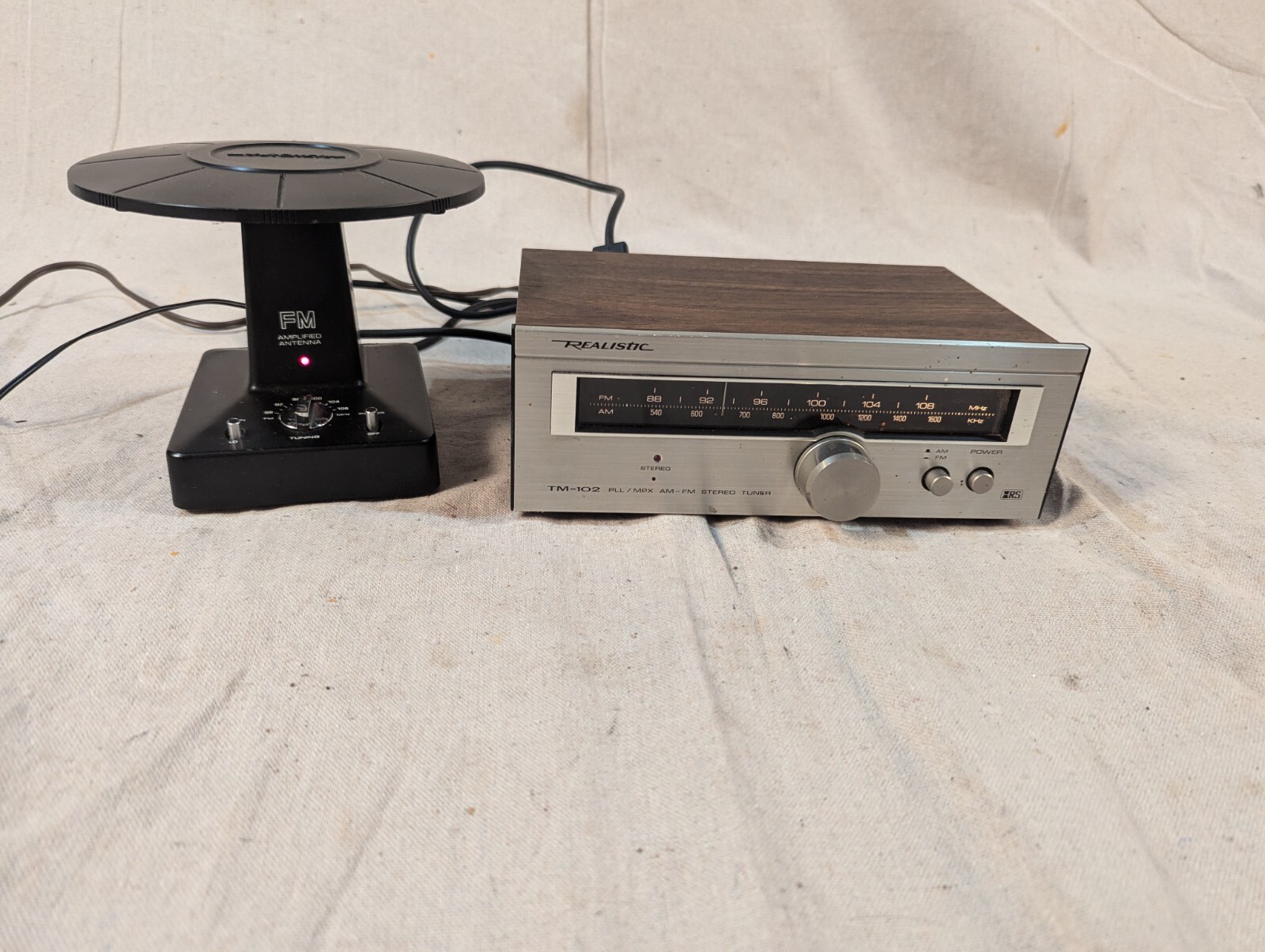
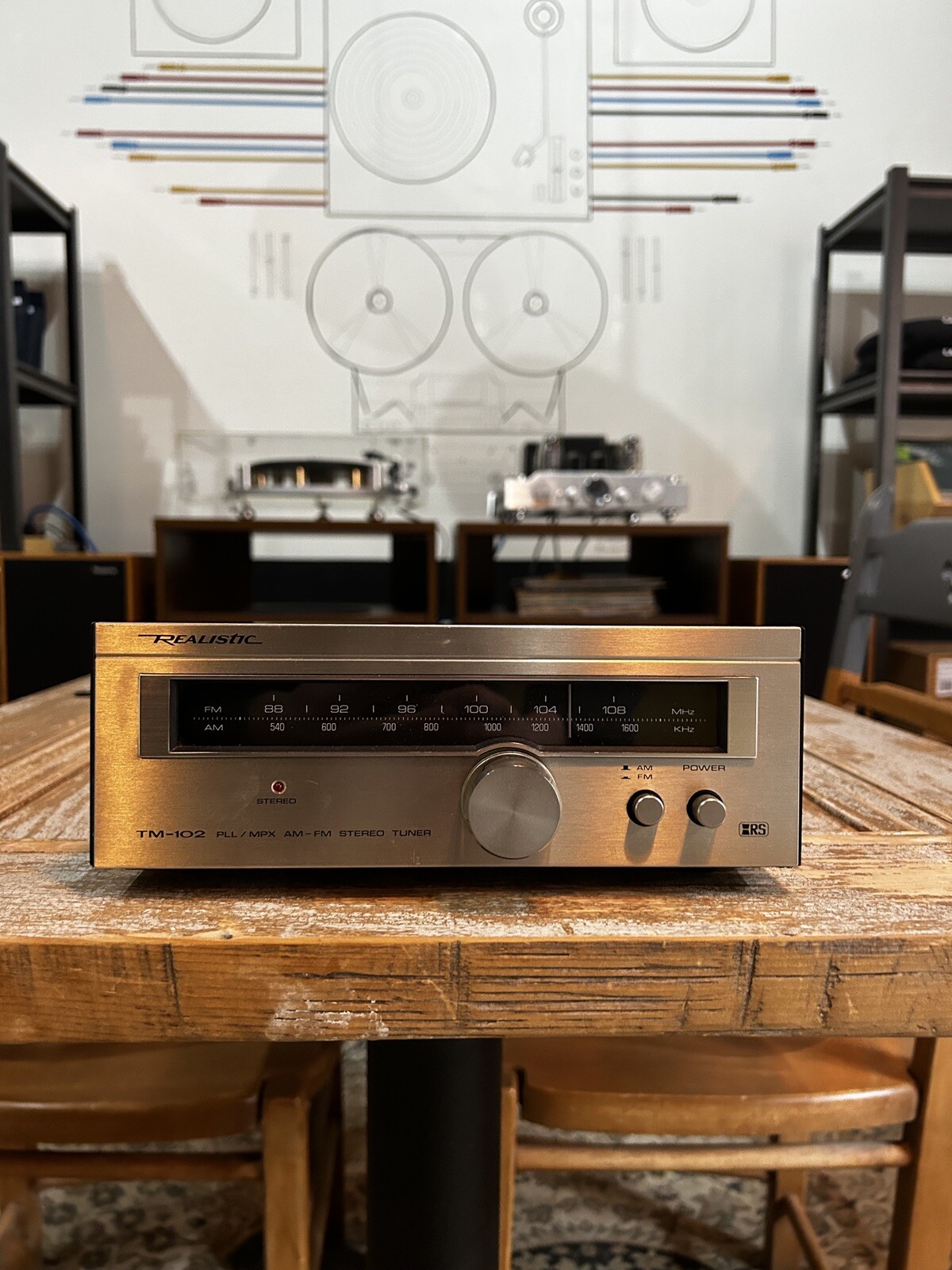
The Realistic TM-102 stereo AM-FM tuner wasn’t built to impress with flashy knobs or glowing VU meters. It was built to do one job: pull in radio stations clearly and reliably, without breaking the bank. Released in 1980 under Radio Shack’s house brand, this compact tuner hit shelves at a time when stereo broadcasting was becoming standard, and home audio enthusiasts were piecing together affordable systems from catalog components. Priced at just $24.95, the TM-102 was positioned as an entry-level gateway to stereo FM—simple, functional, and ready to pair with an amplifier and speakers.
Sold as Radio Shack Catalog Number 31-1964, the TM-102 was never meant to stand alone. It required an external amplifier to function—no built-in power section, no headphone jack, no bells or whistles. But within its modest metal chassis, it packed a PLL (Phase-Locked Loop) multiplex decoder and super-heterodyne circuitry, technology that promised stable, drift-free reception. For many, this meant finally being able to tune into weak or distant stations without constant readjustment, a real upgrade over the analog tuners of earlier decades.
It wasn’t glamorous, but it was part of a larger ecosystem. The Realistic SA-102 stereo amplifier was its natural partner, forming a budget-friendly receiver pair that could anchor a bedroom or kitchen stereo setup. Together, they offered a complete signal path for anyone who wanted decent sound without investing in high-end gear. And for Radio Shack shoppers—tinkerers, students, and first-time audiophiles—that was often enough.
Specifications
| Manufacturer | Radio Shack (Tandy, Realistic, Micronta); USA |
| Model number | 31-1964 |
| Radio Shack Cat. No. | 31-1964 |
| MPN | TM102 |
| Type | Mono/Stereo Tuner |
| Tuning Bands | AM, FM |
| Tuning Scale | Analogue |
| Sensitivity | 5uV (FM), 250uV (MW) |
| Signal to Noise Ratio | 60dB (FM), 20dB (MW) |
| Output | 1000mV (FM) |
| Dimensions | 89 x 236 x 175mm (also listed as 9" x 6" x 3.5") |
| Circuit type | PLL-Multiplex-Decoder - Super-Heterodyne |
| Made in | Japan |
Key Features
PLL Super-Heterodyne Tuning
At the heart of the TM-102 is its PLL-multiplex decoder and super-heterodyne design—a significant step up from the basic analog tuners found in many budget receivers of the era. This circuit type provided what owners called "drift free reception," meaning once you tuned in a station, it stayed put. No creeping off-frequency as the unit warmed up or ambient temperature shifted. For listeners chasing weak FM signals or fringe-area AM broadcasts, that stability was a real win.
FM and AM Stereo Reception
The TM-102 handled both AM and FM bands, decoding stereo signals on FM for that spacious, modern sound that defined the late 1970s and early 1980s. While AM stereo decoding wasn’t part of the spec sheet (and wasn’t widely adopted anyway), the tuner’s ability to pull in weak stations was repeatedly noted by users. With a sensitivity of 5µV on FM and 250µV on medium wave, it could extract listenable signals from marginal conditions—especially when paired with a decent outdoor antenna.
Analogue Tuning with Practical Output
Tuning was done via a traditional analogue dial, a small window across the front panel showing station frequency as you turned the knob. It’s a simple system, but not without quirks—some owners reported the dial “never made it across the scale even one time,” suggesting mechanical issues in certain units. The output level is rated at 1000mV for FM, a healthy line-level signal that could easily drive the inputs of the SA-102 or any standard amplifier of the time.
Compact and External Design
Measuring just under 9 inches wide and built in Japan, the TM-102 followed the utilitarian Realistic design language: black metal case, minimal controls, and a focus on function over form. Its compact size made it easy to integrate into small systems or shelving units. But remember: this is a tuner only. It requires an amplifier! It won’t work by itself.
Collectibility & Value
The Realistic TM-102 isn’t a high-demand collector’s item, but it holds steady as a nostalgic and functional piece of 1980s audio history. Units in working condition have sold for as little as $24, while new-in-box examples have listed for $44.50—reflecting its status as affordable gear then and now.
Condition is everything. Common issues include missing tuning knobs, burnt-out backlighting (particularly on the left side of the dial), and frayed or missing power cords. Some units suffer from mechanical dial problems, with the tuning mechanism failing to track across the full band. A working, tested TM-102 with intact controls and a smooth dial is worth the hunt, especially for someone restoring a period-correct Realistic system.
Owner opinions are split. Some call it a "great tuner from the mid seventies" and declare it "Awesome Sauce! Yep!" Others have labeled it "junk" due to dial failures. The truth likely lies in individual unit condition—this was mass-produced gear with variable quality control.
eBay Listings


As an eBay Partner, we earn from qualifying purchases. This helps support our independent vintage technology research.
Related Models
- Realistic OPTIMUS-1 (1976)
- Realistic 42-2108 (1979)
- Realistic 42-2108 Stereo Reverb System (1975)
- Realistic LAB-400 (1977)
- Realistic LAB-420 (1975)
- Akai AM-2850 (1975)
- Akai AP-206 (1975)
- Nakamichi BX-1 (1985)
- Acoustic Research research-ar-17 (1978)
- Acoustic Research AR-19 (1994)