Realistic TM-1000 (1975–1978)
That rare Radio Shack find with a cult following: a warm-sounding, auto-tuning AM/FM receiver from the golden age of stereo.
Overview
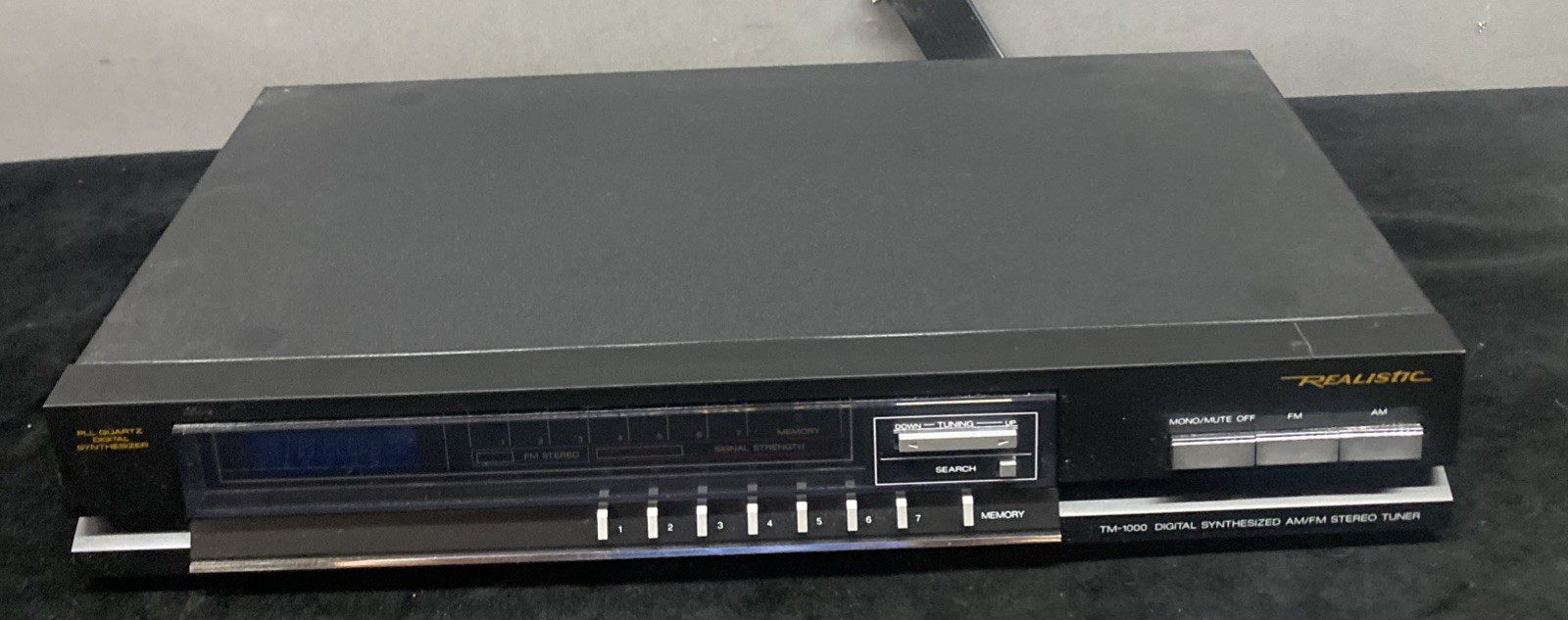
Don’t let the Realistic badge fool you—this wasn’t some bargain-bin tuner cobbled together for the holiday rush. The TM-1000, sold through Radio Shack in the mid-1970s, was a serious piece of gear with a reputation that’s only grown among analog enthusiasts. Introduced in 1975 and sold through 1978, it was designed as the companion to the Realistic SA-1000 integrated amplifier, forming a matched high-fidelity system that brought solid performance to the DIY crowd. And while it carried the Realistic name—a brand often associated with entry-level audio—it punched well above its weight, especially in the warmth and fullness of its sound.
Owners report a surprisingly rich bottom end compared to other tuners of its class, with one describing its tonality as having a “nice warm tone.” That kind of character wasn’t accidental. Built in Japan by Foster Electric—a known OEM for quality audio gear of the era—the TM-1000 benefited from disciplined engineering and a well-executed front end: a 4-gang tuner assembly that contributed to its strong tracking and stability. It wasn’t flashy, but it was effective, with clean signal handling and a tuning system that split the difference between analog tradition and emerging automation.
Specifications
| Manufacturer | Realistic (Tandy Corporation) |
| Model | TM-1000 |
| Year Introduced | 1975 |
| Production Years | 1975–1978 |
| Type | AM/FM Stereo Tuner |
| Tuning Bands | FM, MW |
| FM Tuning Range | 88 to 108 MHz |
| MW Tuning Range | 525 to 1650 kHz |
| Sensitivity | 2uV (FM), 250uV (MW) |
| Signal to Noise Ratio | 65dB (FM), 45dB (MW) |
| Selectivity | 65dB (FM), 32dB (MW) |
| Output | 1000mV (FM), 330mV (MW) |
| Front End | 4 gang front end |
Key Features
"Auto Magic" Tuning
The TM-1000’s standout feature was its “Auto Magic” tuning system—a clever hybrid approach that automated station capture without jumping fully into digital synthesis. When activated, the tuner would sweep the band and lock onto a station cleanly, avoiding the drift and instability that plagued many analog designs. Some owners have reported needing to adjust an internal inductor to restore proper lock-on behavior, suggesting the system relied on precise analog calibration rather than microprocessor control. Despite conflicting claims across sources—some calling it “digital synthesized,” others firmly analog—the consensus leans toward it being an advanced analog design with automated tracking, not a true synthesized tuner.
Blue "Magic Tune" Indicator
Originally, the tuner featured blue lighting for the “Magic Tune” indicator—a subtle but distinctive touch that illuminated when a station was properly acquired. Over the decades, many of these bulbs have burned out or been replaced, and a common restoration step now involves swapping the aging incandescent bulbs with modern LEDs for longevity and reliability. The blue glow became a signature of the experience, a small visual reward for finding that perfect FM signal on a quiet Sunday evening.
Japanese Build Quality
Manufactured in Japan by Foster Electric, the TM-1000 benefited from the precision and reliability associated with Japanese audio OEMs of the 1970s. This wasn’t a cost-cut domestic assembly—it was a component built to last, with a layout and parts selection that reflected serious design intent. The 4-gang front end, in particular, provided excellent tracking across the FM band, minimizing the need for constant manual tweaking and contributing to its strong selectivity and sensitivity ratings.
Historical Context
The Realistic TM-1000 debuted in 1975 as the designated tuner partner for the Realistic SA-1000 integrated amplifier. Together, they formed a complete stereo system aimed at the serious hobbyist who wanted good performance without the premium price tag of high-end brands. At a time when stereo was becoming mainstream and FM broadcasting was hitting its stride, the TM-1000 offered a compelling mix of automation, fidelity, and build quality. It arrived during a period when Radio Shack was still capable of delivering genuinely competitive audio gear, not just accessories and cables, and it remains one of the standout tuners from their catalog.
Collectibility & Value
Today, the TM-1000 is quietly gaining recognition among vintage audio collectors, particularly those restoring classic systems or seeking that warm, analog FM sound. While not widely advertised, it’s showing up in active markets: a listing on Canuck Audio Mart in March 2025 asked $80.00 CAD, while a unit sold on eBay in February 2025 for $60.00 USD. These prices reflect working condition, though cosmetic flaws—like a scratch on the display screen—don’t necessarily deter buyers if the tuner functions properly.
Restoration typically involves recapping, especially in the power supply, and replacing the original display bulbs with LEDs to restore the iconic blue “Magic Tune” glow. Some owners have had to fine-tune an internal inductor to bring the Auto Magic feature back to life, a minor calibration that underscores the tuner’s analog nature. With no major reports of chronic failures beyond typical age-related wear, the TM-1000 is considered a reliable project for those already working on 1970s gear.
eBay Listings

As an eBay Partner, we earn from qualifying purchases. This helps support our independent vintage technology research.
Related Models
- Realistic SCT-10 (1979)
- Realistic SCT-86 (1983)
- Realistic CTR-23 (1975)
- Realistic CTR-71 (1979)
- Realistic OPTIMUS-5 (1979)
- Sony TC-2050SD (1978)
- Aiwa AD-F990 (1993)
- Kenwood KX-3060 (1982)
- Sony TC-2130A (1974)
- Sony TC-2220 (1972)