Realistic STA-90: The Workhorse Amplifier from RadioShack’s Golden Era
In the mid-1970s, as the high-fidelity audio boom swept across American households, even electronics retailers like RadioShack entered the arena with their own line of affordable, no-frills audio gear. Among these offerings, the Realistic STA-90 stands out as a dependable, solid-state integrated amplifier that brought quality sound within reach of budget-conscious consumers. Sold through RadioShack stores and catalogs under the Realistic brand—their house label for audio equipment—the STA-90 was never intended to be a showstopper, but it earned a quiet reputation for reliability, clean amplification, and straightforward functionality.
Though overshadowed by more prestigious names like Pioneer, Marantz, or Sansui, the STA-90 represents an important chapter in democratizing hi-fi audio. It exemplifies the era when average families could assemble a full stereo system from components bought at their local electronics store, often with helpful advice from in-store technicians. The STA-90 wasn’t flashy, but it delivered what mattered most: consistent performance and honest sound reproduction.
Technical Specifications
The STA-90 was designed as a mid-tier integrated amplifier, combining a preamplifier and power amplifier in one chassis. It was built during a transitional period when solid-state technology had largely replaced vacuum tubes, offering greater reliability and lower maintenance. Below are its key specifications based on original RadioShack documentation and user reports from the era:
| Specification | Detail |
| Model | Realistic STA-90 |
| Manufacturer | Tandy Corporation (sold as Realistic) |
| Year Introduced | 1975 |
| Type | Solid-state integrated amplifier |
| Power Output | 45 watts RMS per channel (8Ω) |
| Total Harmonic Distortion | Less than 0.5% (at rated power) |
| Frequency Response | 20 Hz – 20 kHz (+/-1 dB) |
| Input Sensitivity | 3 mV (MM), 150 mV (Line) |
| Input Impedance | 47 kΩ (Line), 1 MΩ (MM) |
| Tone Controls | Bass, Treble (±12 dB at 100 Hz / 10 kHz) |
| Inputs | 2x Line, 1x Phono (MM only) |
| Outputs | Tape Out, Preamp Out, Speaker A/B |
| Speaker Impedance | 8 ohms (minimum) |
| Damping Factor | Approx. 40 (8Ω) |
| Dimensions | 17" W × 5.5" H × 13" D |
| Weight | 22 lbs (10 kg) |
| Power Requirement | 120V AC, 60 Hz, 350 watts max |
The amplifier used discrete transistor circuitry—no integrated circuits in the signal path—which was typical for mid-range amplifiers of the time. Its layout prioritized serviceability, with clearly labeled terminals and a modular internal design that made repairs accessible even for hobbyists.
Sound Characteristics and Performance
The STA-90 delivers a balanced, neutral sound profile that leans slightly toward clarity over warmth. With 45 watts per channel into 8 ohms, it provided ample power for efficient bookshelf or floor-standing speakers of the era, such as the Realistic Concert 8 or Advent speakers. Its low distortion and wide frequency response ensured accurate reproduction across genres, from classical to rock.
While not as dynamically expressive as higher-end contemporaries, the STA-90 avoids harshness or excessive brightness, even at higher volumes. The phono preamp, designed for moving magnet (MM) cartridges, performs respectably with modest turntables like the Realistic Concert 4 or 5, though audiophiles often paired it with external phono stages for improved detail retrieval.
One of its strengths is channel separation and stereo imaging—remarkably good for a budget amplifier. The soundstage is well-defined, with instruments placed cleanly across the front plane. Bass response is tight and controlled, though not overly deep, which reflects the limitations of its power supply and output stage design.
Notable Features and Innovations
While the STA-90 didn’t introduce groundbreaking technology, it offered thoughtful features for its price point:
- Dual Speaker Outputs (A/B): Allowed users to switch between two pairs of speakers or run them simultaneously—ideal for multi-room listening.
- Tape Monitor Function: Enabled quick switching between live input and tape playback without re-patching cables.
- Preamp Output: Permitted future expansion, such as adding an external power amplifier for bi-amping or increased headroom.
- Solid Build Quality: Despite its budget branding, the STA-90 featured a heavy steel chassis, quality potentiometers, and robust binding posts—hallmarks of RadioShack’s commitment to durability in their higher-end Realistic models.
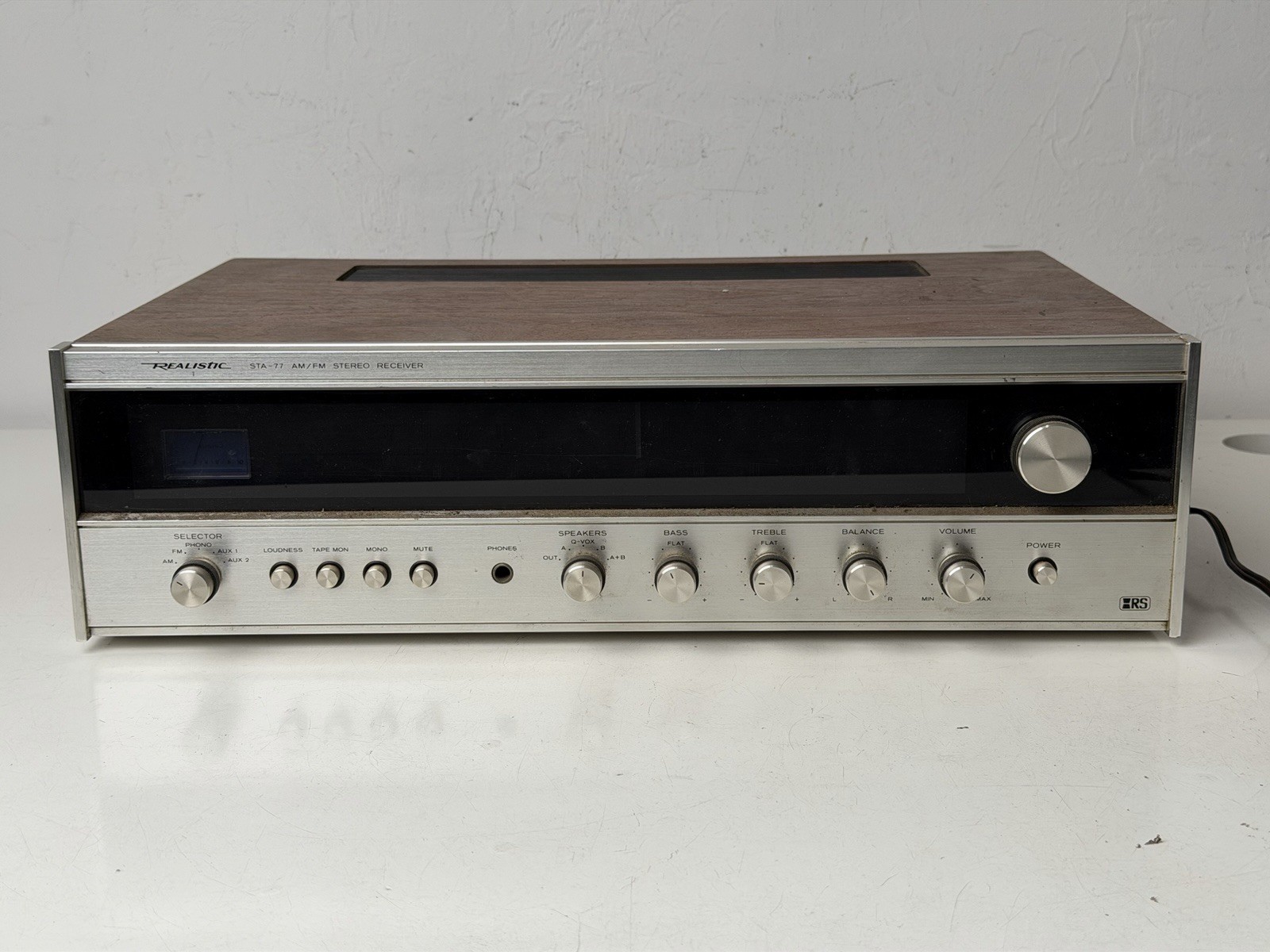
The front panel design is utilitarian but functional, with large rotary knobs for volume, balance, bass, treble, and input selection. The blue VU meters (a signature Realistic touch on higher-end models) were absent here, but a simple LED power indicator and illuminated input selector added a touch of visual feedback.
Common Issues and Maintenance
Like many amplifiers of its era, the STA-90 is prone to a few age-related issues:
- Capacitor Aging: Electrolytic capacitors in the power supply and signal path may dry out over time, leading to hum, reduced output, or channel imbalance. Replacing these is often the first step in restoring vintage units.
- Tarnished Controls: The tone and balance pots can develop crackling noises due to oxidation. Contact cleaner or pot replacement can resolve this.
- Binding Post Corrosion: Speaker terminals may corrode, especially in humid environments. Cleaning with electrical contact spray and tightening connections is recommended.
- Bias Drift: Output transistors may require bias adjustment after long periods of disuse or capacitor replacement.
Fortunately, the STA-90’s service manual was widely available, and many of its components are either standard or cross-referenced with common equivalents. Its simple design makes it a favorite among DIY restorers looking to breathe new life into a reliable classic.
Current Market Value and Collectibility
Today, the Realistic STA-90 is not a high-value collector’s item, but it holds nostalgic appeal for vintage audio enthusiasts and RadioShack historians. Units in working condition typically sell for $75 to $150, depending on cosmetic condition and functionality. Fully restored models with replaced capacitors and cleaned controls may command slightly more, especially when paired with other Realistic components.
While not sought after like Japanese receivers of the same era, the STA-90 is appreciated for its role in bringing quality audio to middle-class homes. It’s also popular in retro audio setups, where its understated design and solid performance complement period-correct turntables and speakers.
Conclusion and Legacy
The Realistic STA-90 may not have made headlines, but it played a vital role in the democratization of high-fidelity sound. As part of RadioShack’s broader push into consumer audio, it offered dependable performance, sensible features, and excellent value. For many, it was their first real taste of stereo sound—a gateway into the world of music appreciation.
Today, the STA-90 stands as a testament to an era when electronics were repairable, understandable, and built to last. It may not have the prestige of a Marantz 2270 or the cult following of a Sansui AU-9900, but for those who remember the thrill of setting up a stereo system from the local RadioShack, the STA-90 remains a cherished piece of audio history.
If you stumble upon one in a basement, thrift store, or online marketplace, don’t overlook it. With a little care, the Realistic STA-90 can still deliver honest, engaging sound—just as it did over four decades ago.
eBay Listings


As an eBay Partner, we earn from qualifying purchases. This helps support our independent vintage technology research.
Related Models
- Realistic STA-16 (1975)
- Realistic STA-7 (1973)
- Realistic STA-800 (1975)
- Realistic STA-850 (1975)
- Realistic STA-235B (1975)
- Luxman L-530 (1975)
- Luxman R-404 (1975)
- Luxman RV-371 (1975)
- Luxman SQ-38U (1975)
- Luxman T-14 (1972)