Realistic STA-77A: The Unsung Workhorse of 1970s Budget Hi-Fi
In the golden era of analog audio, when tube warmth was giving way to solid-state precision and home stereo systems were becoming household staples, RadioShack’s Realistic brand emerged as a surprising champion of accessible high fidelity. Among its lineup of turntables, speakers, and receivers, the Realistic STA-77A stands out as a modest yet capable integrated amplifier that brought respectable sound to countless living rooms across America. Though not a showstopper in terms of power or features, the STA-77A exemplifies the spirit of 1970s consumer audio: functional, affordable, and built to last.
Released around 1975, the STA-77A was part of a broader push by RadioShack to offer complete, budget-friendly stereo systems under the Realistic name. Unlike the flashy receivers from brands like Pioneer or Sansui, the STA-77A didn’t aim for audiophile acclaim or high-wattage bragging rights. Instead, it served a practical role—delivering clean amplification for modest speaker setups, often paired with Realistic turntables, cassette decks, and AM/FM tuners.
Despite its humble origins, the STA-77A has developed a quiet cult following among vintage audio enthusiasts who appreciate its no-nonsense design, clean signal path, and the nostalgic charm of a bygone era when you could walk into your local electronics store and build a full stereo system off the shelf.
Technical Specifications
The Realistic STA-77A is a solid-state integrated stereo amplifier, meaning it combines preamplifier and power amplifier functions in a single chassis. While not a powerhouse, it was engineered for efficiency and reliability, using components typical of mid-tier consumer electronics of the 1970s.
| Specification | Detail |
| Model | STA-77A |
| Manufacturer | Tandy Corporation (sold under Realistic) |
| Year Introduced | 1975 |
| Type | Solid-state integrated amplifier |
| Power Output | Approximately 25 watts per channel (RMS, 8Ω) |
| Frequency Response | 20 Hz – 20 kHz (+/- 1 dB) |
| Total Harmonic Distortion | < 0.5% (at rated power) |
| Input Sensitivity | 2.5 mV (phono), 150 mV (line) |
| Input Impedance | 47 kΩ (line), 1 MΩ (phono) |
| Output Impedance | 8Ω minimum load |
| Tone Controls | Bass, Treble (±12 dB at 100 Hz / 10 kHz) |
| Inputs | 2x Line, 1x Phono (MM) |
| Outputs | Speaker A/B, Preamp Out |
| Power Supply | Linear transformer, dual rail design |
| Dimensions (W×H×D) | 17" × 5" × 13" (approx. 43 × 13 × 33 cm) |
| Weight | 14 lbs (6.4 kg) |
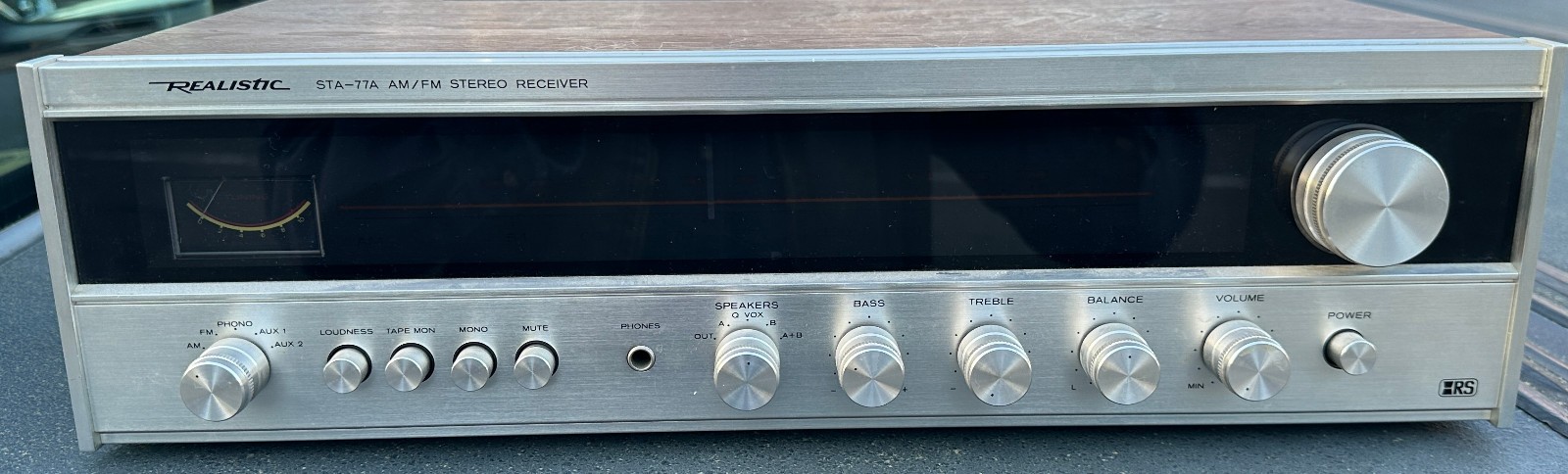
| Finish | Black textured vinyl wrap, aluminum face |
| Made in | Japan (contract manufacturing) |
Note: Exact specifications may vary slightly depending on production batch, as Realistic often sourced designs from OEM manufacturers in Japan.
Sound Characteristics and Performance
The STA-77A delivers a sound signature typical of mid-tier 1970s solid-state amplifiers: clean, balanced, and slightly warm. It lacks the aggressive dynamics of high-end contemporaries but compensates with a smooth, listenable presentation that pairs well with efficient bookshelf speakers of the era—such as Realistic’s own Concert Series or even vintage AR or Advent models.
With 25 watts per channel, the STA-77A is best suited for small to medium-sized rooms. It won’t drive power-hungry floorstanders to concert levels, but it handles 8-ohm speakers with ease and maintains composure at moderate volumes. The phono stage is designed for moving magnet (MM) cartridges, offering decent RIAA equalization and low noise—perfect for pairing with a basic turntable like the Realistic Concert 810-T.
One of its strengths is its low distortion and tight bass response, thanks to a well-designed output stage and a robust power supply. While not as detailed as some higher-end Japanese receivers, the STA-77A avoids the harshness that plagued certain budget amplifiers of the time. Its midrange is clear and articulate, making it ideal for vocals and acoustic instruments.
Notable Features and Design
The STA-77A’s front panel is minimalist and functional, reflecting the utilitarian ethos of RadioShack’s house brand. It features a large central volume knob flanked by bass and treble controls, input selector, and a prominent "Loudness" button—a popular feature in the 1970s that boosts bass and treble at low volumes to compensate for human hearing limitations.
The rear panel includes:
- Two line-level inputs (labeled "Aux" and "Tuner")
- One MM phono input
- Speaker A/B outputs
- Preamp output for connecting to a separate power amp or tape recorder
- Ground terminal for turntable
The amplifier uses a dual-rail power supply, which helps improve channel separation and reduce crosstalk—a thoughtful touch for a budget component. The chassis is steel with a black textured vinyl coating, and the faceplate is brushed aluminum with simple labeling. While not glamorous, the build quality is sturdy, and the layout is intuitive.
One unique aspect of the STA-77A is its modular construction. Like many Realistic units, it was designed for serviceability, with accessible circuit boards and clearly labeled connections—making it a favorite among tinkerers and restorers today.
Common Issues and Maintenance
As with any 45-year-old electronics, the Realistic STA-77A can suffer from age-related wear. However, its simple design and high-quality Japanese build mean many units still function well with minimal maintenance.
Common issues include:
- Capacitor degradation: Electrolytic capacitors in the power supply and signal path may dry out, leading to hum, low output, or channel imbalance. Replacing these (recapping) is often the first step in restoration.
- Dirty controls: Pots (potentiometers) for volume and tone can become noisy over time. Cleaning with contact cleaner usually resolves crackling or static.
- Oxidized connectors: RCA jacks and speaker terminals may corrode. Light sanding or contact cleaner can restore conductivity.
- Weak fuses: Always check the main AC fuse if the unit doesn’t power on.
Because the STA-77A was not over-engineered, it’s relatively easy to repair. Schematics are occasionally found in online vintage audio forums or RadioShack archives, and many of its transistors and ICs are standard types still available today.
Current Market Value and Collectibility
The Realistic STA-77A is not a high-value collector’s item, but it holds steady appeal among budget-conscious vintage audio fans and DIY restorers. Units in working condition typically sell for $50–$100, with pristine, fully serviced models fetching up to $150.
Its collectibility stems more from nostalgia and utility than rarity. For those building a period-correct 1970s stereo setup—especially with other Realistic components—the STA-77A is a logical, authentic choice. It’s also popular in "budget vintage" builds, where enthusiasts seek good sound without breaking the bank.
While it won’t compete with a Marantz 2270 or Sansui AU-717 in performance, the STA-77A offers a satisfying entry point into vintage amplification and a testament to the quality RadioShack could deliver under the Realistic brand.
Conclusion and Legacy
The Realistic STA-77A may not have made headlines in audiophile magazines, but it played a quiet yet important role in democratizing high-fidelity sound. For thousands of Americans, it was their first real stereo amplifier—faithfully powering records, cassettes, and FM broadcasts through the 1970s and beyond.
Today, it stands as a symbol of accessible audio engineering: modest, reliable, and musically satisfying. While overshadowed by flashier brands, the STA-77A earns respect for its durability, clean design, and honest sound. For the vintage audio enthusiast, it’s not just a forgotten amplifier—it’s a piece of everyday hi-fi history worth rediscovering.
eBay Listings


As an eBay Partner, we earn from qualifying purchases. This helps support our independent vintage technology research.
Related Models
- Realistic STA-16 (1975)
- Realistic STA-7 (1973)
- Realistic STA-800 (1975)
- Realistic STA-850 (1975)
- Realistic STA-235B (1975)
- Luxman L-530 (1975)
- Luxman R-404 (1975)
- Luxman RV-371 (1975)
- Luxman SQ-38U (1975)
- Luxman T-14 (1972)