Realistic STA-64 (1976)
You can still hear that warm, analog thump from a Realistic STA-64 cranking out vintage rock—proof that budget gear from Radio Shack could punch way above its weight.
Overview
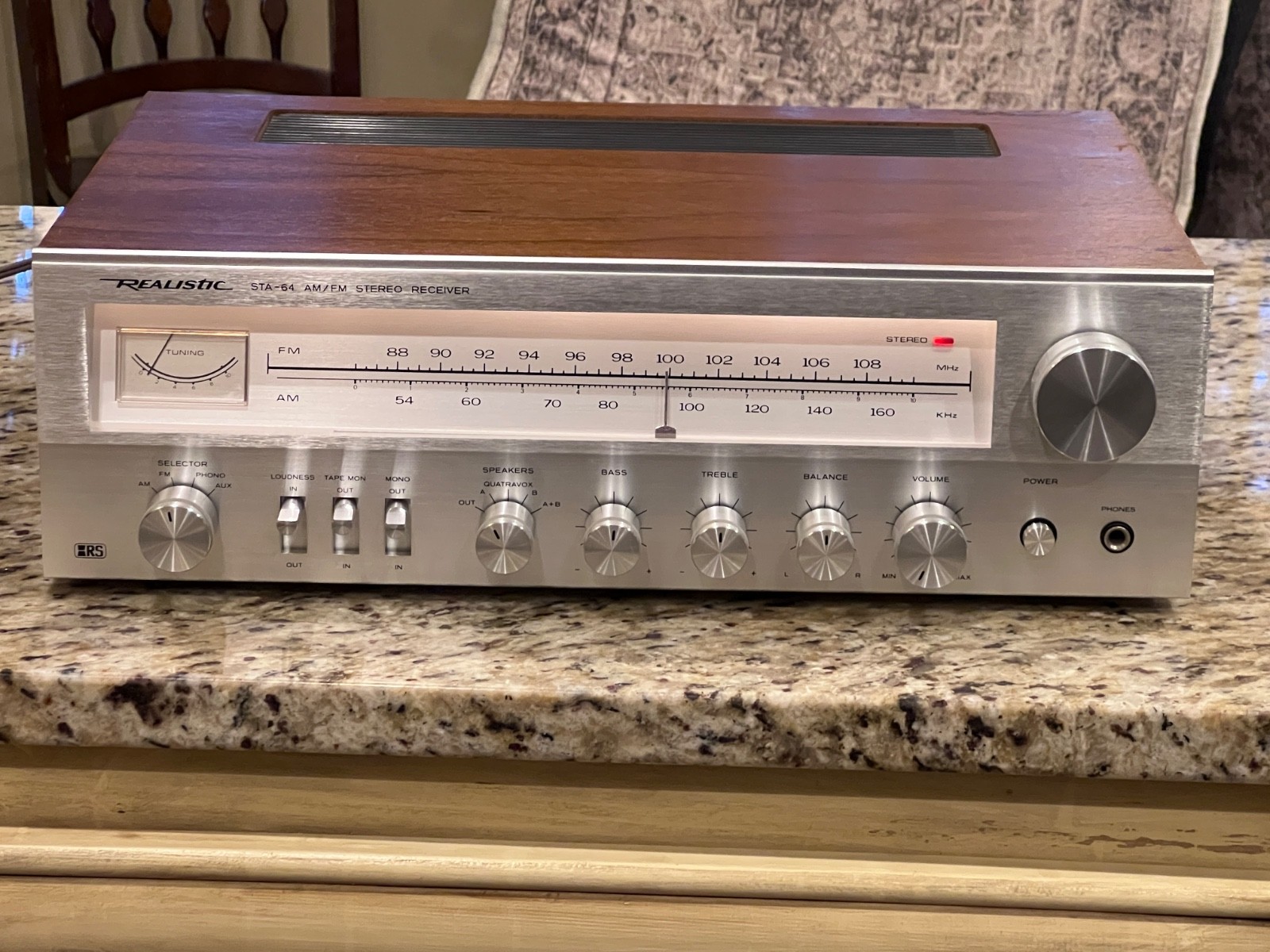
The Realistic STA-64 Quatravox Receiver wasn’t built to impress audiophiles with flashy specs or exotic parts—it was built to bring real stereo sound into real living rooms, and it did so with surprising flair. Released by Radio Shack under its Realistic brand in 1976 for the 1977 model year, the STA-64 landed squarely in the middle of the company’s growing receiver lineup, slotted between the STA-52 and STA-77A. Positioned as an entry-level to mid-range receiver, it offered solid-state performance, an integrated AM/FM tuner, and a quirky but memorable feature: the Quatravox(r) 4-Channel Synthesizer, which simulated quadraphonic sound from standard stereo sources—a neat party trick in the mid-70s.
Despite its modest power rating of 16 watts per channel, owners consistently report that it delivers a full, dynamic sound that belies its paper specs. One reviewer even claimed it “sounded better on test than my 200 watt modern Pioneer receiver,” and another swore they’d “put that setup against any newfangled receiver with a thousand bells and whistles any day!” That kind of loyalty speaks volumes, especially for a unit that was never meant to be a high-end statement piece. The STA-64 was, and still is, a workhorse for budget-conscious listeners who wanted real hi-fi without the markup.
It wasn’t just functional—it had character. Clad in a walnut veneer cabinet measuring 5.25" H × 18.5" W × 14" D, it looked the part of a proper 1970s stereo component, fitting neatly on a shelf alongside turntables and tape decks. And thanks to Radio Shack’s nationwide presence, it was accessible. No special audio boutique, no mail-order wait—just walk into your local store, hand over $239.95, and walk out with a complete stereo brain for your system.
Specifications
| Manufacturer | Realistic |
| Model | STA-64 |
| Year Introduced | 1976 |
| Type | AM/FM Stereo Receiver |
| Configuration | Solid State |
| Power Output | 16 watts per channel, minimum RMS from 20-20,000Hz, ≤0.8% THD |
| Frequency Response | 15-30,000Hz ±2dB |
| Signal-to-Noise Ratio | 65dB (phono), 70dB (aux) |
| FM Tuner Sensitivity (IHF) | 2.2uV |
| FM Capture Ratio | 2dB |
| FM Alternate Channel Selectivity | 70dB |
| FM Stereo Separation | 38dB at 1kHz |
| FM Total Harmonic Distortion | 0.6% stereo; 0.5% mono |
| FM Signal-to-Noise Ratio | 65dB |
| AM Tuner Sensitivity | 200uV for 20dB S+N/N |
| AM Selectivity | 28dB |
| AM Image Rejection | 45dB |
| AM Signal-to-Noise Ratio | 42dB |
| Power Requirements | 120VAC, 60Hz |
| Size | 5.25x18.5x14" |
| Finish | Walnut Veneer |
| Catalog Number | 31-2073 |
Key Features
Quatravox® 4-Channel Synthesizer
The STA-64’s standout feature—and the reason it carries the “Quatravox Receiver” moniker—is its built-in 4-channel synthesizer. This wasn’t true discrete quadraphonic sound, but rather a matrix system that extracted rear-channel cues from standard stereo recordings, routing them to a second pair of speakers to create a sense of surround. It was a clever, low-cost way to simulate spatial audio in an era when quad was a hot but short-lived trend. While purists dismissed it as a gimmick, plenty of owners loved the immersive effect it added to rock and live albums. It’s also a big part of why the STA-64 still turns heads today—few budget receivers from this era came with any kind of spatial processing at all.
Integrated AM/FM Tuner with Solid Performance
For a mid-tier receiver, the STA-64’s tuner section holds up well. The FM stage delivers 2.2uV sensitivity (IHF), 70dB alternate channel selectivity, and 38dB stereo separation at 1kHz—specifications that compare favorably with many higher-end units of the time. The AM tuner, while less sensitive, still offers decent 28dB selectivity and 45dB image rejection, making it usable even in areas with moderate interference. Owners tuning in local stations today report that, once aligned, the receiver pulls in signals cleanly—though misaligned tuning circuits are a known issue that can degrade performance over time.
Likely Foster/Fostex Manufacturing
While branded as Realistic, the STA-64—and many of Radio Shack’s receivers from this era—was likely manufactured by Foster Electric or Fostex, a Japanese company known for producing OEM audio gear for Western brands. This wasn’t unusual; many department store and private-label receivers were quietly built by reputable Japanese firms. This origin likely contributed to the STA-64’s solid build quality and reliable performance, even if it never carried the prestige of a Sony or Pioneer badge.
Historical Context
The Realistic STA-64 wasn’t a replacement for any specific model—it was an expansion, inserted into the STA series as Radio Shack broadened its offerings to meet growing consumer demand for affordable stereo systems. The STA line as a whole was designed to deliver real hi-fi to the masses, and the STA-64 became one of Radio Shack’s big sellers during the late 1970s. At $239.95, it sat in a sweet spot: more capable than entry-level models, yet far cheaper than high-wattage powerhouses like the STA-2000. Its timing was perfect—released when stereo was becoming standard in homes, and when buyers wanted integration, not just amplification.
Collectibility & Value
Today, the Realistic STA-64 trades in a narrow but active niche. A tested and cleaned unit listed on Reverb in March 2026 sold for $333, while another on eBay went for $179.33—prices that reflect condition, seller reputation, and whether the Quatravox circuit is functional. There’s no broad collector frenzy, but there’s steady demand from vintage audio tinkerers and nostalgic owners who remember its sound.
One common complaint: a 60Hz hum when the volume is turned down to zero and no input is connected. This isn’t universal, but when it occurs, it’s often traced to aging capacitors or grounding issues. More broadly, faulty capacitors causing audio distortion and misaligned tuning circuits affecting reception are the most frequently reported problems. The advice from experienced restorers? Don’t just “recap everything”—test each capacitor with a basic meter and replace only what’s faulty. A full rebuild kit is available on eBay for $50, while a more comprehensive “restoration kit” with filter capacitors is listed on Reverb for $185, suggesting that servicing these units remains both feasible and cost-effective.
eBay Listings


As an eBay Partner, we earn from qualifying purchases. This helps support our independent vintage technology research.
Related Models
- Realistic STA-16 (1975)
- Realistic STA-7 (1973)
- Realistic STA-800 (1975)
- Realistic STA-850 (1975)
- Realistic STA-235B (1975)
- Luxman L-530 (1975)
- Luxman R-404 (1975)
- Luxman RV-371 (1975)
- Luxman SQ-38U (1975)
- Luxman T-14 (1972)