Realistic STA-117 (1987)
That hulking black box from RadioShack with the glowing digital tuner—cheap, loud, and full of surprises.
Overview
You know the Realistic STA-117 the second you see it: a no-nonsense slab of 1980s consumer audio, sold under RadioShack’s house brand and built to deliver maximum watts per dollar. Released in 1987, this AM/FM stereo receiver wasn’t trying to win audiophile awards—it was built to power bedroom stereos, college dorm setups, and budget living room systems with a straightforward promise: turn it on, tune in, and crank it up. As part of the long-running STA series, the STA-117 carried on Realistic’s tradition of bringing receiver technology within reach of everyday buyers, offering digital tuning, solid power output, and basic source options in a utilitarian chassis.
Unlike the delicate preamps or tube-driven curiosities of earlier decades, the STA-117 was a product of its time: a transistorized, mass-market receiver with a digital synthesizer tuner, a feature that still felt futuristic to many shoppers flipping through the RadioShack catalog. It wasn’t flashy, but it was functional—designed to be the centerpiece of a modest stereo stack, driving bookshelf speakers with enough volume to fill a room. While it lacked the refinement of higher-end receivers from brands like Pioneer or Sony, it delivered what mattered most to its target audience: reliability, simplicity, and punchy sound at a price that wouldn’t break the bank.
Specifications
| Manufacturer | Realistic, the house brand of Radio Shack (Tandy Corporation) |
| Product type | Digital Synthesized AM/FM Stereo Receiver |
| Production year | 1987 |
| Power output | 55 watts per channel into 8Ω (stereo) |
| Frequency response | 20Hz to 20kHz |
| Total harmonic distortion | 0.3% |
| Input sensitivity | 2.5mV (MM), 150mV (line) |
| Signal to noise ratio | 84dB (MM), 100dB (line) |
| Tuning range | FM, MW |
| Dimensions | 430 x 110 x 245mm |
| Weight | 6.1kg |
| Accepts 2 sets of speakers | A & B |
| Inputs | Tape 1, Aux 1, Aux 2, Phono |
| Tuner type | Digital synthesizer tuner |
Key Features
Digital Synthesizer Tuner
One of the STA-117’s standout features for its time was its digital synthesizer tuner, a significant upgrade over the analog dial tuners found on earlier budget receivers. This allowed for precise frequency selection, station memory (implied by synthesizer tuning, though exact number of presets not confirmed), and improved reception stability—especially on the FM band. For listeners tired of fiddling with a sticky tuning knob or chasing fading signals, the STA-117 offered a cleaner, more reliable way to navigate the airwaves. The MW (medium wave) AM band was also covered, making it suitable for talk radio, news, and local stations.
Output Stage Design
Under the hood, the STA-117 used UPC1225 VAS brick modules to drive the output transistor current pair—a common integrated solution in mid-tier receivers of the 1980s. These modules helped streamline manufacturing and reduce costs while delivering consistent performance. While not as serviceable as discrete transistor designs, they provided a stable foundation for the receiver’s 55-watt output. The use of such ICs reflects the industry’s shift toward modular construction during this era, balancing performance with affordability.
Historical Context
The STA-117 was part of the broader Realistic STA series, which included models like the STA-95 and STA-2100D, all aimed at bringing receiver technology to budget-conscious consumers. This line represented RadioShack’s commitment to affordable hi-fi for the masses, offering functional, no-frills audio gear through its vast network of retail stores. By 1987, the integrated stereo receiver had become the dominant form factor for home audio, combining AM/FM tuning, preamp functions, and power amplification in a single chassis. The STA-117 fit squarely into this trend, offering a modern feature set—like digital tuning—at a price accessible to students, young professionals, and casual listeners.
Collectibility & Value
Today, the Realistic STA-117 trades in the secondary market as a functional vintage receiver rather than a high-value collectible. Recent eBay listings show prices ranging from $50 to $109, with international examples selling for CA$61, CA$109, or £99 depending on condition and region. A listing on PicClick showed a unit priced at $29.75, while another on Reverb was listed at $38 plus $39 shipping five years ago—suggesting limited appreciation over time. One owner reported purchasing a working STA-117 with two speakers for $20, underscoring its status as affordable, functional gear rather than a premium vintage item.
The most commonly reported issue is a weak or failing output channel, typically caused by blown output transistors and/or emitter resistors—a known failure point in receivers using this output stage design. While not difficult to repair for someone with soldering experience, these issues mean buyers should test units thoroughly or budget for servicing. Despite its age, the STA-117 remains a practical choice for those seeking a period-correct 1980s receiver for a retro setup, especially given its 55-watt output and dual speaker switching (A/B).
eBay Listings


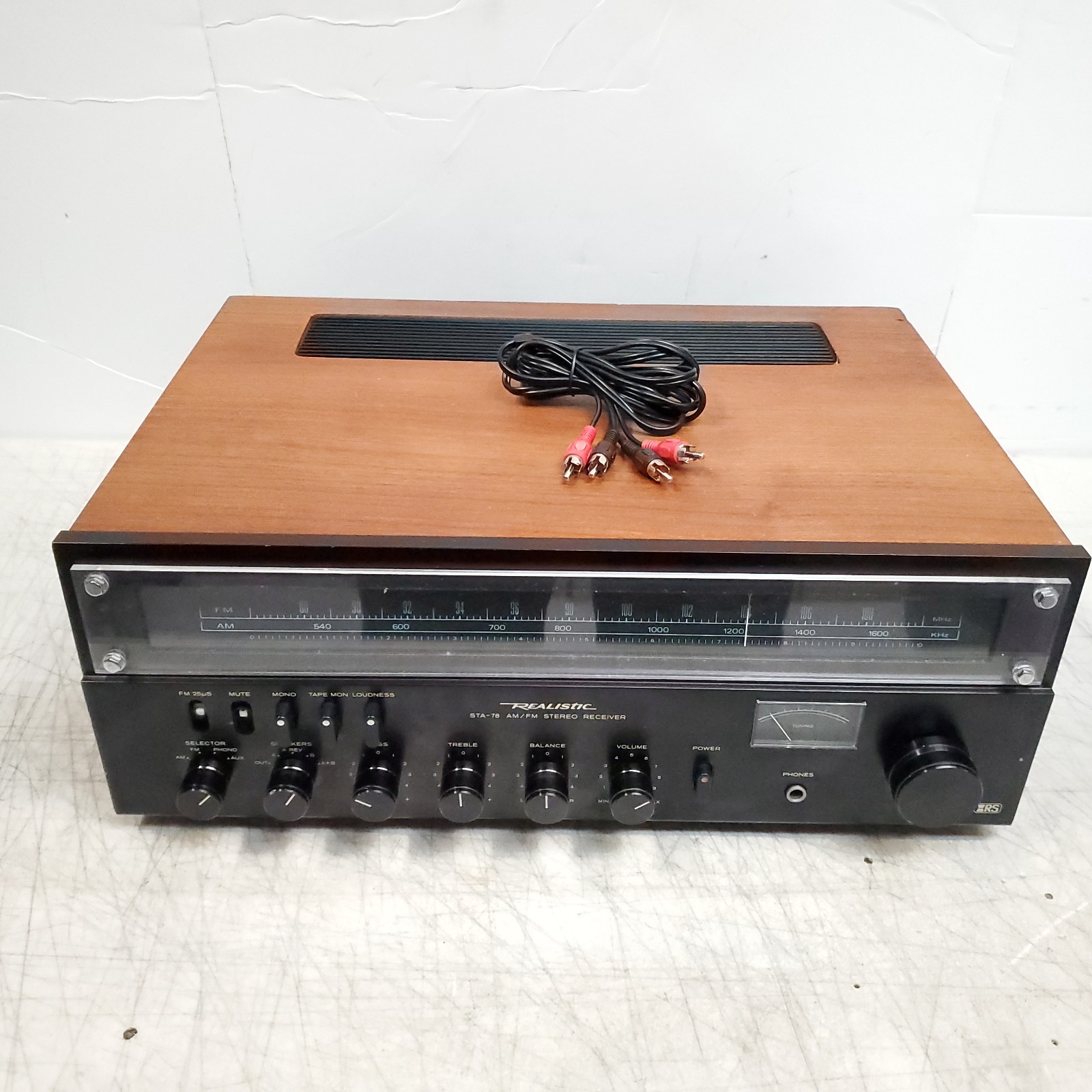

As an eBay Partner, we earn from qualifying purchases. This helps support our independent vintage technology research.
Related Models
- Realistic STA-16 (1975)
- Realistic STA-7 (1973)
- Realistic STA-800 (1975)
- Realistic STA-850 (1975)
- Realistic STA-235B (1975)
- Luxman L-530 (1975)
- Luxman R-404 (1975)
- Luxman RV-371 (1975)
- Luxman SQ-38U (1975)
- Luxman T-14 (1972)