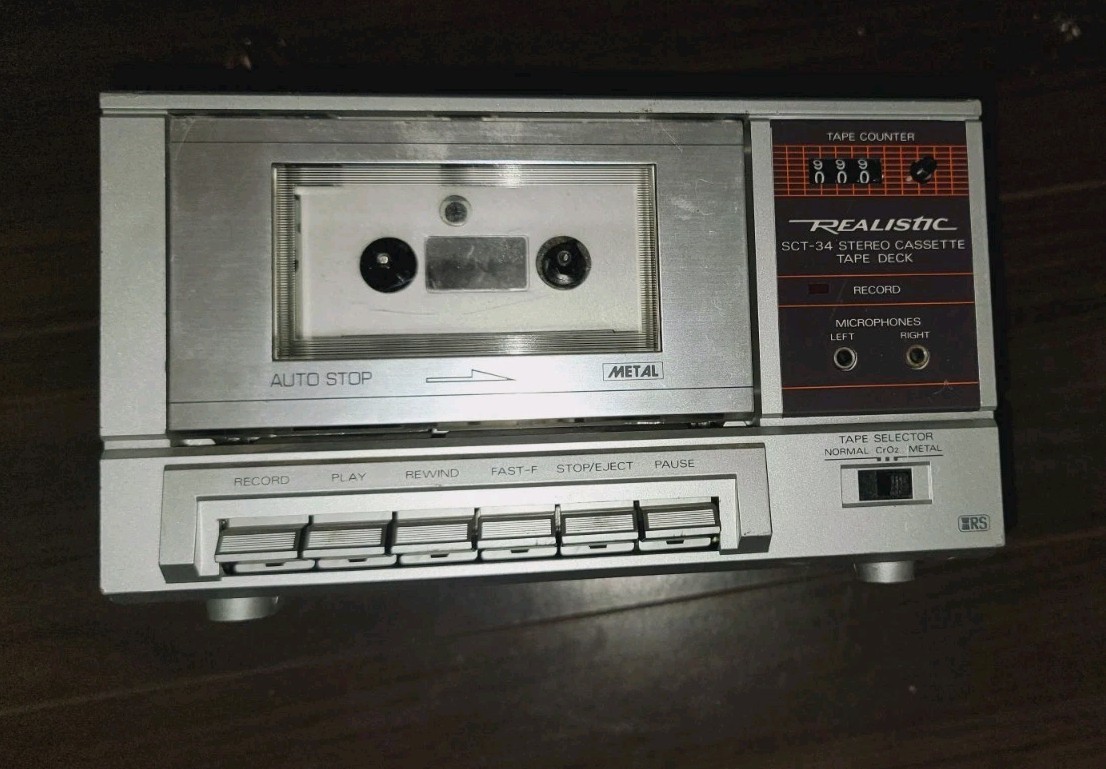
Realistic SCT-34: The Compact Cassette Service Tool for the DIY Audiophile
In the golden age of analog audio, when cassette tapes were the dominant medium for portable music and home recording, maintaining tape deck performance was essential for achieving optimal sound quality. Enter the Realistic SCT-34, a modest yet invaluable tool from the RadioShack catalog: a compact cassette service and alignment tester designed for hobbyists, technicians, and audiophiles who wanted to keep their tape decks in top form.
Released in 1979 under RadioShack’s trusted Realistic brand, the SCT-34 wasn’t an amplifier, a tuner, or a deck — it was a test instrument. While not glamorous, it played a crucial role in the ecosystem of vintage audio maintenance. At a time when high-fidelity cassette decks from brands like Sony, TEAC, and Pioneer were pushing the limits of analog tape fidelity, precise alignment of azimuth, bias, and equalization was necessary to extract the best possible performance. The SCT-34 brought basic service capabilities within reach of the average user.
Though not as sophisticated as professional-grade equipment like the Ampex 350 or high-end cassette alignment kits, the SCT-34 offered an affordable, entry-level solution for checking and adjusting cassette decks — making it a quiet hero in the world of vintage audio preservation.
Technical Specifications
The Realistic SCT-34 was engineered as a straightforward, plug-and-play cassette test tool. It interfaced with a tape deck via standard RCA audio cables and required an external oscilloscope and AC voltmeter for full functionality. It generated reference test tones and signals used in alignment procedures.
| Specification | Detail |
| Model | SCT-34 |
| Manufacturer | Realistic (Tandy Corporation) |
| Release Year | 1979 |
| Type | Cassette test and alignment generator |
| Output Signals | 400 Hz, 1 kHz, 10 kHz, 16 kHz test tones; bias oscillator (100 kHz) |
| Output Level | Approximately 0 dBm (0.775V) at 1 kHz into 600Ω |
| Output Impedance | 600Ω |
| Power Requirement | None (passive signal generator) |
| Connections | Dual RCA (phono) outputs |
| Dimensions | Approx. 5.5" x 3.5" x 1.5" |
| Weight | 12 oz (340 g) |
| Included Accessories | None (required external meter and oscilloscope) |
The device contained no internal power source or active electronics — it relied on internal oscillators and passive circuitry to generate precise test frequencies. Users would play the SCT-34 in a cassette deck (if used as a tape), or more commonly, connect it directly to the deck’s input jacks to feed test signals into the record circuitry for calibration.
Sound Characteristics and Performance
As a test generator rather than a playback device, the SCT-34 doesn’t produce "sound" in the traditional sense. However, its signal purity and frequency accuracy were critical to its performance. The unit provided clean, stable tones at 400 Hz, 1 kHz, and 10 kHz — standard reference points for setting record/playback levels and equalization (time constants: 120 µs for bass, 50 µs or 70 µs for high frequencies, depending on tape type).
The inclusion of a 16 kHz tone and a 100 kHz bias oscillator signal allowed users to align high-frequency response and bias settings, essential for maximizing the clarity and dynamic range of Type I (ferric) and Type II (chrome) tapes. While not lab-grade, the SCT-34’s signals were sufficiently accurate for home use, especially when paired with a decent AC voltmeter and oscilloscope.
Its passive design meant signal levels could vary slightly depending on the input impedance of the connected equipment, so careful calibration was recommended. Still, for its price point and intended audience, the SCT-34 delivered reliable performance.
Notable Features and Innovations
The Realistic SCT-34 stood out for its accessibility and simplicity:
- All-in-one test signal source: Combined multiple essential tones in one compact unit, eliminating the need for multiple generators.
- Bias oscillator output: Enabled proper bias alignment, a critical but often overlooked step in deck calibration.
- Durable construction: Housed in a rugged metal case with clear labeling, built to withstand shop and field use.
- Educational value: Came with a detailed instruction manual explaining alignment procedures, making it a learning tool for aspiring technicians.
While not innovative in a groundbreaking sense, the SCT-34 democratized tape deck maintenance. At a time when professional service could be costly, it empowered users to perform basic alignments themselves — a hallmark of the DIY audio culture fostered by RadioShack.
Common Issues and Maintenance
Being a passive electronic device with no moving parts, the SCT-34 is generally reliable. However, over time, several issues may arise:
- Loose or corroded RCA jacks: Due to frequent plugging/unplugging, solder joints can weaken. Cleaning with contact cleaner and resoldering can restore connectivity.
- Internal oscillator drift: Though rare, aging components may cause slight frequency inaccuracies. Calibration against a known reference (like a frequency counter) is recommended for precision work.
- Worn case or labeling: Decades of use can fade labels or dent the metal enclosure, though this doesn’t affect functionality.
Maintenance is minimal: keep the unit clean, store it in a dry place, and periodically verify output levels and frequencies if used for critical alignment work.
One limitation is the lack of support for Dolby calibration tones, meaning it cannot be used to align noise reduction circuits — a gap for users working with high-end decks. For that, more advanced tools like the Audio Dynamics or IEC reference tapes were required.
Current Market Value and Collectibility
Today, the Realistic SCT-34 is a niche item sought after by vintage audio restorers, cassette deck enthusiasts, and tinkerers keeping analog gear alive. It’s not a collectible in the traditional sense — you won’t find it on display shelves like a Marantz receiver — but it’s highly functional and increasingly rare.
On the secondary market (eBay, audio forums, etc.), prices typically range from $25 to $60, depending on condition and whether the original manual is included. Units with verified output and clean connectors command a slight premium.
Its value lies not in nostalgia, but in utility. As more people rediscover cassette culture — from mixtapes to analog synth recordings — tools like the SCT-34 are experiencing a quiet resurgence. It’s especially prized by those restoring vintage Portastudios, Tascam recorders, or high-end Revox and Nakamichi decks.
Conclusion and Legacy
The Realistic SCT-34 may not have the sonic glamour of a tube amplifier or the visual appeal of a dual-cassette deck, but it represents an essential chapter in the history of consumer audio: the empowerment of the user.
In an era when electronics were becoming more complex, RadioShack’s Realistic line — including tools like the SCT-34 — kept repair and calibration within reach of the average person. It embodied the spirit of hands-on audio, where understanding your gear was just as important as listening to it.
While modern digital analyzers and software-based tools have surpassed it in precision, the SCT-34 remains a symbol of analog self-reliance. For anyone restoring a vintage cassette deck or diving into the art of tape alignment, the SCT-34 is more than a tool — it’s a bridge to the meticulous craftsmanship of analog audio’s heyday.
If you find one in a thrift store or estate sale, don’t overlook it. That little metal box might just be the key to unlocking the full potential of your vintage tape machine.
eBay Listings


As an eBay Partner, we earn from qualifying purchases. This helps support our independent vintage technology research.
Related Models
- Realistic SCT-10 (1979)
- Realistic SCT-86 (1983)
- Realistic CTR-23 (1975)
- Realistic CTR-71 (1979)
- Realistic OPTIMUS-5 (1979)
- Sony TC-2050SD (1978)
- Aiwa AD-F990 (1993)
- Kenwood KX-3060 (1982)
- Sony TC-2130A (1974)
- Sony TC-2220 (1972)