Realistic SCT-1000: The Forgotten Broadcast Cassette Console
In the mid-1970s, as the cassette format began to transition from a dictation curiosity to a legitimate medium for high-fidelity audio, a quiet revolution was taking place behind the scenes—particularly in radio stations, production studios, and educational institutions. One of the more obscure yet fascinating artifacts from this transitional era is the Realistic SCT-1000, a cassette transcription console marketed under RadioShack’s house brand, Realistic. Unlike the typical consumer-grade cassette decks found in home stereo systems, the SCT-1000 was engineered for professional use, specifically for cassette-based transcription, broadcast logging, and audio monitoring applications.
Though not widely documented and rarely seen today, the Realistic SCT-1000 stands as a testament to RadioShack’s brief but ambitious foray into semi-professional audio equipment. It was designed during a time when radio stations were beginning to replace reel-to-reel tape machines with more compact and cost-effective cassette systems for time-delayed programming, news editing, and station identification logging. The SCT-1000 filled a niche role in this ecosystem, offering features that were advanced for a cassette machine in its price range.
Technical Specifications
| Feature | Specification |
| Manufacturer | Realistic (Tandy Corporation) |
| Model | SCT-1000 |
| Year Introduced | 1975 |
| Format | Full-Track Mono Cassette |
| Tape Speed | 1⅞ ips (inches per second) |
| Recording Method | AC Bias, Ferric Tape |
| Frequency Response | 100 Hz – 8 kHz (typical) |
| Signal-to-Noise Ratio | ~42 dB (Dolby not supported) |
| Input Connectors | XLR, ¼" TRS (balanced), RCA |
| Output Connectors | XLR, ¼" TRS (balanced), RCA |
| Power Supply | Internal 120V AC, 60 Hz |
| Dimensions | 17" W × 6" H × 12" D |
| Weight | 14 lbs (6.4 kg) |
| Special Features | Remote control input, start/stop relay, level meters, cue monitoring |
The SCT-1000 was built around a full-track mono recording system, which meant it recorded a single monophonic channel across the entire width of the tape. This design maximized output level and signal-to-noise ratio compared to the standard stereo cassette format, making it ideal for voice recording and broadcast applications where clarity and reliability were paramount.
It operated at the standard slow speed of 1⅞ ips, but its transport was engineered for durability and consistent tape tension—critical for long-duration recordings such as overnight program logs or press conferences. The inclusion of XLR and balanced ¼" inputs/outputs was unusual for a cassette deck at the time, especially under the Realistic brand, and signaled its intended use in professional environments where noise rejection and long cable runs were concerns.
Sound Characteristics and Performance
The SCT-1000 was never intended to compete with high-end stereo cassette decks like the Nakamichi 580 or even the more modest Revox B77. Instead, its sonic profile prioritized clarity, reliability, and intelligibility—especially in the midrange frequencies where human speech resides.
With a frequency response extending from 100 Hz to 8 kHz, the SCT-1000 captured voice with surprising fidelity for a machine of its era and format. Bass was tightly controlled, avoiding the muddiness common in consumer cassette recorders, while the upper mids were slightly boosted to enhance articulation. The lack of Dolby noise reduction meant tape hiss was present, but acceptable given the narrow bandwidth and professional context.
The built-in VU meters provided accurate level monitoring, and the electronic start/stop relay allowed for remote triggering—essential for unattended recording sessions. This made the SCT-1000 a favorite among small-market radio stations that needed a low-cost way to log FCC-mandated content or record remote broadcasts.
Notable Features and Innovations
What set the SCT-1000 apart from other Realistic cassette decks was its broadcast-ready feature set:
- Balanced Audio I/O: The inclusion of XLR and TRS connectors allowed direct integration into professional mixing consoles and patch bays.
- Remote Control Capability: A dedicated remote input enabled connection to automation systems, allowing the deck to be triggered by external signals such as tone bursts or contact closures.
- Cue Monitoring: Engineers could listen to the tape playback while recording on another channel—a useful feature for editing and verification.
- Heavy-Duty Transport: Built with a metal chassis and robust capstan drive, the SCT-1000 was designed for continuous operation in demanding environments.
- Dual-Level Outputs: Separate "line" and "monitor" outputs allowed flexible routing to recording systems and headphones simultaneously.
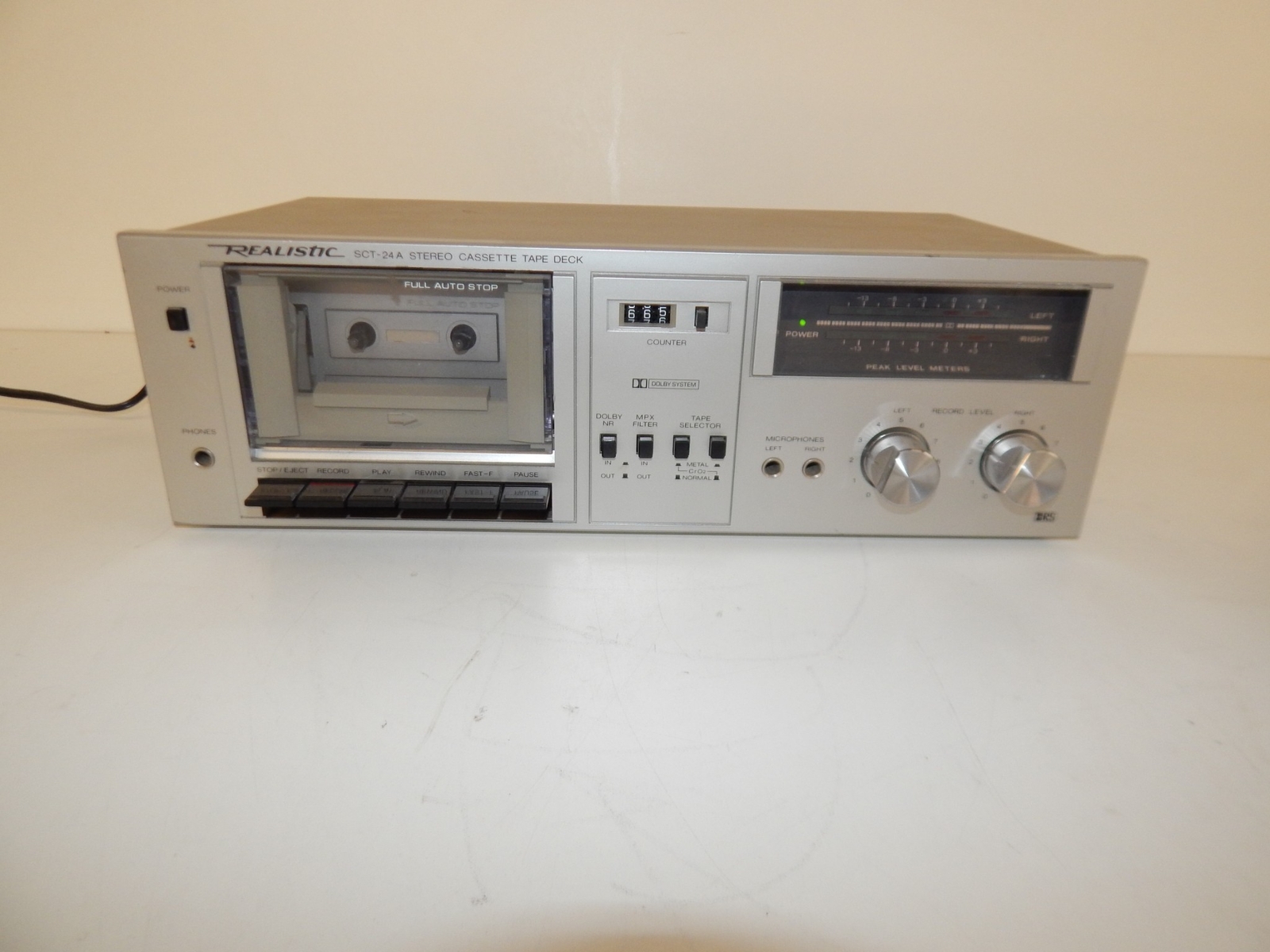
Despite its utilitarian appearance—featuring a brushed aluminum faceplate, minimal controls, and industrial toggle switches—the SCT-1000 exuded a no-nonsense professionalism uncommon in RadioShack’s catalog.
Common Issues and Maintenance
Today, finding a working SCT-1000 is a challenge. Few were produced, and even fewer have survived decades of storage and neglect. Those that do surface often require restoration.
Common issues include:
- Deteriorated rubber drive belts and pinch rollers: These dry out and crack over time, leading to inconsistent speed or tape slippage.
- Dirty or oxidized tape heads: The record/play head can lose high-frequency response if not cleaned or demagnetized.
- Sticky lubrication in the transport mechanism: Old grease can gum up gears and solenoids, preventing proper operation.
- Failing capacitors in the power supply: Electrolytic capacitors degrade over time and may need replacement to avoid damage.
Maintenance typically involves a full clean, demagnetize, and lubricate (CDL) service, belt replacement, and inspection of electrical components. Due to the scarcity of service manuals, technicians often rely on reverse engineering or donor units.
Current Market Value and Collectibility
The Realistic SCT-1000 is a rare find in the vintage audio market. It does not enjoy the fame of more iconic cassette decks, but among broadcast equipment collectors and RadioShack historians, it holds a quiet reverence.
Units in working condition typically sell for $150–$300, depending on completeness and cosmetic state. Fully restored examples with documentation can fetch higher prices, especially if accompanied by the original remote control interface or mounting hardware.
Its collectibility stems not from sonic superiority, but from its historical significance as a bridge between consumer and professional audio. It represents a moment when cassette technology was trusted enough to be used in regulated broadcast environments—a milestone in audio history.
Conclusion and Legacy
The Realistic SCT-1000 may never grace the shelves of high-end audiophiles, but it occupies a unique space in the evolution of audio technology. It was a pragmatic, well-engineered solution for a specific need at a pivotal time—when radio stations were downsizing their reel-to-reel archives and embracing compact, reliable cassette systems.
Though overshadowed by more glamorous decks, the SCT-1000 exemplifies RadioShack’s often-overlooked contribution to professional audio. It reminds us that innovation doesn’t always come from the top-tier brands—sometimes, it emerges from the back rooms of local radio stations, quietly recording history, one cassette at a time.
For the vintage audio enthusiast, the SCT-1000 is more than a curiosity—it’s a functional artifact of broadcast history, a machine built not for show, but for service. And in that, it earns its place in the pantheon of vintage audio equipment.
eBay Listings


As an eBay Partner, we earn from qualifying purchases. This helps support our independent vintage technology research.
Related Models
- Realistic SCT-10 (1979)
- Realistic SCT-86 (1983)
- Realistic CTR-23 (1975)
- Realistic CTR-71 (1979)
- Realistic OPTIMUS-5 (1979)
- Sony TC-2050SD (1978)
- Aiwa AD-F990 (1993)
- Kenwood KX-3060 (1982)
- Sony TC-2130A (1974)
- Sony TC-2220 (1972)