Realistic OPTIMUS-5B (1980s)
Big sound in a walnut cabinet — these tower speakers punch way above their price tag, if you're willing to tinker.
Overview
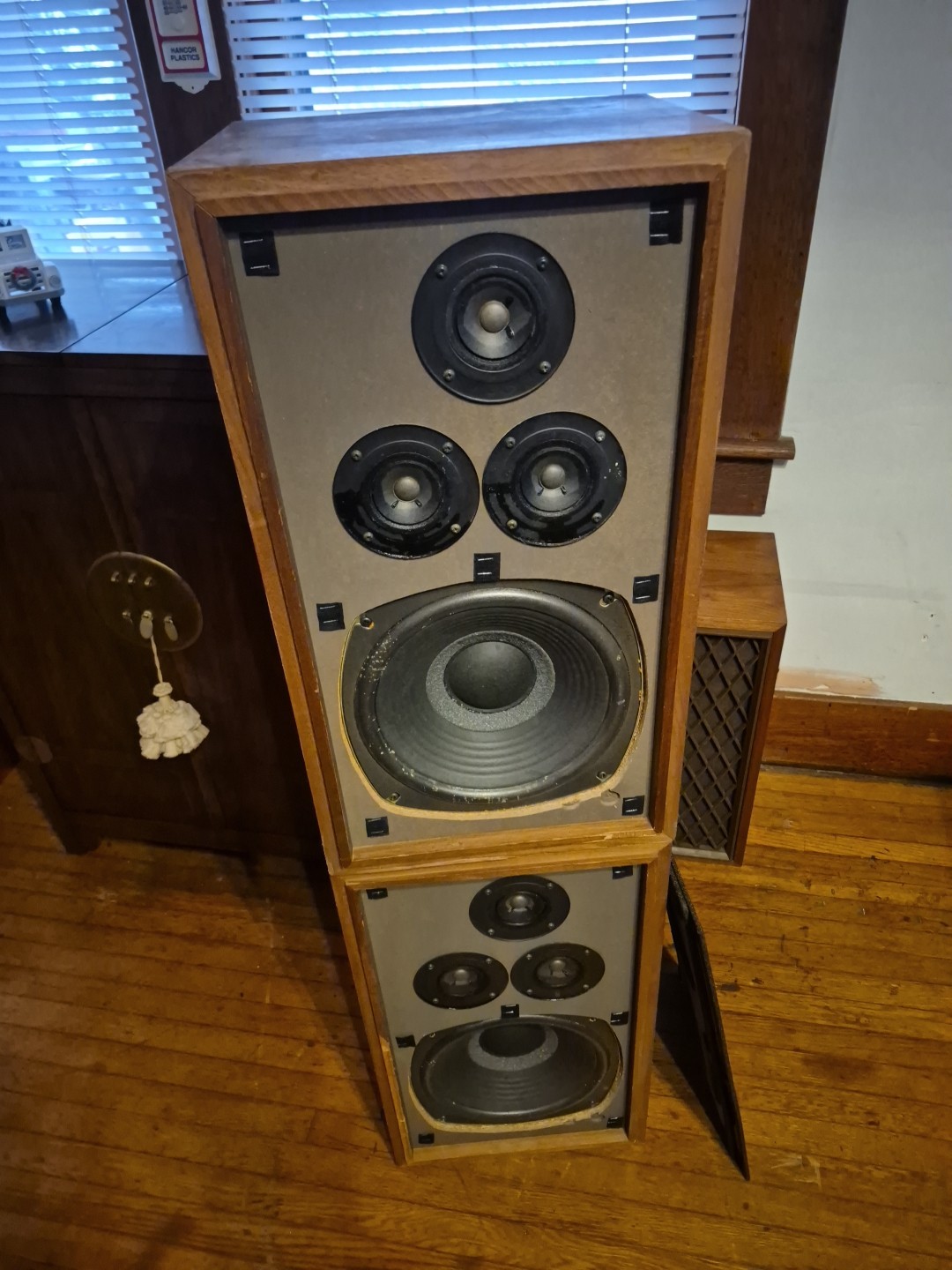
You pull one out of a dusty closet or spot it on a thrift store shelf, and it hits you: that warm, oiled walnut finish, the vintage cloth grilles, the hulking presence of a true 1980s floor-standing speaker. The Realistic Optimus-5B Acoustic Suspension Speaker System isn’t just another pair of old RadioShack boxes — it’s one of the most collectible models the brand ever produced. Sold under the Realistic name, Radio Shack’s house brand, these three-way tower speakers were built to deliver serious sound without the serious price tag. And while they weren’t marketed alongside high-end audiophile gear, owners report they “throw out a big sound with strong bass and nice highs,” a rare compliment for budget speakers of the era.
Part of the Optimus line — a series that represented a step up in both styling and performance from Radio Shack’s more basic offerings — the Optimus-5B was designed to fill a room, not just a corner. Standing 25 inches tall with a 12-inch woofer anchoring the low end, these weren’t shelf speakers for casual listening. They were statement pieces, meant to anchor a stereo setup in a living room or den. And despite their modest origins, they’ve earned a cult following among vintage audio enthusiasts who appreciate their potential — especially once the original crossovers are rebuilt. Because here’s the truth: these speakers were never about plug-and-play perfection. They were about value, potential, and that unmistakable analog warmth that only a well-tuned acoustic suspension design can deliver.
Specifications
| Manufacturer | Realistic (Tandy Corporation) |
| Model | Optimus-5B |
| Type | Three-way tower speaker system |
| Woofer | 12" acoustic suspension woofer |
| Midrange drivers | 2 midrange drivers |
| Tweeter | 1 tweeter |
| Frequency response | 20 Hz - 20 kHz |
| Power Capacity | 100 W (Music Power), 4 W (RMS) |
| Impedance | 8 ohms |
| Inputs | Screw terminals (+/-) and 1/4-inch phone jack |
| Controls | Continuously Variable Mid- and High Frequency Controls (adjustable midrange: 1–5 kHz, high frequency: 5 kHz and up) |
| Dimensions | 25" x 14" x 11 1/2" |
| Cabinet finish | Oiled walnut |
Key Features
Acoustic Suspension Design
The Optimus-5B uses an acoustic suspension enclosure — Unlike ported cabinets that use a vent to enhance low-end output, acoustic suspension relies on the air inside a sealed box to act as a spring for the woofer. This results in cleaner, more accurate bass, especially at lower volumes, though it demands more power to achieve deep extension. For a budget-conscious buyer in the 1980s, getting true acoustic suspension in a 12-inch tower from RadioShack was a big deal — it signaled a move toward more serious audio engineering in the consumer space.
Three-Way Crossover System
With a 12-inch woofer, two midrange drivers, and a single tweeter, the Optimus-5B splits the audio spectrum across three dedicated drivers. This allows each to operate within its optimal range, reducing distortion and improving clarity. The system includes a crossover network — referred to in listings as a “terminal connector crossover x-over” — that routes the appropriate frequencies to each driver. While the original crossovers are functional, one owner notes, “If you build new crossovers, these can be really sweet speakers and punch way above their weight,” suggesting the stock components may be a limiting factor in their performance. Another user mentions their Optimus 1s “Need to get them recapped someday,” implying that capacitor degradation in the crossover is a known issue over time.
Adjustable Frequency Controls
One of the standout features is the pair of continuously variable controls on the front baffle: one for midrange (1–5 kHz) and one for high frequency (5 kHz and up). This level of tonal shaping was uncommon in budget speakers of the era. It lets users tailor the sound to their room or preference — dialing back harshness in the highs or boosting presence in vocals. It’s a thoughtful touch that hints at the Optimus line’s goal of offering improved performance and flexibility over Radio Shack’s entry-level models.
Build and Aesthetics
Housed in sturdy oiled walnut cabinets, the Optimus-5B has a classic, furniture-like presence. The finish ages gracefully, and the vintage cloth grilles add to the nostalgic appeal. At 25 inches tall, they’re imposing without being massive — a sweet spot for a room that isn’t a dedicated listening space. The combination of real wood veneer, functional design, and practical size made these speakers a popular choice for buyers who wanted something that looked and sounded better than plastic bookshelf units but didn’t want to spend hundreds on separates.
Historical Context
The Optimus-5B emerged in the 1980s as part of the broader Optimus line, which represented a clear step up in both styling and performance from Radio Shack’s more basic audio offerings. While the brand was known for affordable, no-frills gear, the Optimus series aimed to deliver better sound and more refined design without breaking the bank. The Optimus 7 is noted as a larger model in the same line, suggesting a tiered lineup where the 5B occupied a mid-tier position — big enough for full-range listening, but not the flagship. There’s no mention of direct competitors or the specific market moment that led to its creation, but its feature set places it firmly in the era when consumers were beginning to expect more from their home audio systems.
Collectibility & Value
The Optimus-5B is listed as one of the “Most collectible models” for Realistic, a rare distinction for a Radio Shack-branded speaker. While not commanding audiophile prices, they’ve developed a loyal following among vintage audio tinkerers and budget-conscious listeners. A pair sold for $23.00 in an auction ending September 5, 2025, though the listing noted they were untested for sound and showed cosmetic wear — dust on controls, scuffs and chips on cabinet edges — with knobs still present. Other observed prices range from $39.87 to $250.00, with one Reddit user reporting a thrift shop find for $20. The wide price range reflects condition, provenance, and whether the crossovers have been upgraded. Given the suggestion that rebuilding the crossovers can significantly improve performance, collectors often view these speakers not as museum pieces, but as projects with serious sonic potential.
eBay Listings


As an eBay Partner, we earn from qualifying purchases. This helps support our independent vintage technology research.
Related Models
- Realistic SCT-10 (1979)
- Realistic SCT-86 (1983)
- Realistic CTR-23 (1975)
- Realistic CTR-71 (1979)
- Realistic SCT-1000 (1975)
- Sony TC-2050SD (1978)
- Aiwa AD-F990 (1993)
- Kenwood KX-3060 (1982)
- Sony TC-2130A (1974)
- Sony TC-2220 (1972)