Realistic LAB-500 (1979)
The turntable that made RadioShack a serious player in high-end vinyl—yes, really.
Overview
You don’t expect to find a heavyweight in the discount bin, but the Realistic LAB-500 turns that assumption on its head. Forget the flimsy belt-drive portables gathering dust in thrift stores—this is RadioShack’s forgotten flagship, a fully automatic direct-drive turntable built like a tank and engineered for performance. Introduced in 1979, the LAB-500 wasn’t just another house-brand curiosity; it was the top model in the Radio Shack catalogue that year, marketed as the pinnacle of their Realistic audio line and described by collectors as "the best turntable Realistic ever released." And once you lay eyes on it, you understand why.
At a time when most department-store turntables cut corners on tonearms, platters, and electronics, the LAB-500 did the opposite. It’s a direct-drive, quartz-locked deck with a low-mass S-shaped tonearm, a heavy-duty platter, and electronic automation that actually works. It feels solid—owners call it a "beast"—and with good reason. This is a Japanese-made deck (country of manufacture: Japan) that shares design DNA with models from Mitsubishi and ITT, two names with real credibility in the analog world. It wasn’t just assembled to a price point; it was built to perform.
What really sets it apart is the integrated approach. The original Realistic R9000E-LWS headshell and cartridge come pre-mounted and glued together, which might sound like a limitation, but in practice, it made setup foolproof for average users. No alignment jigs, no frustration—just plug in, drop the needle, and let the automatic functions do the rest. And because the cartridge inside is equivalent to a Shure M95, a respected budget-midrange model of the era, the sonic foundation is surprisingly capable. Paired with its 19.8g effective mass tonearm and 227mm length, it tracks well within its 0.75–1.5g range, handling complex passages without skipping or distortion when properly maintained.
Specifications
| Manufacturer | Realistic (Radio Shack's house brand) |
| Model | LAB-500 |
| Year Introduced | 1979 |
| Type | Fully automatic direct-drive turntable |
| Speeds | 33⅓ and 45 RPM |
| Speed Control | Quartz lock |
| Tonearm Type | Static balance, tubular, S-shaped |
| Tonearm Effective Length | 227mm |
| Tonearm Overhang | 14mm |
| Tonearm Effective Mass | 19.8g |
| Tracking Force Range | 0.75 - 1.5g |
| Original Cartridge | Realistic R9000E-LWS (moving-magnet) |
| Original Stylus | Realistic RS-9E (RS9E) |
| Cartridge Frequency Response | 20 - 20,000Hz |
| Dimensions (L×W×H) | 16.75" × 11.5" × 4" |
| Country of Manufacture | Japan |
| Features | Repeat function, automatic return via optoelectronic semiconductor |
| Cabinet Finish | Vinyl wood wrap |
Key Features
Heavy-Duty Build and Precision Platter
The LAB-500 doesn’t just look substantial—it is. The platter is heavier, thicker, and wider than typical consumer models of the era, contributing to stable rotation and reduced wow and flutter (though official specs for those aren’t available). Its direct-drive motor, locked by quartz, ensures consistent speed without the belt slippage that plagues many vintage decks. That stability is critical for accurate pitch and rhythm, especially on longer classical or jazz cuts. And because most functions are electronically controlled, including the automatic return, the deck operates with a level of precision that feels more like a late-’70s Technics than a RadioShack product.
Integrated Headshell and Cartridge System
The original R9000E-LWS headshell is a fixed, plastic unit with the cartridge glued in place—no user swaps without disassembly. While this limits upgrade flexibility, it also eliminates alignment errors for the average buyer. Inside, the moving-magnet cartridge is functionally equivalent to a Shure M95, a proven performer with a nude bi-radial elliptical stylus (5 x 18 micron) that tracks detail without excessive wear. Owners report the combination as "very lightweight," which helps with transient response and reduces record wear when tracking force is properly set. Just be careful with replacements: using incorrect styli can throw off alignment and damage records.
Low-Mass Tonearm with Electronic Automation
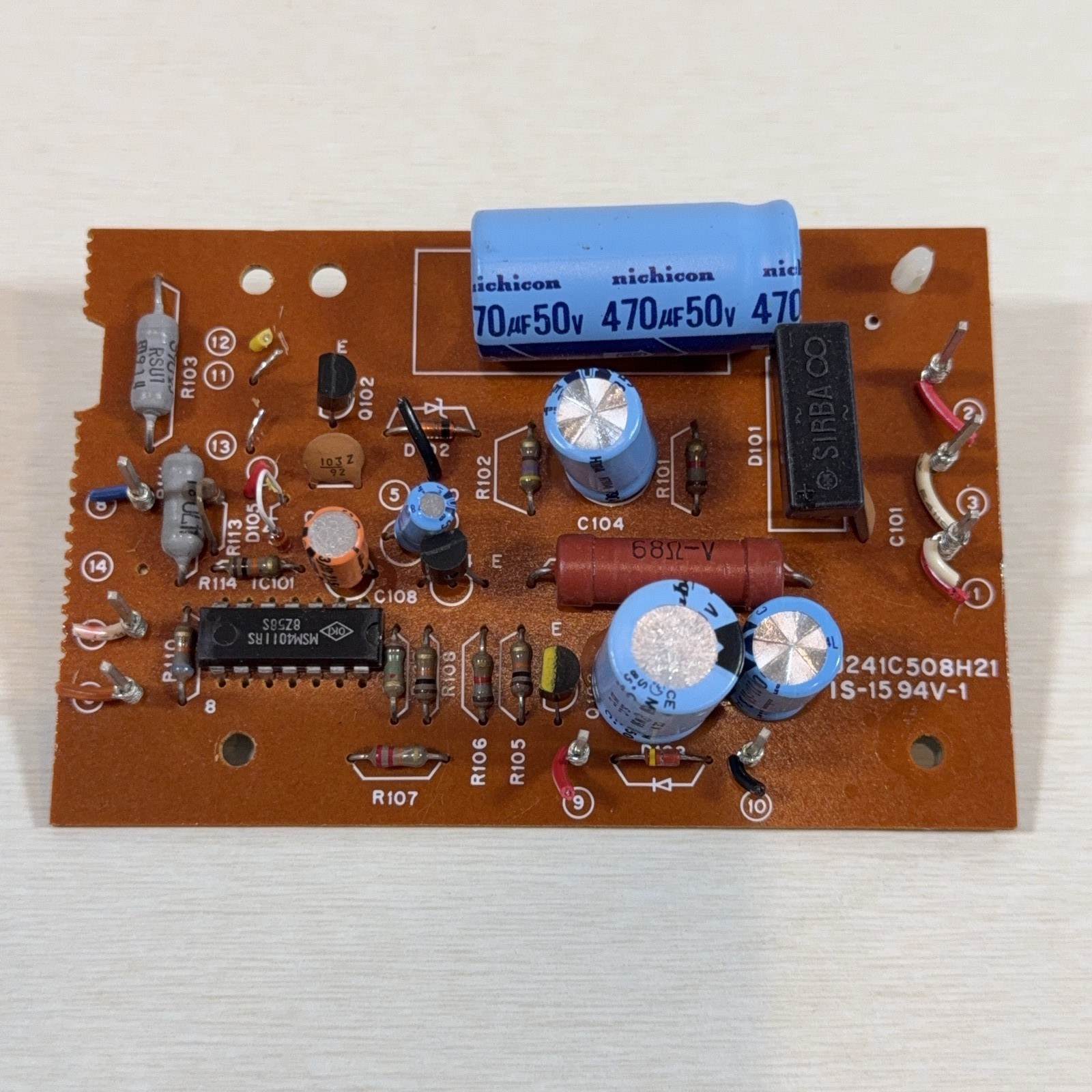
The tubular S-shaped tonearm is a static balance design with a low-mass counterweight, contributing to the 19.8g effective mass. This setup is nimble and responsive, avoiding the sluggishness of high-mass arms. The automatic start and return are triggered by a special optoelectronic semiconductor device—a clever bit of engineering that replaced mechanical trip levers with a solid-state sensor. It’s one of the reasons the LAB-500 feels more advanced than its price suggests. And while the cabinet wears a vinyl wood wrap rather than real veneer, the overall fit and finish are clean, understated, and functional—no gaudy chrome or fake woodgrain excess.
Historical Context
In 1979, RadioShack wasn’t just selling cables and batteries—they were pushing into high-fidelity audio with serious intent. The LAB-500 wasn’t just another model in the catalog; it was the top-of-the-line turntable, positioned as the flagship of the Realistic brand. Its design wasn’t developed in-house from scratch—evidence suggests it shares core engineering with turntables from Mitsubishi and ITT, two companies with strong reputations in consumer electronics. That lineage explains the build quality and technical sophistication. This was an era when mass-market retailers rarely offered direct-drive, quartz-locked decks with electronic automation, but the LAB-500 proved RadioShack could compete beyond the budget segment.
Collectibility & Value
Today, the LAB-500 flies under the radar compared to Technics or Dual, but it’s gaining traction among budget-savvy vinyl enthusiasts. Anecdotal purchase prices for used units range from $15 to $60—often as project decks needing attention. The original 1979 price was $259.95, a significant sum at the time, but now you can pick one up for less than the cost of a modern cartridge.
Common issues include dust cover cracking, cueing arm sticking, and aging capacitors that cause speed instability. The original headshell’s plastic can become flimsy over time, and incorrect replacement styli are a frequent source of tracking problems. But many of these are fixable: cueing issues often respond to lubrication, and recap kits (available for around $15) can restore quartz lock accuracy. A full electronic recap is a common and effective repair for speed drift.
While current market prices for fully restored units aren’t well documented, the cost of upkeep is manageable. A replacement RS-9E stylus runs about $42.29, and the shared heritage with Shure and Mitsubishi means parts and knowledge aren’t entirely lost. Owners consistently describe the sound as "wonderful," the look as "great," and the setup as easy—praise that holds up even after decades.
eBay Listings



As an eBay Partner, we earn from qualifying purchases. This helps support our independent vintage technology research.
Related Models
- Realistic OPTIMUS-1 (1976)
- Realistic 42-2108 (1979)
- Realistic 42-2108 Stereo Reverb System (1975)
- Realistic LAB-400 (1977)
- Realistic LAB-420 (1975)
- Akai AM-2850 (1975)
- Akai AP-206 (1975)
- Nakamichi BX-1 (1985)
- Acoustic Research research-ar-17 (1978)
- Acoustic Research AR-19 (1994)