Realistic 42-2108 Stereo Reverb System: The Forgotten Spring in the Basement
In the golden era of DIY electronics and home audio experimentation—the 1970s—RadioShack stood as a beacon for hobbyists, musicians, and tinkerers. Under its house brand Realistic, the company offered a wide array of affordable audio gear, from speakers and receivers to microphones and tape decks. Among the more unusual and intriguing offerings was the Realistic 42-2108 Stereo Reverb System, a compact, self-contained spring reverb unit designed to add lush, ambient echo effects to instruments and vocals. While not a household name like Fender or Echoplex, the 42-2108 carved out a niche for itself as an accessible, no-frills reverb solution during an era when studio-grade effects were prohibitively expensive.
A Product of Its Time
Released around 1975, the Realistic 42-2108 arrived at a time when musicians and home recordists were increasingly experimenting with effects to emulate the spacious sounds heard on records. Spring reverb—famously used in guitar amps like the Fender Twin Reverb—was a sought-after texture, but standalone units were rare and costly. Realistic stepped in with a budget-friendly alternative: a compact, stereo-capable reverb tank housed in a simple metal chassis with basic controls and RCA inputs/outputs.
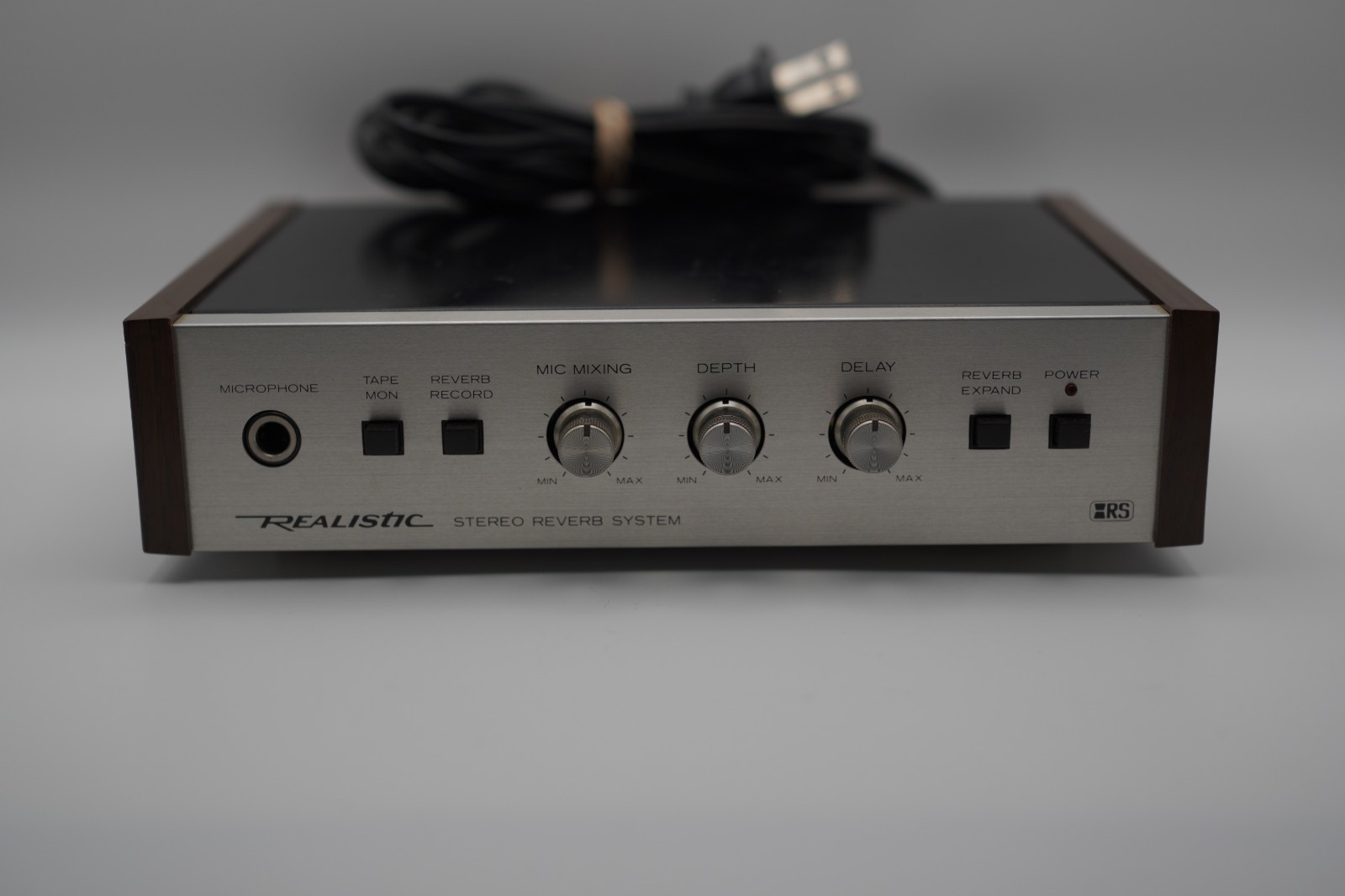
Though marketed under the Realistic brand, the 42-2108 was likely manufactured by a third-party OEM (original equipment manufacturer), a common practice for RadioShack at the time. Its design reflects the utilitarian aesthetic of mid-70s consumer electronics: a brushed steel faceplate, black rotary knobs, and minimal labeling. It was never intended to be a high-fidelity studio processor, but rather a practical tool for guitarists, vocalists, and tape deck users looking to add dimension to their recordings or live sound.
Technical Specifications
Despite its modest appearance, the 42-2108 packed genuine spring reverb technology into a compact form. Unlike digital reverb units that would emerge in the 1980s, this unit relied on analog spring reverb tanks, where audio signals are converted into mechanical vibrations that travel through coiled springs before being reconverted into electrical signals—producing that signature "drippy," resonant echo.
| Specification | Detail |
| Model Number | 42-2108 |
| Brand | Realistic (RadioShack) |
| Year of Release | 1975 |
| Type | Analog Spring Reverb Unit |
| Channels | Stereo (dual reverb tanks) |
| Input Impedance | 100kΩ (RCA) |
| Output Impedance | 600Ω (RCA) |
| Power Requirement | 120V AC, 60Hz (external power adapter) |
| Reverb Control | Single rotary knob (wet/dry blend) |
| Bypass | No dedicated bypass switch |
| Dimensions | 10.5" x 6" x 3" |
| Weight | 6.5 lbs |
| Notable Features | Dual spring tanks, RCA I/O, line-level operation |
The unit operated at line level, meaning it was best suited for use with tape decks, mixers, or instrument preamps—not directly with passive guitars. It featured RCA jacks for both input and output, making it compatible with the home audio gear of the era. The stereo designation came from its use of two independent spring reverb tanks, one for each channel, allowing for a wider, more immersive reverb field when used in a stereo setup.
Sound Characteristics and Performance
The 42-2108 delivers a classic spring reverb tone—warm, slightly metallic, and rich in harmonic artifacts. It doesn’t aim for pristine clarity; instead, it embraces the quirks of analog spring reverberation: the "boing" transients, the low-end resonance, and the natural decay that tapers off with a gentle shimmer.
When used with electric guitar (via a preamp or amp line-out), the reverb adds a surf-rock or spaghetti-western character—ideal for lo-fi recording or experimental music. Vocalists using the unit with a microphone through a mixer would find it useful for creating a sense of space without the need for echo chambers or tape delay.
While not as refined as a Fender amp’s built-in reverb or high-end studio units like the EMT 140, the 42-2108 holds its own as a characterful, organic effect. Its stereo field is surprisingly wide for a unit of its size, and the dual tanks avoid the phasing issues sometimes found in mono spring units.
Notable Features and Innovations
What made the 42-2108 stand out in its class was its affordability and accessibility. At a time when professional reverb units cost hundreds of dollars, the Realistic 42-2108 retailed for under $100, making it one of the most budget-friendly stereo reverb options available.
- Dual Spring Tanks: Rare for a consumer-grade unit, this allowed true stereo reverb imaging.
- RCA Connectivity: Seamlessly integrated with home audio systems, tape recorders, and early mixers.
- Compact Design: Easy to place on a desk or shelf, ideal for bedroom studios.
- Line-Level Operation: Made it safe to use with tape decks and preamps without overloading inputs.
Though it lacked modern features like footswitch control, wet/dry balance per channel, or tone shaping, its simplicity was part of its charm. It was a “plug and play” reverb solution for the average user.
Common Issues and Maintenance
Like all vintage spring reverb units, the 42-2108 is prone to a few common issues:
- Microphonics and Rattling: Over time, the springs can become loose or misaligned, causing unwanted vibrations when the unit is moved or touched. Securing the unit on a stable surface or isolating it with foam can help.
- Dusty Controls: The blend pot can develop crackles due to oxidation. Cleaning with contact cleaner often resolves this.
- Failing Power Adapter: The original external power supply is long out of production. Modern replacements must match the voltage (typically 12–18V AC) and polarity to avoid damage.
- Degraded Springs: In extreme cases, the springs may corrode or sag, reducing reverb effect or introducing distortion. Replacing the tanks with modern equivalents (e.g., Accutronics) is possible for the technically inclined.
Because the unit was not mass-produced in large numbers, replacement parts are scarce. However, its simple circuitry makes it relatively easy to repair for those with basic soldering skills.
Current Market Value and Collectibility
Today, the Realistic 42-2108 is a cult curiosity among vintage audio enthusiasts and DIY musicians. It rarely appears on the market, and when it does, prices range from $75 to $150, depending on condition and whether it includes the original power supply.
It’s not a high-value collector’s item like a Neve preamp or a vintage Lexicon, but it has gained attention in the lo-fi, bedroom recording, and synth-wave communities for its authentic 1970s vibe. Some experimental artists seek it out specifically for its gritty, imperfect reverb character—something hard to replicate with digital plugins.
Its value lies more in its nostalgia and usability than in technical excellence. For under $100, a working unit can still serve as a fun, tactile way to add analog reverb to a modern setup.
Conclusion and Legacy
The Realistic 42-2108 Stereo Reverb System may not have revolutionized the music industry, but it represents an important moment in audio history: the democratization of studio effects. At a time when reverb was a luxury, RadioShack brought it into basements, garages, and home studios across America.
While overshadowed by more famous gear, the 42-2108 deserves recognition as a humble pioneer—an affordable, functional, and sonically interesting tool that empowered a generation of amateur musicians. Today, it stands as a charming artifact of 1970s DIY culture, a reminder that great sound doesn’t always come from expensive gear.
If you stumble upon one in a thrift store or online marketplace, consider giving it a second life. With a little cleaning and a proper power supply, the Realistic 42-2108 can still add that classic spring shimmer to your music—just as it did over 45 years ago.
eBay Listings


As an eBay Partner, we earn from qualifying purchases. This helps support our independent vintage technology research.
Related Models
- Realistic OPTIMUS-1 (1976)
- Realistic 42-2108 (1979)
- Realistic LAB-400 (1977)
- Realistic LAB-420 (1975)
- Realistic LAB-440 (1976)
- Akai AM-2850 (1975)
- Akai AP-206 (1975)
- Nakamichi BX-1 (1985)
- Acoustic Research research-ar-17 (1978)
- Acoustic Research AR-19 (1994)