Quad FM Tuner (1975)
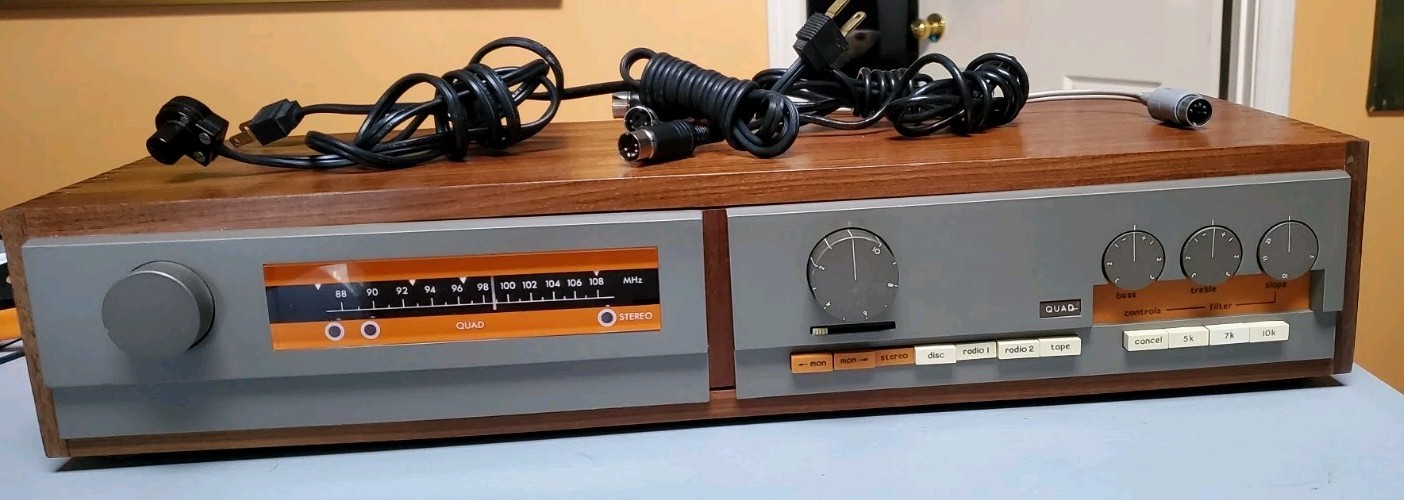
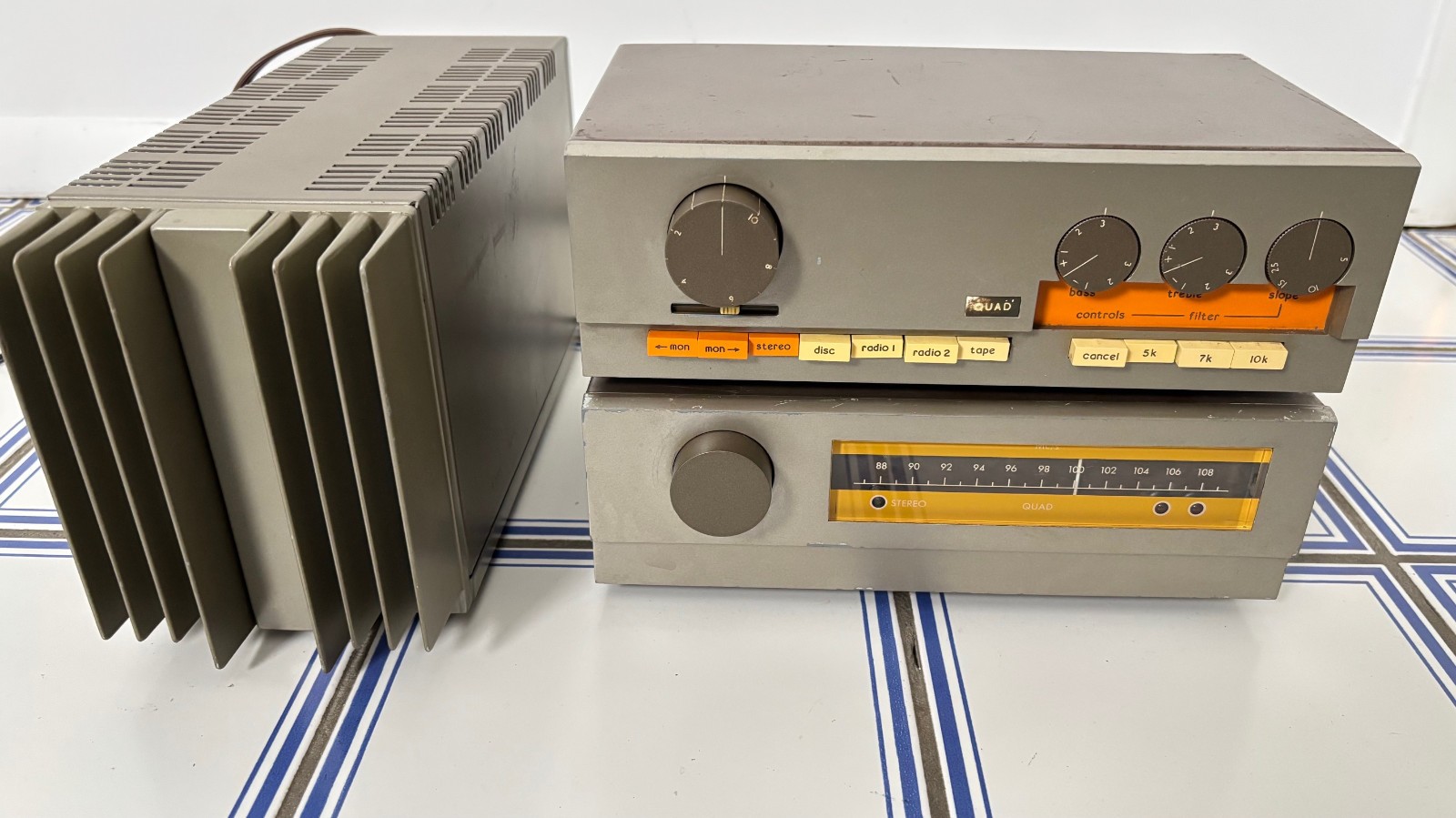
The Quad FM is a high-fidelity FM tuner introduced in 1975 by British audio manufacturer Quad (officially known as Acoustical Manufacturing Co. Ltd.). Renowned for its precision engineering and audiophile-grade performance, the Quad FM was a landmark product in the evolution of FM reception technology. Designed for discerning listeners, it combined advanced circuitry with elegant craftsmanship, setting new standards for tuner accuracy, stereo imaging, and signal stability during the golden era of analog radio.
Specifications
| Feature | Specification |
| Year of Production | 1975–1982 |
| Type | FM Stereo Tuner |
| Power Output | N/A (no amplification) |
| Impedance | N/A (no speaker output) |
| Sensitivity (Mono) | 1.8 μV for 30 dB S/N |
| Sensitivity (Stereo) | 3.5 μV for 50 dB S/N |
| Stereo Decoder | Phase-Locked Loop (PLL) |
| Front-End | FET input stage |
| Oscillator | Quartz crystal-stabilized |
| Noise Reduction | Dolby FM compatible |
| Display | Signal strength meter, tuning indicator |
| Construction | Steel chassis with walnut veneer side panels |
| Dimensions | 435 mm (W) × 130 mm (H) × 310 mm (D) |
| Weight | 8.5 kg |
Key Features
- Phase-Locked Loop (PLL) Stereo Decoder: One of the first consumer tuners to employ PLL technology, offering superior stereo separation and reduced distortion compared to conventional passive matrix decoders.
- FET Front-End: Utilizes field-effect transistors in the RF stage for low noise and high input impedance, improving weak-signal reception.
- Quartz Crystal Oscillator: Ensures exceptional frequency stability and minimizes drift, allowing for precise and consistent tuning.
- Dolby FM Noise Reduction: Compatible with Dolby-encoded broadcasts, significantly reducing high-frequency noise and improving signal clarity.
- Analog Meters: Dual meters display signal strength and tuning peak for accurate manual tuning.
- Premium Build Quality: Housed in a classic Quad chassis with a brushed aluminum front panel and real walnut veneer side cheeks, reflecting the brand’s commitment to both function and aesthetics.
Historical Significance
The Quad FM tuner emerged during a period of rapid advancement in high-fidelity audio equipment. As FM broadcasting gained popularity in the 1970s for its superior sound quality over AM, demand grew for tuners capable of extracting the full potential of stereo broadcasts. The Quad FM answered this need with cutting-edge engineering.
Its use of a phase-locked loop stereo decoder was groundbreaking, offering stereo separation figures exceeding 40 dB—far superior to the 20–25 dB typical of contemporary tuners. This resulted in a more immersive and accurate soundstage, making it a favorite among audiophiles and critics alike.
The integration of a quartz-locked oscillator eliminated tuning drift, a common annoyance in analog tuners, while the Dolby FM compatibility provided a noticeable reduction in background hiss on compatible stations. These innovations established the Quad FM as a benchmark in tuner design and influenced the development of high-end tuners throughout the late 1970s and 1980s.
Sound Signature
The Quad FM is celebrated for its clean, neutral, and highly detailed sound. It delivers a transparent window into the broadcast signal with minimal coloration, low distortion, and exceptionally low noise. Its precise stereo imaging and wide soundstage make it particularly well-suited for classical, jazz, and live recordings.
Reviewers and users consistently praise its musicality and accuracy, noting that it renders vocals and instruments with lifelike clarity and spatial coherence. When paired with high-quality source material and a good antenna, the Quad FM remains competitive with many modern tuners.
Maintenance and Tips
Due to its age, the Quad FM may require servicing to perform at its best. Consider the following maintenance tips:
- Capacitor Replacement: The most common issue is aging electrolytic capacitors, particularly in the power supply and stereo decoder circuitry. A full recapping is recommended for units that have not been serviced in decades.
- Tuning Meter and Lamps: The analog meters and pilot lamps may degrade over time. Check for dim or flickering lights and ensure meter responsiveness. Replacement lamps and meter calibration may be necessary.
- Cleaning and Lubrication: Clean internal switches and potentiometers with contact cleaner. The tuning knob mechanism may benefit from light lubrication if stiff.
- Alignment: Optimal performance requires proper RF and oscillator alignment, best performed by a technician experienced with vintage Quad equipment.
- Antenna Matching: Use a high-quality outdoor FM antenna with 300-ohm twin-lead or a balun adapter for best reception. Signal strength meters aid in precise antenna positioning.
Collectibility and Market Value
The Quad FM is highly collectible among vintage audio enthusiasts, earning a collectibility rating of 8/10. Its innovative use of PLL decoding, solid build quality, and association with the revered Quad brand contribute to its enduring appeal.
As of recent market trends, working and well-maintained units typically sell for $300–$600, with prices varying based on cosmetic condition, service history, and originality. Fully restored examples with documented servicing often command the higher end of the range.
Conclusion
The Quad FM tuner stands as a milestone in analog audio engineering. Combining pioneering technology with meticulous design, it delivered reference-grade FM reception in its era and continues to impress today. For collectors and audiophiles alike, the Quad FM is not just a tuner—it's a testament to the pursuit of sonic excellence.
eBay Listings


As an eBay Partner, we earn from qualifying purchases. This helps support our independent vintage technology research.
Service Manuals & Schematics
- Owner's Manual (1988) — archive.org
Related Models
- Quad quad-fmii (1970)
- Quad quad-am (1971)
- Quad quad-am3 (1971)
- Quad quad-amii (1973)
- Quad quad-fm2 (1969)
- Aiwa CS-250 (1978)
- Denon TU-1500RD (1995)
- Denon TU-280 (1976)
- Denon TU-501 (1977)
- Denon TU-550 (1978)