Quad 33 Preamplifier
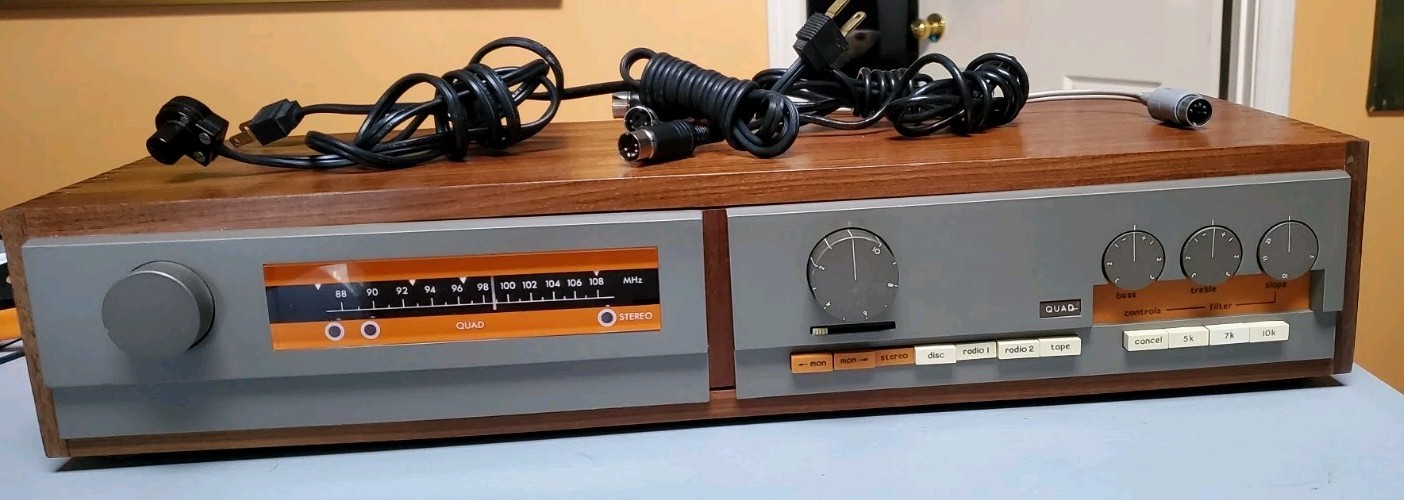
The Quad 33 is a legendary stereo preamplifier introduced in 1967 as part of Quad's renowned 33/303 amplifier system. Designed by the British audio pioneer Peter Walker, the Quad 33 was engineered to pair with the Quad 303 power amplifier, forming a modular high-fidelity separates system that set new standards for transparency, accuracy, and build quality during its era.
Despite being labeled as an "amplifier" in common usage, the Quad 33 is specifically the preamplifier unit—responsible for source selection, volume control, and tone shaping—while the actual power amplification was handled by the separate Quad 303. Together, they formed one of the most respected amplifier combinations of the 1960s and 1970s.
Specifications
| Feature | Specification |
| Model | Quad 33 |
| Type | Stereo Preamplifier |
| Year of Production | 1967–1982 |
| Power Output | N/A (preamp only) |
| Recommended Load | 8 ohms (when paired with Quad 303) |
| Power Amplifier Partner | Quad 303 |
| Channels | 2 (Stereo) |
| Power Output (System) | 25W per channel (into 8 ohms, via Quad 303) |
| Tone Controls | Bass, Treble, Tilt, and Filter switches |
| Input Sensitivity | Not officially documented |
| Inputs | 3 line-level inputs |
| Outputs | Tape out, Main out to Quad 303 |
| Distortion | Extremely low for its time (<0.02%) |
| Construction | Modular design with plug-in circuit boards |
| Dimensions | 430 mm (W) × 105 mm (H) × 305 mm (D) |
| Weight | 8.2 kg |
Key Features
- Modular Design: The Quad 33 features a pioneering modular architecture with plug-in circuit boards, making servicing and repairs easier—an advanced concept for the 1960s.
- Tone Control Flexibility: Includes unique Tilt and Filter controls. The Tilt function adjusts the tonal balance around a pivot point, while the Filter bypasses tone controls entirely for pure signal path integrity.
- Low Distortion & High Stability: Engineered for minimal harmonic and intermodulation distortion, contributing to its transparent sound.
- Robust Build Quality: All-metal chassis, high-quality potentiometers, and durable switches reflect Quad’s commitment to longevity and performance.
Historical Significance
The Quad 33, together with the Quad 303 power amplifier, represented a milestone in high-fidelity audio engineering. Released during a period when integrated amplifiers were the norm, the 33/303 system championed the separates philosophy, allowing audiophiles to upgrade or service components independently.
Quad (originally known as Acoustical Manufacturing Co. Ltd.) had already gained acclaim for its ESL-57 electrostatic speakers, and the 33/303 series was designed to drive them with precision. The system became a favorite among critical listeners for its neutral, uncolored sound, aligning perfectly with Quad’s design ethos: "The aim of high fidelity is to reproduce the original sound so accurately that the performance is indistinguishable from the live event."
This series influenced generations of amplifier designs and remains a benchmark for transparency and engineering integrity in vintage audio.
Sound Signature
The Quad 33/303 combination is celebrated for its:
- Neutral tonal balance
- Exceptional clarity and detail retrieval
- Smooth, non-fatiguing presentation
- Low coloration and natural midrange
It avoids the warmth or brightness typical of many tube or early solid-state designs, instead offering a transparent window into the recording. When properly maintained, it delivers a surprisingly modern listening experience, especially with acoustic, jazz, and vocal recordings.
Maintenance and Tips
Due to its age, the Quad 33 requires careful attention to ensure reliable and optimal performance:
Common Issues
- Aging Capacitors: Electrolytic capacitors degrade over time and should be replaced (recapped) by a qualified technician.
- Oxidized Controls: Potentiometers and switches often develop crackling or channel imbalance due to oxidation. Cleaning with contact cleaner or replacement is recommended.
- Transistor Failures: While robust, early germanium and silicon transistors can fail. Testing and replacement with modern equivalents may be necessary.
- Dust Accumulation: The modular design exposes circuit boards; regular dusting (with power off) helps prevent overheating and tracking issues.
Servicing Tips
- Always have the unit inspected by a technician experienced with vintage Quad gear before powering on if it has been dormant.
- Use the Filter mode when available to bypass tone circuits for the purest sound.
- Match with high-sensitivity speakers, especially Quad ESLs, for best results.
- Avoid overdriving inputs; the Quad 33 has limited headroom compared to modern preamps.
Market Value and Collectibility
- Market Value: $200–$500 (for a fully serviced unit; untested or non-working units may sell for less)
- Collectibility Rating: 8/10
The Quad 33 is highly sought after by vintage audio enthusiasts, particularly those restoring classic Quad systems. Original, well-maintained units command premium prices, especially when paired with the Quad 303.
Its combination of historical importance, modular innovation, and sonic purity ensures its status as a classic of British hi-fi engineering.
Conclusion
The Quad 33 preamplifier is more than just a vintage component—it's a testament to thoughtful, no-compromise design. While it demands care and occasional restoration, its performance, when properly maintained, remains competitive with many modern preamps. For collectors and audiophiles alike, the Quad 33 represents a golden era of high-fidelity audio and continues to earn admiration over half a century after its debut.
eBay Listings


As an eBay Partner, we earn from qualifying purchases. This helps support our independent vintage technology research.
Service Manuals & Schematics
- Manual — archive.org
- Service Manual — archive.org
Related Models
- Quad 33/303-COMBINATION (1970)
- Quad quad-405-2
- Quad quad-405 (1975)
- Quad quad-44 (1981)
- Quad quad-ii
- Luxman L-530 (1975)
- Luxman R-404 (1975)
- Luxman RV-371 (1975)
- Luxman SQ-38U (1975)
- Luxman T-14 (1972)