Quad 44 Preamplifier (1981)
The Quad 44 is a preamplifier introduced in 1981 by British hi-fi maker Quad. It often gets linked with cassette decks because of its era and system integration, but it is a fully discrete Class A preamp. It was the control center for Quad's 44/405/606 system. It is known for its neutral sound, minimal signal path and modular construction, and it set a benchmark for high-end preamp design in the 1980s. Vintage audio buyers still go looking for it.
The 44 follows Quad's "minimum signal path" philosophy, and it still sounds clear, uncolored and dynamic. It has gold-plated connectors and an optional remote control (RC3).
Specifications
| Feature | Specification |
| Model | Quad 44 |
| Year of Production | 1981–1998 |
| Category | Preamplifier (part of cassette deck ecosystem) |
| Circuitry | Fully discrete Class A |
| Inputs | 50k ohms (line), 100k ohms (phono) |
| Outputs | 100 ohms |
| Tape Monitoring | Yes, with dubbing capability |
| Filters | Switchable subsonic filter |
| Connectors | Gold-plated RCA inputs/outputs |
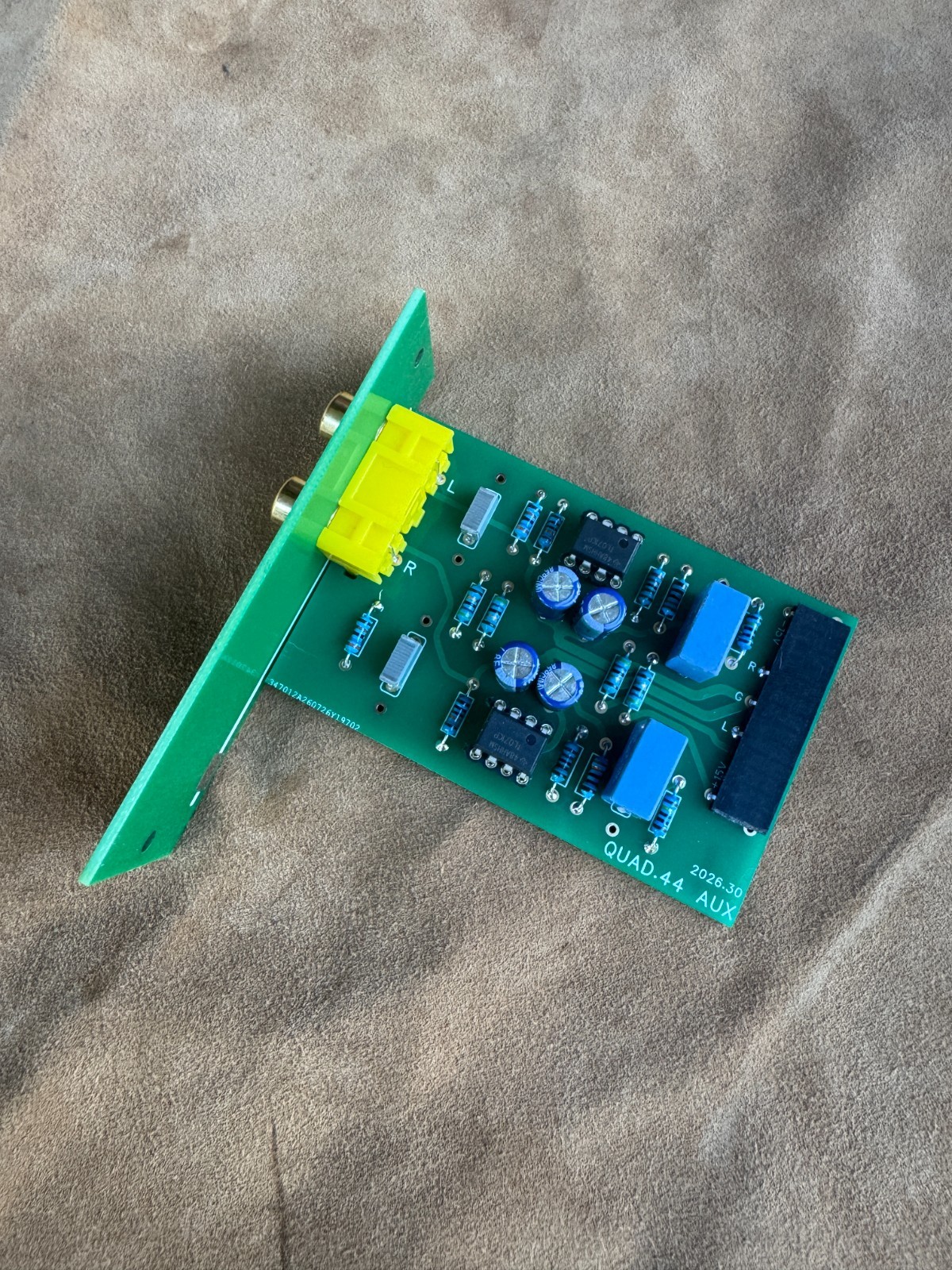
| Design | Modular with plug-in boards (phono, tone control) |
| Remote Control | Optional RC3 remote |
| Dimensions | 435 mm (W) × 88 mm (H) × 310 mm (D) |
| Weight | 7.5 kg |
| Power Consumption | Not applicable (line-level preamp, no amplification) |
> Note: The Quad 44 is a preamplifier and does not power speakers. It was typically paired with the Quad 405 power amplifier and Quad 606/707 loudspeakers for a complete system.
Key Features
- Fully Discrete Class A Circuitry: Ensures low distortion and a pure, transparent signal path.
- Modular Design: Features plug-in boards for phono stage and tone control, allowing for customization and easier servicing.
- Tape Monitor & Dubbing: Enables seamless tape monitoring and cassette-to-cassette dubbing.
- Switchable Subsonic Filter: Removes infrasonic noise from LP playback without affecting audible frequencies.
- Gold-Plated Connectors: Enhance signal integrity and resist corrosion over time.
- Optional RC3 Remote Control: Provides remote source selection and volume control—a rarity for preamps of its era.
Historical Significance
The Quad 44 was a cornerstone of Quad’s high-end audio system in the 1980s, designed to complement the equally acclaimed Quad 405 power amplifier and ESL electrostatic speakers. As part of the 44/405/606 system, it represented a holistic approach to high-fidelity reproduction—prioritizing accuracy, transparency, and musicality over flash or excessive features.
Quad worked to the philosophy of "the nearest approach to the original." The 44 uses discrete components and no integrated circuits or op-amps. The modular construction made upgrades and repairs easier, and it influenced later high-end preamp designs.
Critics and audiophiles praised the 44 as a reference preamplifier for its uncolored sound and build quality. Purists who value accuracy and longevity still favor it.
Sound Signature
The Quad 44 sounds neutral, transparent, and detailed, with very low noise. The Class A discrete circuitry gives it a wide dynamic range and good transient response.
- Tonal Balance: Flat and uncolored—faithful to the source.
- Detail Retrieval: High resolution, especially in the midrange and treble.
- Dynamics: Strong micro and macro dynamics, with a clean, controlled presentation.
- Noise Floor: Exceptionally low, contributing to a “black” background and immersive soundstage.
It adds no warmth or coloration. Some listeners may find that clinical next to tube gear. That neutrality is the reason it is still respected for accurate monitoring and audiophile listening.
Maintenance and Tips
The 44 has a reputation for solid build, but units from the 1980s show their age and need attention. Proper servicing can bring performance close to original specifications.
Common Issues
- Aging Capacitors: Electrolytic capacitors in power supply and signal paths may dry out or leak. Replacement is recommended for optimal performance.
- Scratchy Pots and Switches: Volume potentiometers and selector switches can develop noise due to oxidation. Cleaning with contact cleaner may help, but replacement is often necessary.
- RCA Connectors: May loosen or corrode over time. Inspect for secure connections and clean or replace as needed.
- Plug-in Boards: Phono and tone modules can suffer from cold solder joints or degraded components. Check and reflow if necessary.
Servicing Tips
- Recap the Unit: A full recapping (especially power supply and coupling caps) is strongly advised for long-term reliability.
- Clean Controls: Use high-quality contact cleaner on pots and switches; avoid overuse which can damage resistive tracks.
- Check Internal Wiring: Look for brittle insulation or loose connections, particularly in older units.
- Verify Module Function: Test phono and tone control boards separately if issues arise.
After decades, the Quad 44 benefits greatly from professional restoration, and a restored unit can perform well in a modern system.
Market Value and Collectibility
- Market Value: $300–$600 USD, depending on condition, included modules (phono, tone), and presence of the RC3 remote.
- Collectibility: 8/10 — Highly collectible among Quad enthusiasts and vintage audio collectors. Complete systems (44 + 405 + speakers) command premium prices.
- Restoration Potential: High — Well-serviced units are prized and can outperform many modern preamps in transparency and coherence.
Conclusion
The 44 has a modular design, discrete Class A circuitry and an uncolored sound. It needs care because of its age, but a properly maintained unit is still a good choice for listeners who want a transparent preamp.
For owners of vintage cassette decks and other analog sources, the Quad 44 works as the control center between tape, turntable and amplifier.
eBay Listings



As an eBay Partner, we earn from qualifying purchases. This helps support our independent vintage technology research.
Related Models
- Dynaco PAS-2 (1960)
- Eico ST-84 (1957)
- Fisher RS-1056 (1978)
- Luxman T-550V (1975)
- Onkyo TX-6500MKII (1982)
- Luxman JPX-10000-C (1983)
- Luxman SR-680 (1975)
- Luxman SR-800 (1979)
- Onkyo TX-8500 (1981)
- Thorens TP-19 (1975)