Pro-Ject Debut Carbon
At 300mm, the platter spins with a stability that belies its entry-level price, driven by decades of Austrian minimalism.
Overview
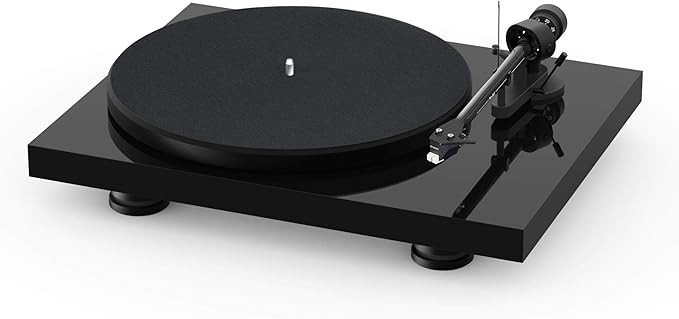
The Pro-Ject Debut Carbon isn’t a showpiece for flamboyant engineering—it’s a focused, no-frills turntable built to get out of the way of the music. Part of the long-running Debut series first introduced in 1999, this model arrived as an upgraded variant featuring a carbon fiber tonearm, a change that significantly tightened sonic presentation . Owners report it quickly became a benchmark in the sub-$500 market, often cited as the default starting point for newcomers stepping into analog playback with audiophile intent. Its design philosophy leans hard into Pro-Ject’s signature approach: rigid plinths, simple belt-drive mechanics, and carefully chosen materials that do only what’s necessary—and do it well.
While lacking advanced adjustability, the Debut Carbon’s 8.6″ carbon fiber tonearm reduces resonance and improves tracking, delivering a cleaner, more focused sound that consistently punches above its class. It was never meant to rival high-end decks costing ten times as much, but within its range, it carved out a reputation for transparency and musical coherence. The turntable operates manually, requiring user engagement for cueing and speed selection, reinforcing its role as an educational yet rewarding entry point. According to available documentation, it served as the foundation upon which later refinements—like the Debut Carbon EVO—were built.
Specifications
| Manufacturer | Pro-Ject Audio Systems |
| Product type | manual belt-drive turntable |
| Platter diameter | 300mm |
| Tonearm material | carbon fiber |
| Effective tonearm length | 218.5mm |
| Effective tonearm mass | 6g |
| Wow and flutter | ±0.10% (reportedly) |
| Speed drift | ±0.8% (reportedly) |
| Signal-to-noise ratio | 68dB (reportedly, with Ortofon 2M Red) |
| Frequency range | 20–20,000 Hz (reportedly, with Ortofon 2M Red) |
8.6″ Carbon Fiber Tonearm
The defining upgrade over earlier Debut models is the 8.6″ (218.5mm) carbon fiber tonearm, which brings measurable improvements in rigidity and damping. Carbon fiber’s high strength-to-mass ratio allows the arm to track modulations more accurately while rejecting unwanted resonances that can cloud detail. With an effective mass of 6g, it pairs well with a range of moving magnet cartridges in the 5–10mN range, offering a neutral platform without imposing tonal coloration.
300mm Platter and Belt-Drive System
Spinning beneath the record is a 300mm platter, This configuration isolates the platter from motor vibrations, a core principle in Pro-Ject’s design language. The platter’s mass helps maintain speed stability, contributing to the reportedly low wow and flutter of ±0.10%. While specific materials aren’t documented, the assembly rides on a main bearing with a stainless steel shaft and brass bushing—components also found in later EVO models, suggesting continuity in core engineering. Speed drift is rated at ±0.8%, which, while not lab-grade, is considered acceptable for musical enjoyment at this tier. The manual operation means no auto-stop or cueing motor, reinforcing a hands-on experience that many owners appreciate for its ritualistic engagement.
Historical Context
Pro-Ject launched the original Debut series in 1999, and the first units became a runaway success, establishing the brand in the global entry-level hi-fi market. The Debut Carbon emerged later as an upgraded version within that lineage, distinguished by its carbon fiber tonearm. It was developed as the predecessor to the Debut Carbon EVO, which would eventually replace it as the flagship of the Debut line. Positioned within the broader Debut family, the Carbon model represented a step up from basic versions, offering improved performance through material science rather than added complexity. No specific release year is confirmed for the Carbon variant, but it remained in production for several years, evolving quietly through minor revisions.
Collectibility & Value
Today, used units appear regularly on the secondhand market, often valued based on condition and included cartridge. The model has no formal collectible status, but its reputation ensures steady demand. However, owners report recurring issues: motor hum and noise are noted concerns, sometimes requiring isolation fixes or motor replacement. Intermittent power shutdowns and static discharge when touching the chassis have also been reported, particularly in dry environments. These quirks don’t overshadow its performance for many, but they do suggest attention to setup and occasional maintenance. Despite these flaws, the Debut Carbon remains a respected reference in its category—simple, effective, and musically engaging.
eBay Listings


As an eBay Partner, we earn from qualifying purchases. This helps support our independent vintage technology research.
Related Models
- Pro-Ject Debut Carbon EVO
- Pro-Ject Debut Evo 2
- Luxman PD-272 (1983)
- Garrard 2025tc (1968)
- Onkyo CP-1010 (1976)
- Pioneer PL-15R (1975)
- Pioneer PL-250 (1979)
- Pioneer PL-40 (1977)
- Pioneer PL-514 (1978)
- Pioneer PL-516 (1978)