Polk Audio RTA-12 (1979–1984)
The moment you hear your first true bass note from a pair of RTA-12s, you understand why some people never upgraded.
Overview
Let’s get one thing straight: the Polk Audio RTA-12 isn’t just another floor-standing speaker from the late '70s. It’s the machine that put Polk on the serious audiophile map—the first model where they didn’t just tweak crossovers and call it a day, but actually engineered sound with computers. Yeah, in 1979. While most companies were still measuring phase response with oscilloscopes and guesswork, Polk was running their designs through a custom Fast Fourier Transform (FFT) program to nail time alignment down to the microsecond. That’s not marketing fluff. That’s the kind of move that separates the hobbyists from the engineers.
And the RTA-12? It was their debutante ball. Standing 36 inches tall with a clean, no-nonsense cabinet, it looked like a serious speaker, not a piece of living room furniture. No flashy wood veneers or chrome badges—just functional design with a purpose. The name “RTA” stood for “Real Time Array,” a nod to its time-aligned driver array, and it wasn’t just a catchy acronym. This was Polk’s first true time-aligned speaker, a direct step up from the Model 10, and the foundation for everything that came after, including the legendary SDA series.
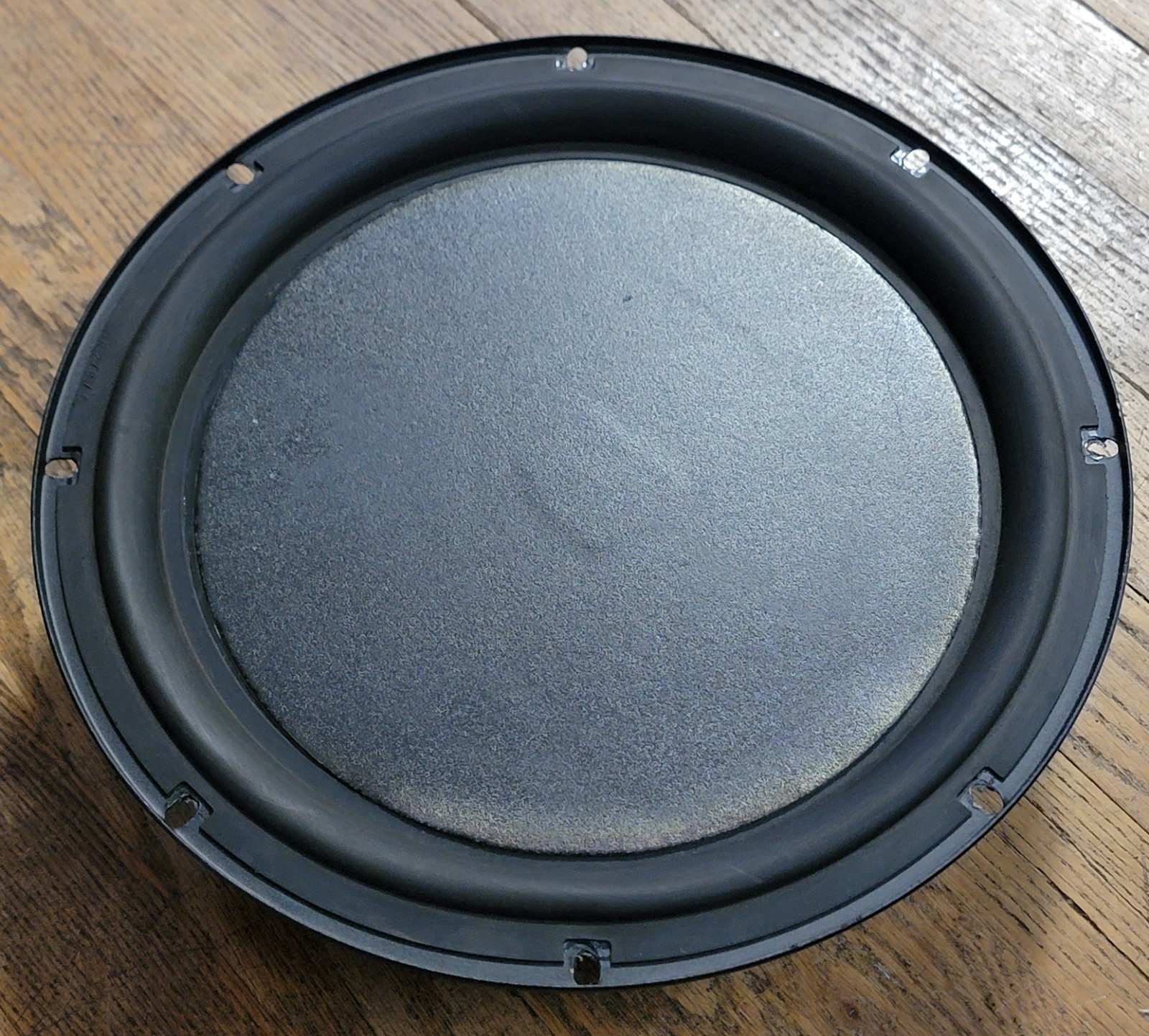
Built between 1979 and 1984, the RTA-12 came in several revisions—A, B, and finally the RTA-12C, which arrived in 1984 as the top model in the “Audio Monitor Series.” Each version refined the formula, but the core DNA stayed the same: a 1-inch dome tweeter mounted on a flat metal plate at the top, two horizontally aligned 6.5-inch midbass drivers, and a massive 12-inch flat-diaphragm passive radiator handling the deep lows. No port, no flapping port tube—just a passive radiator marketed as a “Fluid coupled subwoofer,” which sounds like something out of a sci-fi catalog but was really just Polk’s way of saying, “We made bass that doesn’t fart out.”
Owners still talk about the RTA-12’s sound like it’s a secret handshake. Smooth, transparent, with tight, defined bass that didn’t bleed into the mids. One user replaced their Electrovoice EVC-12s and said they felt like they’d entered “audiophile heaven.” Another called the RTA-12B “arguably one of the best speakers made in the 1980s.” That’s not just nostalgia—that’s reverence.
Specifications
| Manufacturer | Polk Audio, Inc. |
| Model | RTA-12 |
| Production Years | 1979–1984 |
| Type | Floor-standing loudspeaker system |
| Impedance | 4 ohms |
| Driver complement | 1" dome tweeter, two 6.5" midbass drivers, one 12" passive radiator |
| Passive radiator | 12-inch flat-diaphragm type |
| High-frequency driver | 1-inch dome driver |
| Crossover frequency (bass/mid to tweeter) | 2,000 Hz |
| Crossover point to passive radiator | 60 Hz |
| Frequency response | 50 Hz to 20,000 Hz ±3 dB |
| Power handling | 500 watts RMS |
| Dimensions | 36" H x 15" W x 10" D |
| Weight | 85 lbs |
| Driver placement | Midbass drivers located near top of cabinet (~28" from floor); passive radiator center ~17" from floor |
Key Features
Time-Aligned Design via FFT
The RTA-12 wasn’t just another speaker thrown together with off-the-shelf parts. Polk used a proprietary Fast Fourier Transform (FFT) computer program to model and refine the crossover and driver alignment—something almost unheard of in consumer speaker design at the time. The goal? Perfect time alignment. By setting the tweeter slightly back from the midbass drivers and mounting it on a flat metal plate with a downward-sloping ramp at the lower edge, Polk minimized diffraction and ensured that all frequencies reached the listener’s ear at the same time. The result? A coherent, lifelike soundstage with pinpoint imaging—especially in the center, where vocals and solo instruments just hang in the air like they’re supposed to.
Passive Radiator as “Fluid Coupled Subwoofer”
Instead of a port, the RTA-12 used a 12-inch flat-diaphragm passive radiator, which Polk marketed as a “Fluid coupled subwoofer.” It’s a quirky name, but the idea was solid: no chuffing, no turbulence, just clean, extended bass down to 50 Hz. The crossover to the passive radiator is purely acoustic, kicking in at 60 Hz, letting the two 6.5-inch midbass drivers handle the upper bass while the radiator takes over the deep end. It’s a clever design that avoids the port noise that plagues so many bass-reflex cabinets, and owners consistently praise the tight, defined low end—especially compared to the “tubby” character some competitors exhibited.
Modular Tweeter Module
The high-frequency module sits on top of the cabinet, isolated on a flat metal plate. This isn’t just for looks—it’s part of the time-alignment strategy. The tweeter is set back, and the sloped baffle below it reduces edge diffraction, which can smear high-frequency detail. Early versions came with a clear plate over the tweeter; later models used a standard grille. Either way, the placement keeps the tweeter at ear level when seated, and the isolation helps prevent cabinet vibrations from muddying the highs.
Historical Context
The RTA-12 was Polk’s declaration of intent. Before this, they were known for solid, affordable speakers like the Model 10. The RTA-12 changed the game—it was their first serious foray into time-aligned design, and it set the stage for the SDA series, which would become their flagship line. Positioned as a step up from the Model 10, it offered better bass extension, improved imaging, and a more refined overall presentation. The RTA-12C, introduced in 1984, became the top model in the “Audio Monitor Series,” and forum discussions suggest it was considered a significant leap over the A and B versions. This wasn’t just an incremental update—it was the foundation of Polk’s engineering identity.
Collectibility & Value
The RTA-12 wasn’t cheap when it launched—$770 per pair in 1979, which was serious money at the time. Today, depending on condition and revision, they sell for between $600 and $1,200. The RTA-12C, being the final and most refined version, tends to command higher prices, with one dealer listing them at $599 plus tax for a restored pair. But condition is everything. These speakers are now 40+ years old, and the foam surrounds on the 12-inch passive radiator are prone to rot. It’s not a question of *if* they’ll fail, but *when*. The good news? Replacement foam kits are readily available from specialists like Simply Speakers, and recapping the crossover (especially those low-end electrolytic caps with red ends, as one owner put it) is a common and worthwhile upgrade.
Owners report long-term satisfaction, with many pairs still in excellent condition after decades of use. They’re not museum pieces—they’re working speakers, and when restored properly, they still hold their own in modern systems. Just don’t expect 8-ohm compatibility or high sensitivity; these are 4-ohm beasts that demand a solid amplifier. But if you’ve got the juice, the RTA-12 delivers a sound that’s musical, fatigue-free, and surprisingly wide-ranging for its era.
eBay Listings



As an eBay Partner, we earn from qualifying purchases. This helps support our independent vintage technology research.
Related Models
- Polk Audio Model 9 (1973)
- Polk Audio AUDIO-MONITOR 15T (Military) (1991)
- Polk Audio AUDIO-MONITOR 5JR (1984)
- Polk Audio SDA-2B (Studio) (1988)
- Polk Audio RTA-12C (1984)
- Akai AM-2850 (1975)
- Akai AP-206 (1975)
- Nakamichi BX-1 (1985)
- Acoustic Research research-ar-17 (1978)
- Acoustic Research AR-19 (1994)