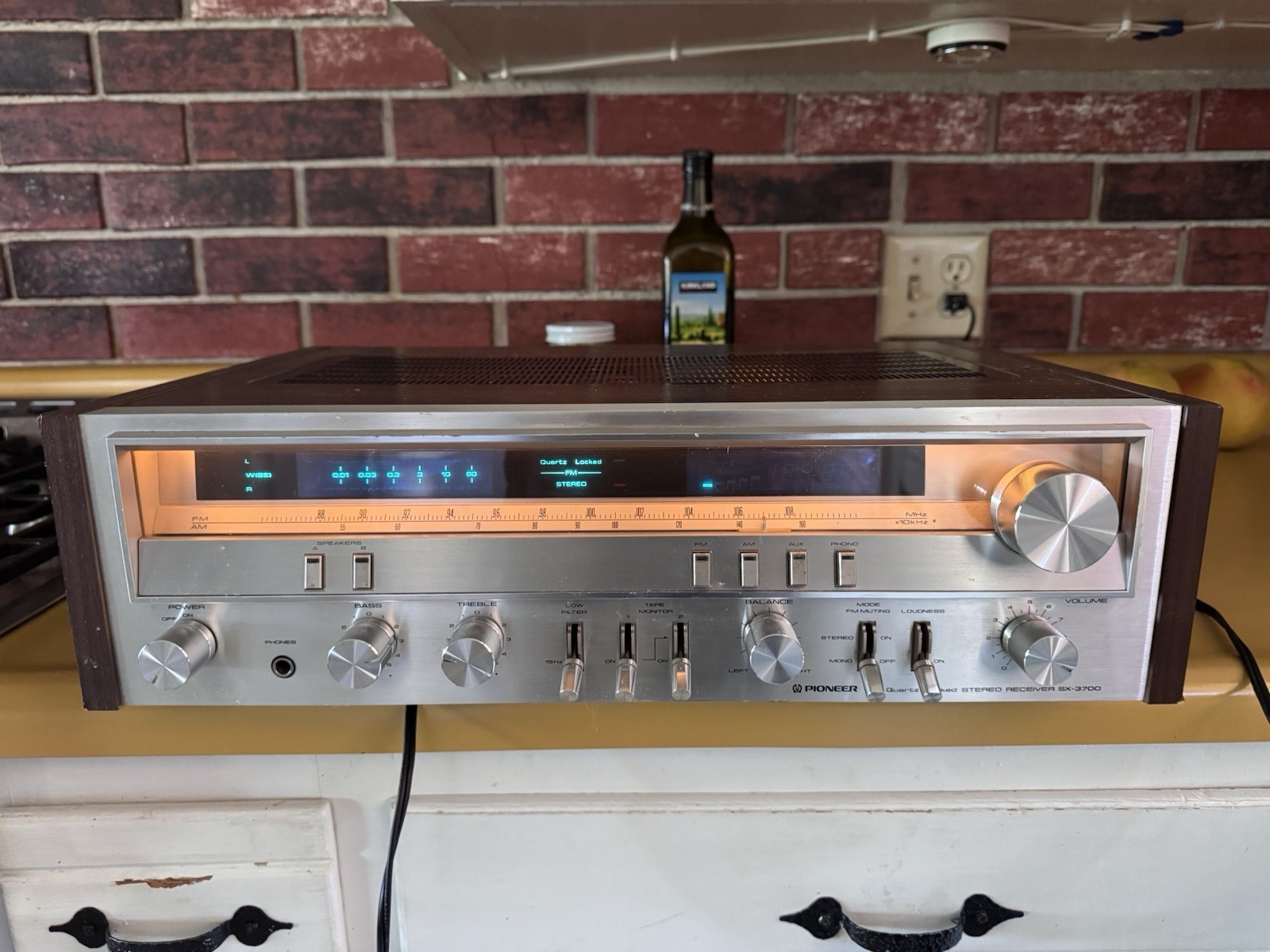
Pioneer SX 3700 (1979-1981)
Specifications
| Feature | Specification |
| Year of Production | 1979-1981 |
| Power Specifications | 45W per channel (8Ω, 20Hz-20kHz, 0.3% THD) |
| Impedance | 4-16Ω |
| Sensitivity | Unknown |
| Key Features | Quartz PLL synthesized tuning, 5-gang tuning capacitor, FET front end, dual power supply, loudness contour, tape dubbing, 4 pairs of speaker outputs |
Historical Significance
The Pioneer SX-3700 isn’t just another receiver from the golden age of analog—it’s a statement piece. Released between 1979 and 1981, it carved its niche as the mid-tier standout in Pioneer’s legendary SX-x800 series, a line revered for pushing the limits of analog performance just before digital began to take hold. This was high-fidelity engineering at its most confident: no gimmicks, just precision-tuned circuitry built to last. With its quartz-locked tuning and robust dual power supply, the SX-3700 delivered broadcast clarity and amplifier control that many still consider unmatched in its class.
Sound Signature
Listen once, and the SX-3700 announces itself: clean, articulate, and effortlessly composed, even at volume. Its 45 watts per channel don’t scream power, but they deliver with authority—tight bass, crisp highs, and a neutral tonal balance warmed just slightly by analog grace. It never feels clinical. FM reception is a particular strength, thanks to that 5-gang tuning cap and FET front end, pulling in weak stations with rare clarity. Whether you're spinning vinyl or tuning into a late-night jazz broadcast, the sound feels alive—detailed without being harsh, dynamic without drama.
Maintenance and Restoration Tips
These receivers were built to endure, but time takes its toll. The most common gremlins? Cranky volume pots and input selectors—cleaning with contact spray often brings them back to life. Aging electrolytic capacitors are due for replacement, especially if the unit has been dormant. The tuning string mechanism, while elegant, can slip or bind after decades; a careful alignment restores smooth tracking. And don’t forget the display bulbs—long gone by now, but simple to replace with modern LED equivalents that won’t yellow or burn out in a year.
Collectibility and Market Value
- Market Value: $150-$300 depending on condition and cosmetic appearance
- Collectibility Rating: 7/10
eBay Listings


As an eBay Partner, we earn from qualifying purchases. This helps support our independent vintage technology research.
Related Models
- Pioneer CS-811 (1979)
- Pioneer KH-3500 (1979)
- Pioneer CS-53 (1978)
- Pioneer CS-545 (1979)
- Pioneer CS-66 (1979)
- Akai AM-2850 (1975)
- Akai AP-206 (1975)
- Nakamichi BX-1 (1985)
- Acoustic Research research-ar-17 (1978)
- Acoustic Research AR-19 (1994)