Pioneer SG-9500: The Precision Tuner of the Golden Age of Hi-Fi
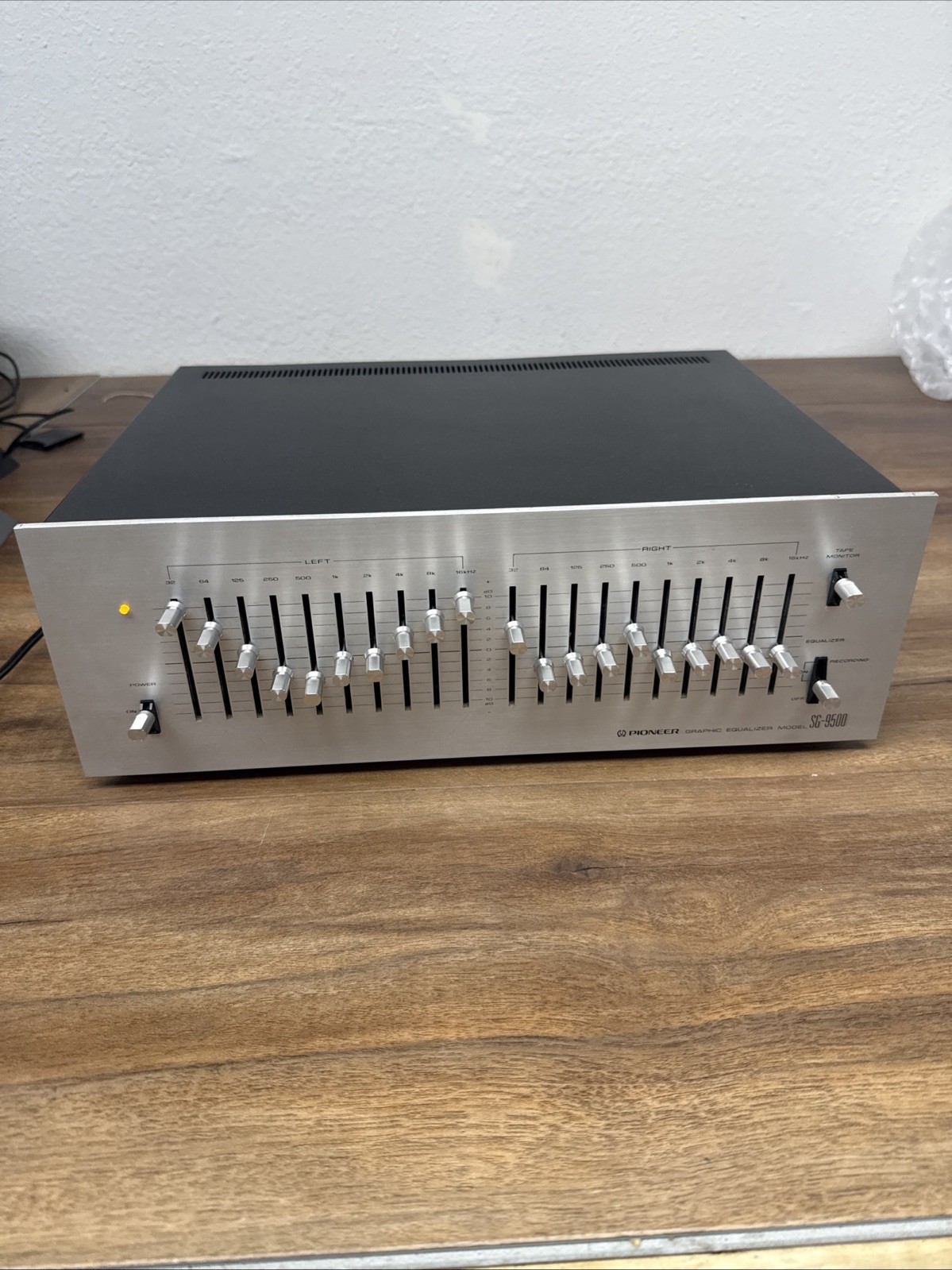
In the late 1970s, as audiophiles and home theater enthusiasts began demanding greater control over their listening environments, equalizers evolved from niche tools into essential components of high-fidelity systems. Among the most revered models of this era stands the Pioneer SG-9500, a 15-band graphic equalizer released in 1978 and manufactured in Japan. Representing the pinnacle of analog audio refinement from one of Japan’s most innovative electronics companies, the SG-9500 was designed not just for tone shaping, but for sonic transparency, precision, and build quality that rivaled the finest preamplifiers of its time.
Historical Context and Release Background
The late 1970s marked a golden age for high-end audio equipment. With the rise of quadraphonic sound, improved recording techniques, and the growing popularity of component stereo systems, manufacturers like Pioneer, Sony, Sansui, and Technics competed fiercely to offer the most advanced and sonically accurate gear. Pioneer, already renowned for its robust receivers and innovative turntables, expanded its professional-grade offerings with the SG-9500 as part of its elite "SG" (Synchro Graphic) series.
The SG-9500 was positioned as a premium accessory for discerning audiophiles and semi-professional studio users. It was often paired with flagship receivers like the Pioneer SX-1980 or used in mastering setups where tonal accuracy and minimal signal degradation were paramount. Its release coincided with the widespread adoption of the IEC 268-3 standard for graphic equalizers, which defined frequency band spacing and response curves—standards the SG-9500 adhered to with remarkable precision.
Technical Specifications
The SG-9500 was engineered with audiophile-grade components and meticulous circuit design. Its specifications reflect a commitment to fidelity and versatility:
| Specification | Detail |
| Type | 15-band Graphic Equalizer |
| Frequency Bands | 25Hz, 40Hz, 63Hz, 100Hz, 160Hz, 250Hz, 400Hz, 630Hz, 1kHz, 1.6kHz, 2.5kHz, 4kHz, 6.3kHz, 10kHz, 16kHz |
| Frequency Range | 20Hz – 20kHz (±0.5dB) |
| Bandwidth (Q) | 1/3 octave |
| Cut/Boost Range | ±12dB per band |
| Input Impedance | 47kΩ (unbalanced, RCA) |
| Output Impedance | 470Ω |
| Total Harmonic Distortion | < 0.05% at 1kHz, 0dB setting |
| Signal-to-Noise Ratio | > 90dB (A-weighted) |
| Gain | 0dB nominal (adjustable via level control) |
| Power Supply | Internal linear transformer |
| Power Consumption | 12W |
| Dimensions (W×H×D) | 430 × 145 × 318 mm |
| Weight | 8.5 kg (18.7 lbs) |
| Construction | Steel chassis, aluminum faceplate |
| Finish | Black with brushed aluminum front panel |
| Made In | Japan |
The unit features high-quality carbon-film potentiometers for each slider, ensuring smooth operation and long-term reliability. Its dual-mono signal path (separate left and right channels with no crosstalk) and fully discrete Class-A buffer amplifiers contribute to its clean, open sound.
Sound Quality Characteristics
The SG-9500 is celebrated for its transparent tonal balance and exceptional clarity. Unlike many equalizers of the era that introduced coloration or veiling when engaged, the SG-9500 maintains a neutral signature even at extreme EQ settings. When all sliders are set to flat (0dB), the unit imparts almost no sonic signature—making it ideal for critical listening and room correction.
Its 1/3-octave bandwidth allows for precise room mode correction, particularly in the bass and lower-midrange frequencies where standing waves are most problematic. Audiophiles often praise its ability to "open up" a system’s soundstage, reduce boxiness in vocals, and tame harshness in bright speakers—without sacrificing dynamics or detail.
The high signal-to-noise ratio and low distortion ensure that even subtle musical nuances are preserved. Whether used to correct acoustic anomalies or to tailor the sound to personal taste, the SG-9500 does so with surgical precision and musicality.
Notable Features and Innovations
The SG-9500 introduced several features that set it apart from competitors:
- Precision 15-Band EQ: At a time when 7- or 10-band equalizers were common, the 15-band layout offered unprecedented control.
- Detented Slide Controls: Each slider has a center detent at 0dB, allowing for repeatable, accurate settings.
- Defeat Switch: A front-panel bypass switch lets users instantly compare EQ’d and flat signals.
- Input Level Control: A master gain knob allows compensation for system volume changes after EQ adjustment.
- Dual-Column LED VU Meters: High-visibility meters monitor left and right channel output levels, helping prevent clipping.
- Balanced Signal Path Design: Though inputs and outputs are unbalanced (RCA), the internal circuitry is optimized for symmetry and low noise.
- Heavy-Duty Construction: The thick steel chassis and internal shielding minimize microphonics and RF interference.
These features made the SG-9500 not only a tool for home audiophiles but also a favorite among broadcast engineers and recording studios during the analog tape era.
Market Value and Collectibility
Today, the Pioneer SG-9500 is a highly collectible piece of vintage audio gear. Units in excellent working condition with all sliders functional and the faceplate free of scratches typically sell for $400 to $700 on the secondary market, with mint, boxed examples occasionally reaching $900+.
Its collectibility is driven by several factors:
- Japanese Manufacturing: Late-1970s Japanese-made Pioneer gear is prized for its build quality.
- Rarity: The SG-9500 was a premium product with limited production, making it less common than mass-market models.
- Performance: It outperforms many modern digital room correction systems in subjective listening tests.
- Aesthetic Appeal: The sleek black chassis with silver sliders and glowing VU meters makes it a centerpiece in any vintage setup.
It is often sought after by collectors of the Pioneer Elite line and those restoring classic systems from the 1970s and early 1980s.
Common Issues and Maintenance
Despite its robust build, the SG-9500 is not immune to age-related issues:
- Slider Noise: The most common problem. Over time, carbon tracks in the sliders can wear or oxidize, causing crackling. Cleaning with DeoxIT D5 contact cleaner can often restore smooth operation.
- Capacitor Aging: The internal power supply and coupling capacitors may dry out after 40+ years. A recapping by a qualified technician is recommended for long-term reliability.
- VU Meter Dimness: The internal bulbs may dim or fail. Replacement with modern LED equivalents is possible but should be done carefully to maintain original aesthetics.
- Slider Misalignment: Sliders can become stiff or misaligned. Gentle realignment and lubrication of the guide rails (with silicone-free grease) can help.
Regular use and proper ventilation prevent most issues. Storing the unit upright and dust-free is essential.
Comparison to Similar Models
| Model | Bands | Year | Key Differences |
| Pioneer SG-9500 | 15 | 1978 | Best build, lowest noise, Japanese-made, premium components |
| Sony EQ-80 | 15 | 1979 | Similar spec, but slightly warmer sound, less robust chassis |
| Sansui G-2500 | 10 | 1977 | Fewer bands, simpler design, less precise |
| Technics SH-GE610 | 15 | 1980 | Excellent alternative, but later model with plastic sliders |
| Audio Research EQ-2 | 12 | 1977 | Tube-based, more coloration, much higher cost |
While the Sony EQ-80 and Technics SH-GE610 are strong competitors, the SG-9500 remains the benchmark for solid-state 15-band equalizers of the era, particularly valued for its neutrality and durability.
Final Thoughts
The Pioneer SG-9500 is more than just a vintage equalizer—it’s a statement of analog excellence. In an age where digital room correction dominates, the SG-9500 reminds us of the beauty of hands-on, tactile audio tuning. Its combination of precision engineering, elegant design, and transparent sound ensures its place in the pantheon of classic audio gear. For collectors, restorers, or anyone seeking to elevate a vintage system, the SG-9500 is not just a component—it’s a masterpiece.
eBay Listings


As an eBay Partner, we earn from qualifying purchases. This helps support our independent vintage technology research.
Related Models
- Heathkit AA-2010 (1975)
- Sony MDR-4 (1978)
- Sony MDR-80 (1975)
- Sony MDR-A60 (1975)
- Accuphase DG-28
- Accuphase G-18
- Altec 804A
- Alpine 3402
- Bang & Olufsen 900K (1975)
- ADC Sound Shaper III Paragraphic