Pioneer SA-7800 (1977–1981)
A silent beast with a blue glow—this amp doesn’t shout, it commands, with near-zero distortion and a circuit that refuses to switch.
Overview
You don’t hear the Pioneer SA-7800 so much as you notice the silence around it—the kind of dead-black background that makes you lean in, wondering if the music ever really stopped. It’s not warm, not lush, not nostalgic. It’s clinical, precise, and unnervingly modern, even by today’s standards. That’s because this isn’t just another silver-faced relic from the late '70s—it’s one of the few integrated amplifiers Pioneer built using their non-switching amplifier topology, a design so stable and clean it borders on obsessive. Most vintage gear from this era trades some distortion for character, but the SA-7800 seems to have skipped that bargain entirely. At 0.009% THD and a signal-to-noise ratio pushing 110dB, it doesn’t just outperform its peers—it embarrasses them.
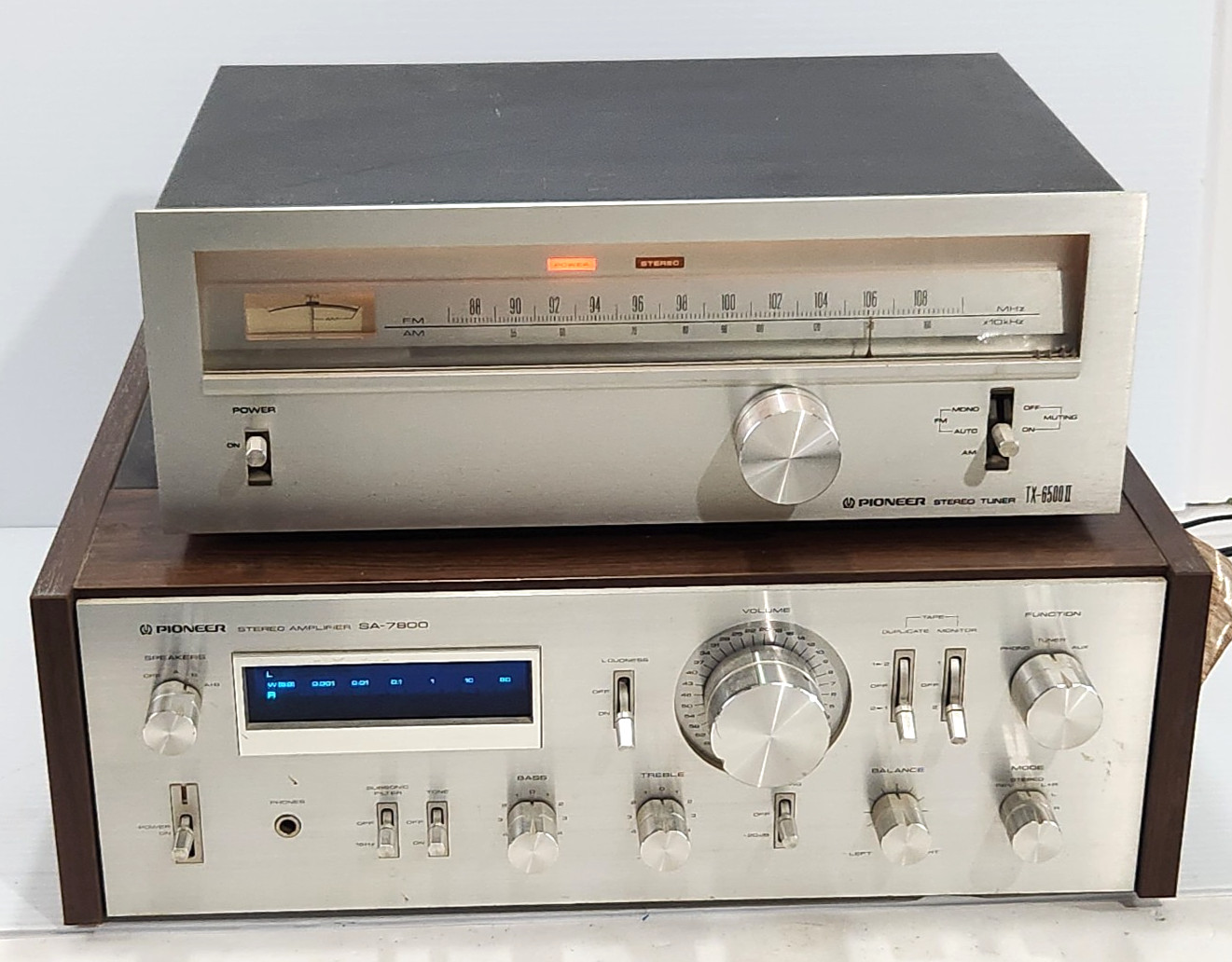
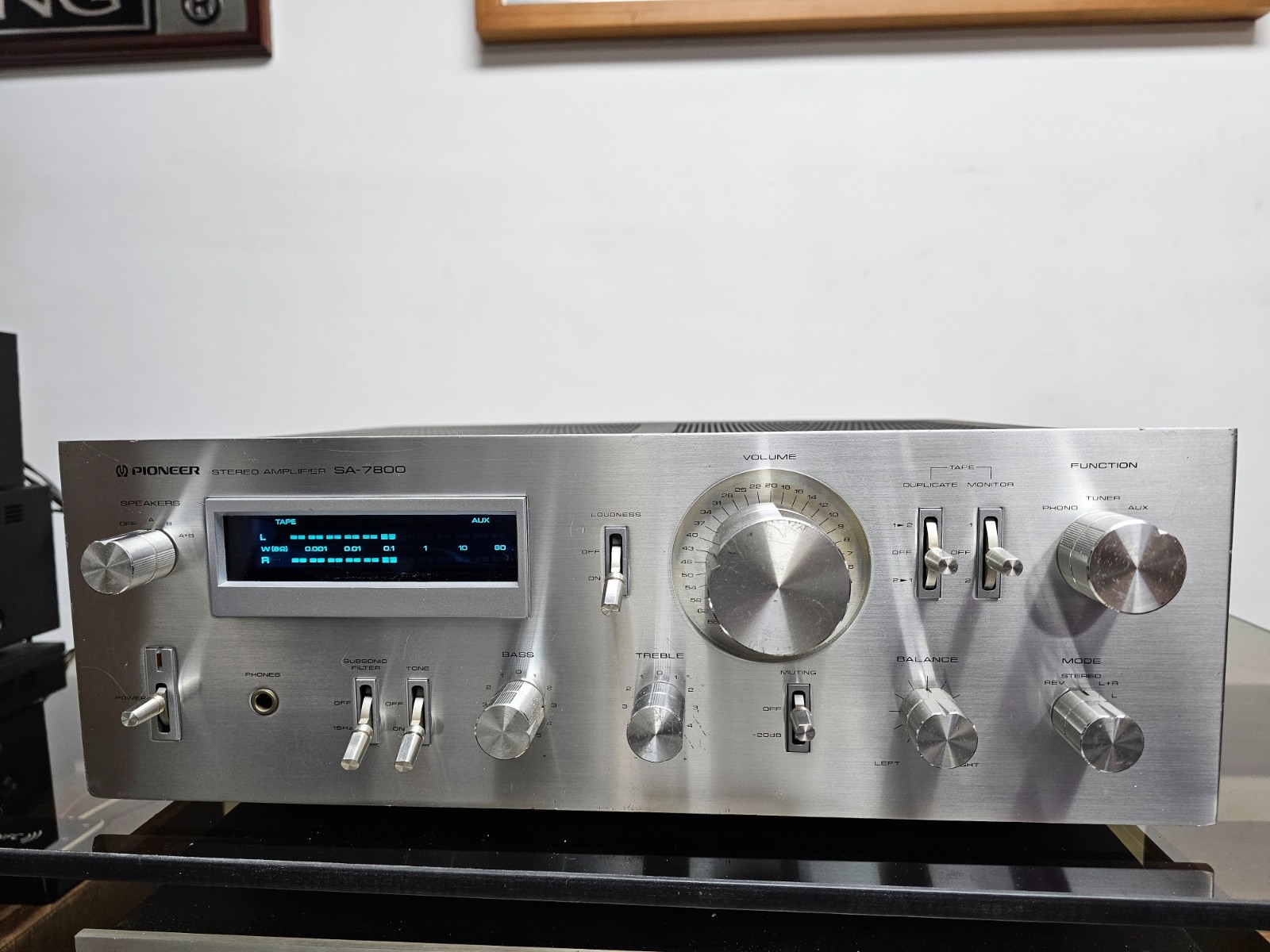
Built between 1977 and 1981, the SA-7800 sits just below the legendary SA-9800 in Pioneer’s hierarchy, but it shares the same DNA: massive power reserves, a dual power supply, and that hypnotic blue fluoroscan power meter that pulses with the music like a heartbeat. It’s not a receiver—there’s no tuner—but it’s packed with everything else: phono stage, tape monitor loops, subsonic filter, loudness contour, and a tone bypass switch for purists. The front panel is all business: silver faceplate, rotary controls for volume, bass, treble, and balance, and a row of satisfyingly chunky switches that click with authority. It’s housed in either a black metal case or, in the S/G variant, a rich walnut veneer cabinet that adds nearly two inches to the width. This is Hi-Fi as engineering statement, not decoration.
Despite its reputation for near-flawless specs, the SA-7800 isn’t flawless in practice. Its volume control, for instance, isn’t a traditional potentiometer—it’s a stepped attenuator using fixed resistors and a precision wiper system, designed to eliminate channel drift and wear. Clever? Absolutely. But it means the volume adjusts in discrete jumps, not a smooth sweep, which can feel jarring if you’re used to analog fades. And while the blue VU meters are iconic, they’re also fragile: vacuum-tube-based, they degrade over time and are notoriously difficult to replace. Still, when everything’s working, the sound is startling—fast, detailed, and dynamically unshackled. It doesn’t romanticize music; it reveals it.
Specifications
| Manufacturer | Pioneer Corporation |
| Production Years | 1977–1981 |
| Original Price | ¥53,800 (approx. $220 in 1979 USD) |
| Power Output | 65W per channel into 8Ω (both channels driven, 20Hz–20kHz, 0.03% THD) |
| Maximum Power Output | 125W per channel into 4Ω (1% THD, DIN) |
| Total Harmonic Distortion | 0.009% (10Hz–20kHz, 65W into 8Ω) |
| Frequency Response | 5Hz–100kHz (-3dB) |
| S/N Ratio | 110dB (IHF-A weighted, input shorted) |
| Damping Factor | 55 (8Ω, 1kHz) |
| Input Sensitivity | 2.5mV (Phono), 150mV (Line) |
| Input Impedance | 47kΩ (Line), 10kΩ (Phono) |
| Load Impedance | 4–16Ω |
| Power Consumption | 650W (HG version), 200W (S/S/G versions) |
| Dimensions (W×H×D) | 420 × 155 × 376 mm (metal case), 453 × 155 × 376 mm (walnut case) |
| Weight | 12.7 kg (27.97 lbs) |
| Inputs | Phono (RCA), Tuner (RCA), Aux (RCA), Tape 1/2 (RCA) |
| Outputs | Speaker A/B, Tape 1/2 (RCA), Headphone (6.3mm) |
| Features | Subsonic filter, loudness contour, tone bypass, tape monitor, dual AC outlets (S/S/G), DIN tape input (HG) |
| Construction | Solid-state, non-switching amplifier design, 73 semiconductors |
| Country of Origin | Japan |
Key Features
The Non-Switching Amplifier Circuit
Most solid-state amplifiers from the 1970s used switching power supplies or conventional rail designs that introduced switching noise or voltage sag under load. The SA-7800 doesn’t. Its “non-switching” amplifier topology—part of Pioneer’s Magni Wide policy—delivers power through a continuous, ultra-stable supply, eliminating the switching artifacts that can blur transients. This isn’t just marketing jargon; it’s why the SA-7800 measures so exceptionally low in distortion and noise. The trade-off? Heat and weight. This thing runs hot, especially the HG version with its 650W draw, and demands serious ventilation. But when it’s dialed in, the result is a level of clarity and control that feels more 1990s high-end than late-’70s mass-market. It’s the kind of amp that makes you question whether “vintage sound” has to mean soft or colored.
Stepped Attenuator Volume Control
Forget pots—Pioneer used a custom stepped attenuator for the volume control, a mechanical marvel built like a precision instrument. Inside, a rotating wiper bridges a series of fixed resistors arranged in a logarithmic ladder, ensuring consistent channel balance and eliminating the scratchiness and drift common in aging potentiometers. It’s a brilliant solution, but it comes with quirks: volume changes happen in 1dB increments, so you can’t fine-tune between levels. Some find it disorienting; others appreciate the repeatability. Either way, it’s a testament to Pioneer’s commitment to long-term reliability over user convenience. The only downside? If the wiper contacts oxidize or the resistor chain fails, repair isn’t a simple pot swap—it requires meticulous cleaning or full replacement.
Blue Fluorescent Power Meters
The glowing blue VU meters aren’t just for show—they’re vacuum-fluorescent displays, rare in consumer audio at the time, and they react with near-instantaneous speed to musical transients. They’re also fragile. These tubes degrade over decades, and replacements are scarce. When they work, they’re mesmerizing—sweeping in perfect sync with the music, glowing brighter as the amp approaches its limits. But when they fail, they either dim unevenly, flicker, or go dark entirely. Some owners bypass them entirely; others hunt down NOS (new old stock) tubes from decommissioned Japanese test equipment. Either way, they’re a signature of the SA-7800’s identity—and a maintenance liability.
Historical Context
The SA-7800 arrived at a turning point in high-fidelity history. The mid-to-late 1970s saw Japanese manufacturers like Pioneer, Denon, and Sansui shifting from tube-inspired warmth to transistor-driven precision. Pioneer’s “Silver Face” era, spanning the mid-’70s to early ’80s, was defined by clean aesthetics, rigorous engineering, and a belief that specs mattered. The SA-7800 wasn’t the flagship—that honor went to the SA-9800—but it was the sweet spot for audiophiles who wanted flagship-level performance without the flagship price. It competed directly with the likes of the Sansui AU-99000, the Yamaha B-2X, and the Sony STR-V300, all of which chased high power and low distortion. But few matched the SA-7800’s combination of measured performance and build quality. Its non-switching design was a direct response to the limitations of early switching amps, which often sacrificed sound quality for efficiency. Pioneer bet that audiophiles would pay for stability, and they were right.
The SA-7800 also reflected a broader shift in consumer behavior. By the late ’70s, many buyers were separating components—using standalone preamps, power amps, and tuners instead of all-in-one receivers. The SA-7800 capitalized on this trend by offering receiver-like connectivity in a pure amplifier form. No tuner, no AM/FM—just clean gain and power. It was a transitional product, bridging the gap between the all-in-one convenience of the early ’70s and the modular high-end systems of the 1980s. And while Pioneer would later move to more cost-effective designs, the SA-7800 remains a monument to their engineering peak.
Collectibility & Value
Today, the SA-7800 trades between $250 and $450, depending on condition, version, and whether it’s been serviced. Unrestored units in “mint” cosmetic shape often sell for $300–$350, but that’s a trap—no SA-7800 from 1979 should be trusted without a full recap and bias check. Realistically, a properly refurbished example costs $400–$600 once labor and parts are factored in. The walnut-cased S/G variant commands a slight premium, especially if the wood is uncracked and the blue meters are bright. The European HG model, with its DIN tape input and IEC power inlet, is rarer but less desirable due to its higher power draw and lack of switched AC outlets.
Common failures are serious but predictable. Electrolytic capacitors—especially in the power supply and signal path—are dried out in nearly every unrecapped unit. If the amp has been powered on in this state, it may have taken out transistors or resistors, particularly in the output stage. The SA-7800’s non-switching design means a single failed component can cascade, destroying multiple parts. Service technicians observe that the most vulnerable points are the driver transistors and the bias adjustment trim pots, which are single-turn types prone to cracking when adjusted. Replacing them with multi-turn pots is a common upgrade.
Owners report that dirty switches and relays are another headache. The tape monitor, speaker select, and mode relays can become intermittent, causing dropouts or channel imbalance. Cleaning helps, but many opt to replace them with modern equivalents. The phono stage is generally robust but can suffer from worn input jacks or degraded RIAA network caps. And while the stepped attenuator is durable, it’s not immune—oxidation on the wiper contacts causes volume jumps or channel imbalance, requiring disassembly and careful cleaning.
Buying advice? Never purchase an untested SA-7800. Always assume it needs a full recap, bias adjustment, and relay service. Look for units with clean PCBs—no corrosion, no char marks, no DIY repairs. The presence of replaced output transistors or hand-soldered jumpers is a red flag unless documented by a reputable tech. And if the blue meters don’t light up, assume they’re dead unless proven otherwise. This isn’t a “plug-and-play” vintage amp—it’s a restoration project with a high payoff.
eBay Listings


As an eBay Partner, we earn from qualifying purchases. This helps support our independent vintage technology research.
Related Models
- Pioneer SX-121 (1975)
- Pioneer F-91
- Pioneer TX-540
- Pioneer TX-6500 II
- Pioneer SX 3600 (1975-1977)
- Aiwa CS-250 (1978)
- Denon TU-1500RD (1995)
- Denon TU-280 (1976)
- Denon TU-501 (1977)
- Denon TU-550 (1978)