Pioneer Elite PDR-99
A CD player that records CDs — and one of the few pieces of digital gear from the mid-'90s that still makes collectors argue.
Overview
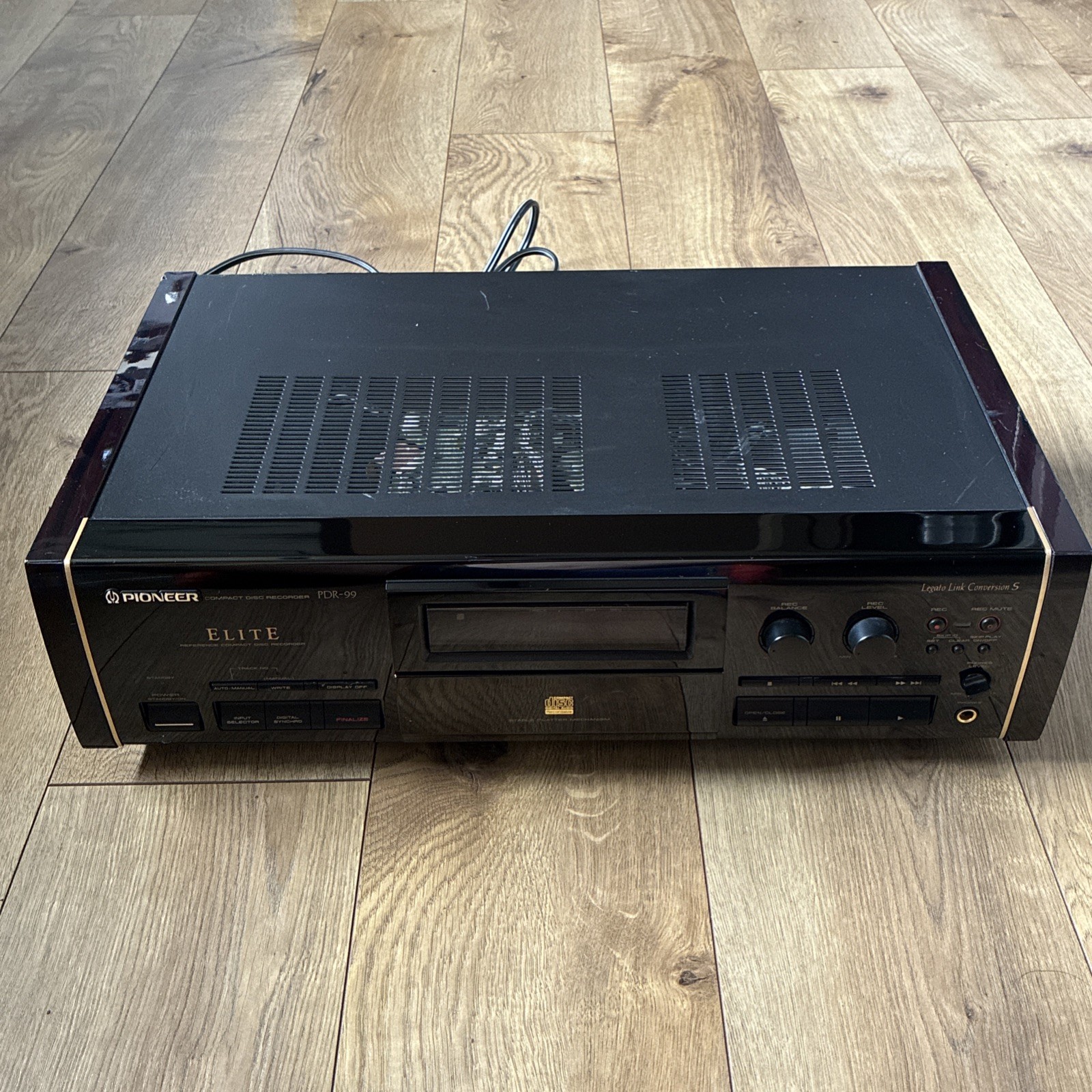
Pioneer's own advertising for the Elite PDR-99 leaned on a deadpan line: after developing a CD player with Legato Link Conversion S, twin D/A converters, and a Stable Platter Mechanism, the company realized one thing was missing — the record button. That bit of copy ran in Audio (September 1996, p.31) and again in other issues that year, and it tells you most of what the machine is: a consumer CD recorder built on the bones of Pioneer's better CD players, aimed at the person who wanted to archive their collection onto the then-new recordable CD format without stepping up to a professional deck.
The conversion side of the deck is straightforward on paper. The PDR-99 accepts 32, 44.1, and 48 kHz sampling rates for recording and plays back at 44.1 kHz, with analog connections on RCA jacks and digital I/O over S/PDIF on both optical and RCA. There is no separate microphone input, and write/read speed is 1x — this is a real-time recorder, not a high-speed duplicator. SCMS copy protection is present, as it was on every consumer digital recorder of the era, and that alone limits what the deck will let you do with a protected source.
In almost every other respect, Audio (February 1996) found the deck exemplary, and the same review noted that the PDR-99 cost half as much as Pioneer's first CD recorder and was easier to use. That price positioning matters — it puts the deck in the odd position of being both an upscale Elite product and a relative bargain next to the company's own earlier recorder.
The Stable Platter Mechanism is the other headline feature, and Pioneer's advertising billed it as a way to suppress resonance and vibration of the disc for more accurate playback and recording. The deck also carries the Legato Link Conversion S system and twin D/A converters, both of which Pioneer promoted heavily in the ad copy that ran through late 1995 and 1996.
Operation is more involved than a modern user would expect. Finalizing a disc is a multistep procedure: pressing "Finalize" brings up a confirmation prompt, a second press reads the temporary TOC and displays the time remaining, and a press of "Pause" then begins actual finalization. Playback features are fairly standard — track cueing by number via the remote keypad, manual advance with program-skip buttons, random playback, and programmed selections via the remote's "PGM" button with "Clear" and "Check" for corrections. Repeat works by pressing the remote's "Repeat" key once for a single track or twice for the whole disc, and in programmed or random mode a double press repeats the sequence or yields repeated random play. The remote's "Time" pad toggles elapsed or remaining time during recording, and in playback cycles through elapsed track time, remaining track time, remaining disc time, and total playing time. A front-panel "Display Off" button lets you check remaining record time while in record or record/pause mode. The remote also permits fading in and out during recording and playback — pressing "Fader" in record mode stops recording in about five seconds, a three-second fade begins automatically when available recording time runs out, and four-second silent passages can be written by pressing "REC Mute" on the panel or remote.
For anyone buying one today, the practical picture is this: it is a 1x consumer CD recorder with SCMS restrictions, a finalization routine that takes some getting used to, and a playback section whose Legato Link conversion measures in ways that will either charm or annoy you depending on what you value. The Stable Platter Mechanism and the Elite badge give it a place in Pioneer's upscale lineage, and the period advertising is unusually explicit about the design intent. What the fact sheet does not establish is production years, original list price, or current collector pricing — those remain undocumented here, and anyone shopping should treat asking prices with skepticism until better market data surfaces. The deck is a genuine piece of mid-'90s consumer digital history, and the Audio review remains the most useful independent account of how it actually performed.
eBay Listings
As an eBay Partner, we earn from qualifying purchases. This helps support our independent vintage technology research.