Pioneer CT-F5151: A Compact Cassette Workhorse from the Early '80s
In the early 1980s, cassette technology was at a fascinating crossroads. No longer just a medium for voice recording or car audio, the compact cassette had evolved into a legitimate format for high-fidelity music playback and home recording. Pioneer, already a major player in receivers, turntables, and speakers, also entered the cassette deck market with a range of models aimed at different segments of the audio enthusiast spectrum. Among these was the Pioneer CT-F5151, a compact cassette deck that balanced affordability, reliability, and respectable performance for its class.
While not a flagship model like the revered CT-F900 or CT-F1100 series, the CT-F5151 served a crucial role in Pioneer’s lineup: delivering solid tape functionality in a space-saving design suitable for smaller systems, secondary setups, or even semi-portable use. Released around 1980, the CT-F5151 reflects the design philosophy of its era—functional, no-nonsense, and built to last.
Technical Specifications
Despite its modest positioning, the CT-F5151 includes essential features expected of a mid-tier cassette deck of its time. It was engineered for accurate playback and basic recording with standard Type I (ferric) tapes, making it ideal for pre-recorded cassettes and home dubbing from turntables or radio.
| Specification | Detail |
| Model | CT-F5151 |
| Year of Release | 1980 |
| Cassette Type Support | Type I (Ferric) |
| Playback System | Reel-to-reel style dual capstan (mechanical) |
| Tape Speed | 1⅞ ips (4.76 cm/s) |
| Frequency Response | 60 Hz – 12 kHz (Type I, 3% THD) |
| Signal-to-Noise Ratio | 56 dB (Dolby B off), ~65 dB (Dolby B on) |
| Wow and Flutter | < 0.25% (WRMS) |
| Output Level | 0.63 mV (1 kHz, 84 dB) |
| Input Level | 120 mV (for recording) |
| Head Configuration | Single-play (record & playback head) |
| Erase Method | AC erase |
| Power Requirements | 120V AC, 60 Hz, 12W |
| Dimensions (W×H×D) | 285 × 95 × 250 mm (11¼ × 3¾ × 9⅞ in) |
| Weight | 2.8 kg (6.2 lbs) |
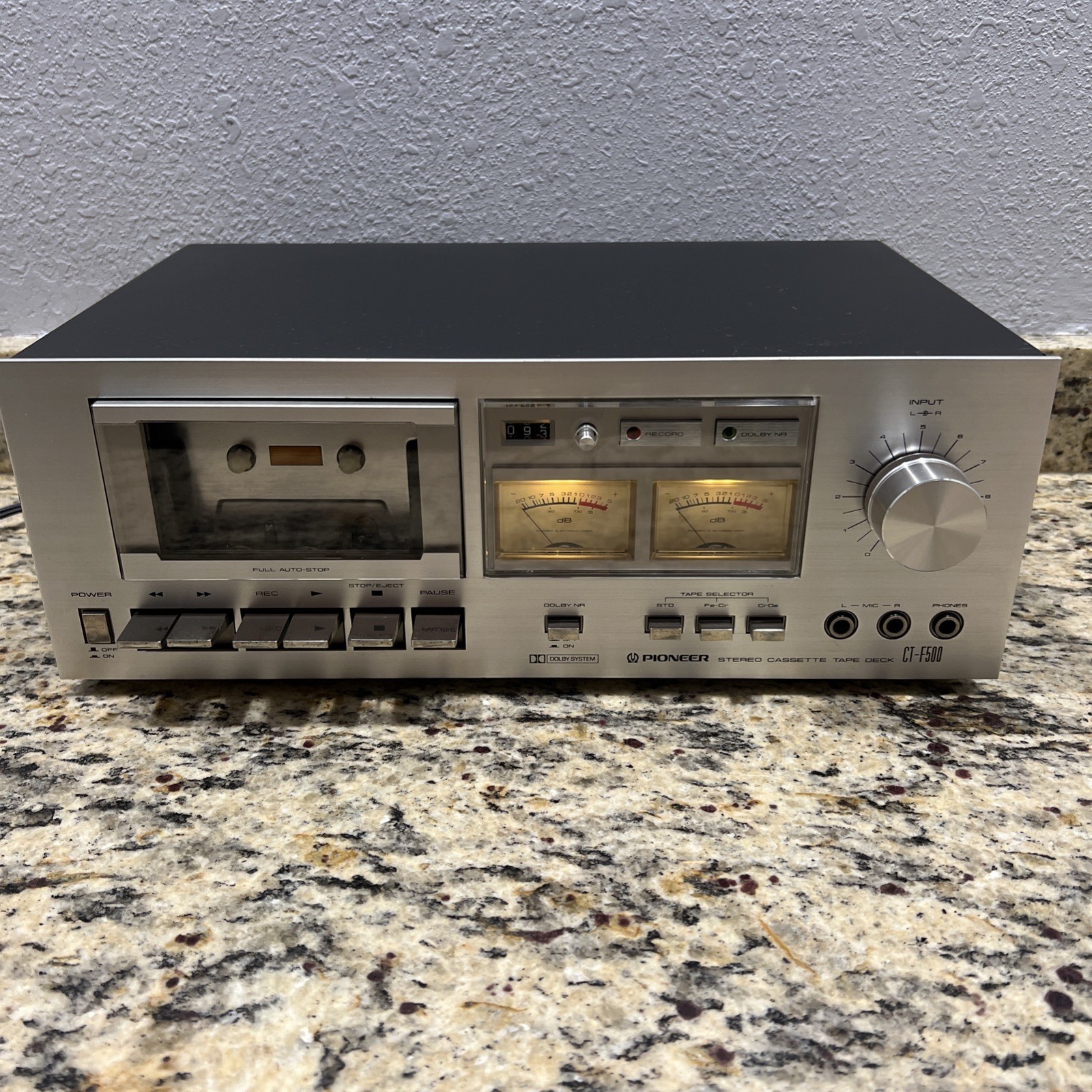
The CT-F5151 uses a mechanical dual-capstan transport, a design borrowed from higher-end models to ensure stable tape-to-head contact and reduce flutter. While not as refined as the quartz-locked systems found in premium decks, it offered noticeably better speed stability than basic rubber pinch roller designs. The front panel is simple and utilitarian, with large transport buttons (Play, Stop, Rewind, Fast Forward), a basic VU meter for level monitoring, and a Dolby B noise reduction toggle.
Sound Characteristics and Performance
As a mid-range cassette deck of the early 1980s, the CT-F5151 delivers sound that is clean, balanced, and faithful to the source—within the limitations of its class. It lacks the high-frequency extension and dynamic range of high-end decks, but for casual listening and tape dubbing, it performs admirably.
The frequency response of 60 Hz – 12 kHz is typical for a non-professional deck of this era. Bass remains tight and controlled, while mids are clear, making it well-suited for vocal-centric music and spoken word. Highs are slightly rolled off, but the inclusion of Dolby B noise reduction helps mask tape hiss and improves perceived clarity, especially on quieter passages.
The VU meter, while not precision-calibrated, provides a helpful visual reference for recording levels, preventing distortion from overmodulation. Users report that the deck records with consistent bias and level, making it reliable for making mixtapes or archiving vinyl records at home.
Notable Features and Design
The CT-F5151 stands out for its compact footprint and durable mechanical transport. At just under 10 inches deep, it fits easily into small shelves or multi-component systems where space is limited. Its brushed metal front panel and recessed display give it a professional look, even if it lacks the luxury finishes of higher-end models.
One of its more appreciated features is the auto-reverse playback—a convenience uncommon in budget decks at the time. This allows uninterrupted playback of both sides of a cassette without manual flipping, a feature that appealed to users building tape libraries or using pre-recorded albums.
The deck includes standard RCA jacks for line-level input and output, making it easy to integrate into any stereo system. It also features a 3.5mm headphone jack on the front panel, allowing private listening—a thoughtful addition for late-night use.
Though it doesn’t support Type II (chrome) or Type IV (metal) tapes, which were becoming more popular by 1980, the CT-F5151 was designed for the most widely used media: standard ferric tapes. This kept the electronics and head alignment optimized for the most common use case.
Common Issues and Maintenance
Like all vintage cassette decks, the CT-F5151 benefits from periodic maintenance, especially if it has been in storage for decades. The most common issues include:
- Deteriorated rubber parts: The pinch roller and drive belts (if applicable) can harden or crack over time, leading to speed instability or transport failure. Replacement with modern equivalents is strongly recommended.
- Dirty or oxidized tape heads: Accumulated oxide residue can degrade sound quality. Cleaning with isopropyl alcohol and cotton swabs or a demagnetizer restores clarity.
- Sticky transport mechanism: Lubrication of mechanical linkages may be needed if buttons feel stiff or unresponsive.
- Capacitor aging: While not as critical as in amplifiers, electrolytic capacitors in the power supply or audio circuitry may dry out, potentially affecting performance.
A full service—cleaning, demagnetizing, and replacing rubber parts—can bring the CT-F5151 back to excellent working condition and ensure years of reliable use.
Current Market Value and Collectibility
The Pioneer CT-F5151 is not a high-demand collector’s item, but it holds steady appeal among vintage audio enthusiasts who appreciate functional, space-saving cassette solutions. Units in good working condition typically sell for $40–$80, depending on cosmetic condition and completeness (original remote, manual, etc.).
Its value lies more in practical utility than rarity. For those building period-correct 1980s systems or digitizing old tapes, the CT-F5151 offers a trustworthy, no-frills option. It’s also popular in retro-modding communities, where its compact size makes it ideal for integration into modern DIY audio projects.
Conclusion and Legacy
The Pioneer CT-F5151 may not have the prestige of its high-end siblings, but it represents an important facet of audio history: the democratization of quality cassette technology. In an era when home taping was booming, decks like the CT-F5151 gave average consumers the tools to build music libraries, share mixtapes, and enjoy portable high-fidelity sound.
Built with Pioneer’s hallmark reliability and thoughtful design, the CT-F5151 remains a capable performer today. With basic maintenance, it continues to serve as a functional bridge between analog past and digital present—perfect for vinyl ripping, nostalgic listening, or completing a vintage stereo setup.
While it won’t win awards for sonic brilliance, the CT-F5151 earns respect for doing the fundamentals right: solid mechanics, clean sound, and enduring build quality. For the discerning vintage audio enthusiast, it’s a quiet achiever worth a spot on the shelf.
eBay Listings


As an eBay Partner, we earn from qualifying purchases. This helps support our independent vintage technology research.
Related Models
- Pioneer SX-1500TD (1978)
- Pioneer C-77 (1977)
- Pioneer EXCLUSIVE-C3 (1983)
- Pioneer CT-3030E (1983)
- Pioneer CT-F4141A (1983)
- Sony TC-2050SD (1978)
- Aiwa AD-F990 (1993)
- Kenwood KX-3060 (1982)
- Sony TC-2130A (1974)
- Sony TC-2220 (1972)