Pioneer EXCLUSIVE-C3 (1983)
The Pioneer EXCLUSIVE-C3 is a premium cassette deck released in 1983 as part of Pioneer’s short-lived but highly regarded EXCLUSIVE series. Positioned at the top of Pioneer’s cassette lineup during the early 1980s, the C3 was engineered to deliver audiophile-grade performance, combining meticulous mechanical design with advanced electronic circuitry. Though cassette decks were often seen as secondary components in high-fidelity systems, the EXCLUSIVE-C3 challenged that perception by offering performance that rivaled open-reel tape recorders of the era.
Design and Build Quality
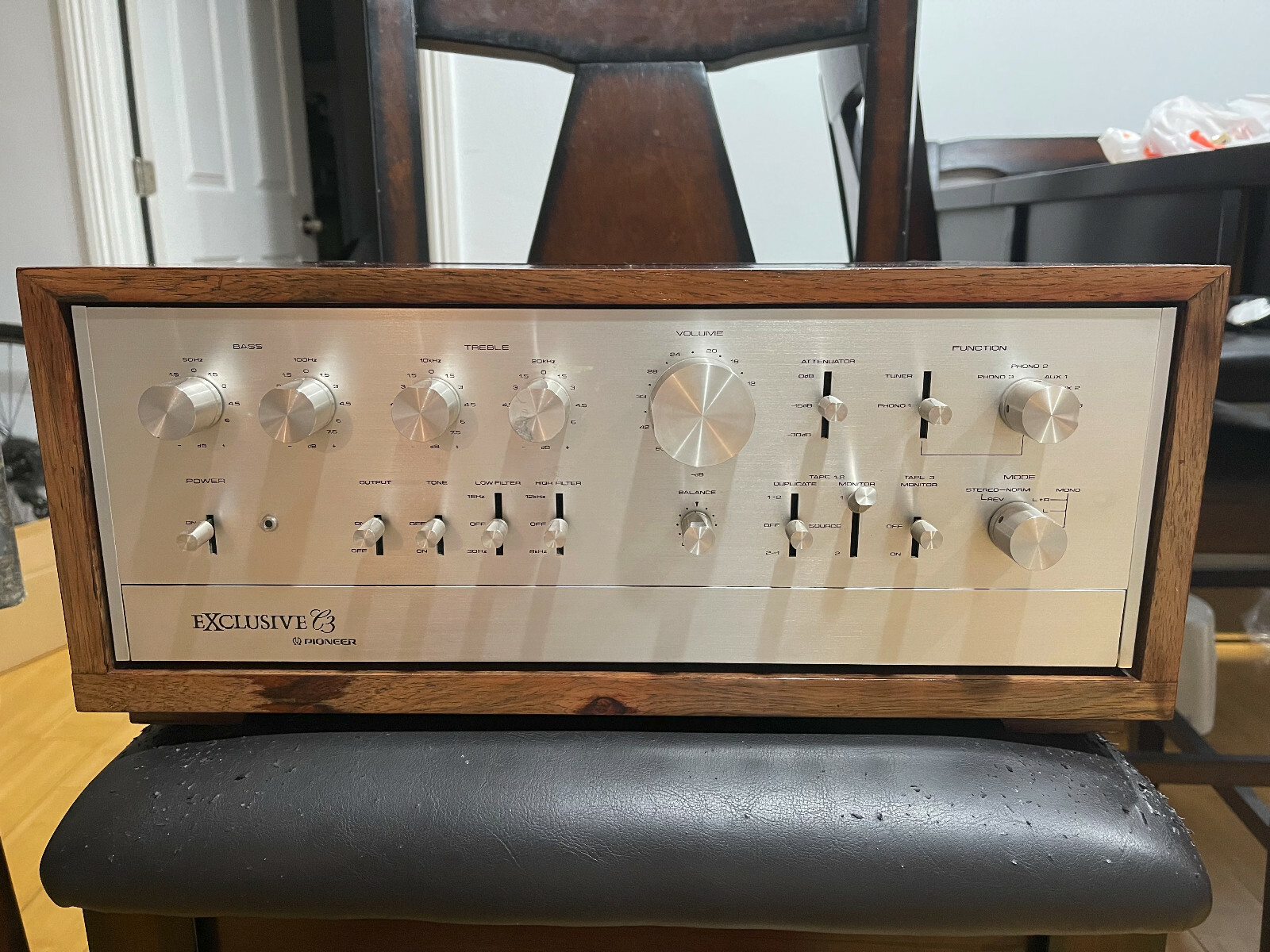
The EXCLUSIVE-C3 was built with a level of precision and attention to detail that set it apart from mainstream cassette decks. Housed in a sleek, minimalist chassis with a brushed aluminum front panel, the C3 exuded a sense of sophistication. Its layout was clean and functional, with large, well-damped transport controls and a prominent VU meter for level monitoring. The deck featured a full logic-controlled tape transport system, ensuring reliable and consistent operation with minimal mechanical wear.
One of the standout mechanical features was the direct-drive capstan system. Unlike belt-driven mechanisms common in lower-tier decks, the direct-drive design minimized speed fluctuations and provided superior wow and flutter performance. The C3 achieved a wow and flutter rating of just 0.025%, among the lowest in its class and comparable to professional studio equipment.
The tape transport used a three-head configuration: separate record, playback, and erase heads. This allowed for precise monitoring during recording (via the playback head) and ensured optimal head alignment for each function. The heads themselves were made by TDK, a trusted name in magnetic recording, and featured permalloy cores for high-frequency response and low distortion.
Audio Performance and Circuitry
Pioneer spared no expense in the audio circuitry of the EXCLUSIVE-C3. The deck supported both Dolby B and the newer Dolby C noise reduction systems, with Dolby C offering up to 20 dB of noise reduction in the high frequencies—significantly improving the signal-to-noise ratio on Type II (chrome) and Type IV (metal) tapes.
The C3 was fully compatible with all tape types: Type I (ferric), Type II (chromium dioxide), and Type IV (metal), automatically adjusting bias and equalization via a tape sensing system. This made it exceptionally user-friendly for audiophiles who wanted optimal performance without manual calibration.
Frequency response was impressive for a cassette deck: 20 Hz to 20 kHz for Type IV tapes at 3% THD, and 30 Hz to 18 kHz for Type I tapes. This wide bandwidth, combined with a dynamic range of 72 dB (Dolby C on metal tape), allowed the C3 to capture and reproduce music with remarkable clarity and detail.
Total harmonic distortion was kept below 1.5% across all tape types, and the signal-to-noise ratio reached 68 dB (unweighted) for metal tapes. These figures placed the EXCLUSIVE-C3 among the elite cassette decks of its time, competing directly with models from Nakamichi, Sony, and TEAC.
Advanced Features
The EXCLUSIVE-C3 included several features aimed at professional and semi-professional users. One such feature was the ability to record and play back in both directions (forward and reverse), a rare capability that allowed for seamless compilation tapes without rewinding. This bi-directional operation was made possible by a sophisticated head assembly that could switch polarity electronically.
Another advanced feature was the inclusion of a real-time counter with frame-accurate positioning, useful for editing and cueing. The counter could be reset to zero at any point, allowing users to mark specific sections of a tape for quick access.
The deck also featured a level calibration function, enabling users to align their tapes to reference levels using a calibration tape. This was particularly useful for archiving or duplicating recordings with consistent volume and fidelity.
Input and output connections included dual RCA jacks for line-level audio, as well as a 3.5mm stereo mini-jack for portable source integration. A remote control input allowed for integration with Pioneer’s high-end preamplifiers and system controllers, enhancing its role in a full-component audio setup.
Market Position and Legacy
The EXCLUSIVE-C3 was part of a small series that included the C1 (a more compact model) and the C5 (a professional variant). Despite its advanced features, the EXCLUSIVE line was short-lived, likely due to the rising popularity of digital formats like the Compact Disc, which began to gain traction in the mid-1980s.
As a result, the EXCLUSIVE-C3 is relatively rare today, especially in working condition. Its scarcity, combined with its high build quality and performance, has made it a sought-after item among vintage audio collectors and cassette enthusiasts.
Pioneer’s engineering in the C3 reflected a transitional moment in audio history—when analog tape technology reached its peak just before the digital revolution. The EXCLUSIVE-C3 stands as a testament to what was possible with analog cassette recording: high fidelity, mechanical precision, and user-centric design.
Conclusion
The Pioneer EXCLUSIVE-C3 is more than just a relic of the past; it represents the pinnacle of cassette deck engineering. With its direct-drive transport, three-head design, Dolby C support, and bi-directional playback, it offered capabilities that few consumer decks could match. While cassette tapes are no longer the dominant medium, the EXCLUSIVE-C3 remains relevant for audiophiles who appreciate the warmth and character of analog tape.
For those restoring vintage systems or exploring the golden age of home audio, the EXCLUSIVE-C3 is a worthy centerpiece. Its combination of elegance, performance, and innovation ensures its place in the pantheon of classic audio equipment. Whether used for digitizing rare recordings or simply enjoying music the analog way, the Pioneer EXCLUSIVE-C3 continues to deliver a listening experience that is both authentic and deeply satisfying.
eBay Listings
As an eBay Partner, we earn from qualifying purchases. This helps support our independent vintage technology research.
Related Models
- Pioneer SX-1500TD (1978)
- Pioneer C-77 (1977)
- Pioneer CT-3030E (1983)
- Pioneer CT-F4141A (1983)
- Pioneer CT-F5151 (1980)
- Sony TC-2050SD (1978)
- Aiwa AD-F990 (1993)
- Kenwood KX-3060 (1982)
- Sony TC-2130A (1974)
- Sony TC-2220 (1972)