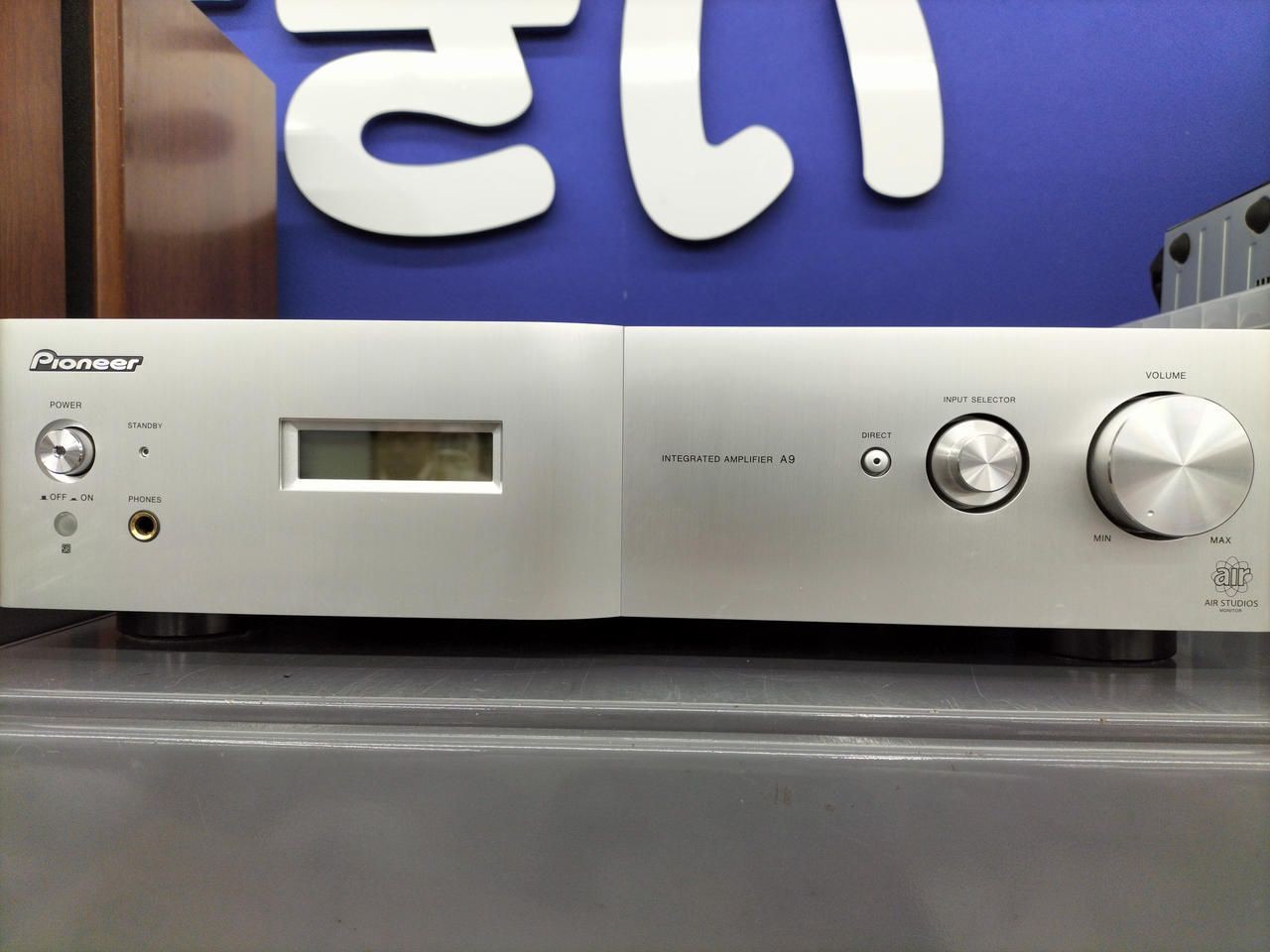
Pioneer A 9 (1985-1987)
Specifications
| Feature | Specification |
| Year of Production | 1985-1987 |
| Power Specifications | 80W per channel into 8Ω (stereo), 100W per channel into 4Ω |
| Impedance | 4-16Ω |
| Sensitivity | 150mV (line), 2.5mV (MM phono) |
| Key Features | Non-switching amplifier design, DC power supply, Direct Energy MOS-FET output transistors, dual power transformers, gold-plated connectors, motorized volume control, MM/MC phono stage, tone controls with defeat switch |
Historical Significance
When Pioneer launched the A 9 in 1985, they weren’t just releasing another amplifier—they were crowning their Elite series with a statement piece. As the flagship integrated of its era, the A 9 stood at the peak of Pioneer’s analog engineering, a final, glorious flex before digital began reshaping the audio world. Every circuit, every component was chosen with obsessive precision. This wasn’t just high fidelity—it was high philosophy in brushed aluminum and polished steel.
Sound Signature
Open, precise, and startlingly alive—that’s the A 9’s voice. Its non-switching amplifier design delivers a transparency that pulls you into the recording, revealing textures and spatial cues many amps simply gloss over. Bass is deep and tightly coiled, never bloated. Mids are neutral, vocals rendered with lifelike clarity. Highs sparkle without harshness. Whether you're spinning vinyl or feeding it a clean line source, the A 9 doesn’t color the sound—it reveals it.
Maintenance and Restoration Tips
Time hasn’t been kind to every part of the A 9’s otherwise bulletproof design. The motorized volume control, while slick in its day, is prone to wear and erratic behavior. Electrolytic capacitors often need replacing after decades of dormancy—don’t power it up without a check. Selector switches gather oxidation, leading to crackles and dropouts. The LED display can flicker or fail, and the thermal protection circuit sometimes trips unnecessarily if components drift out of spec. A full recapping and contact cleaning are almost always worth the investment.
Collectibility and Market Value
- Market Value: $600-$1200 depending on condition and cosmetic appearance
- Collectibility Rating: 8/10
eBay Listings



As an eBay Partner, we earn from qualifying purchases. This helps support our independent vintage technology research.
Related Models
- Pioneer CS-811 (1979)
- Pioneer KH-3500 (1979)
- Pioneer CS-53 (1978)
- Pioneer CS-545 (1979)
- Pioneer CS-66 (1979)
- Akai AM-2850 (1975)
- Akai AP-206 (1975)
- Nakamichi BX-1 (1985)
- Acoustic Research research-ar-17 (1978)
- Acoustic Research AR-19 (1994)