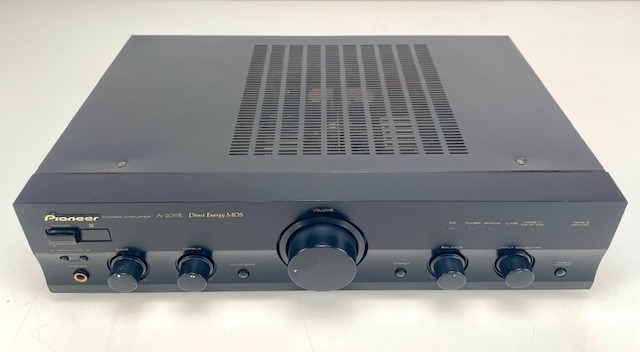
Pioneer A 307R (1987-1989)
Specifications
| Feature | Specification |
| Year of Production | 1987-1989 |
| Power Specifications | 40W per channel (8Ω, 20Hz-20kHz, 0.05% THD), 50W per channel (8Ω, 1kHz, 0.008% THD) |
| Impedance | 4-16Ω |
| Sensitivity | Unknown |
| Key Features | Non-switching amplifier design, DC servo circuitry, gold-plated RCA inputs, MM phono stage, tone controls, headphone output, aluminum front panel |
Historical Significance
Emerging in 1987, the Pioneer A 307R marked a quiet turning point in the company’s design language—swapping brushed silver for a sleek black finish, signaling the arrival of Pioneer’s 'R' series. This wasn’t just a cosmetic shift; it reflected a deeper engineering commitment. Built around a non-switching amplifier architecture, the A 307R delivered a cleaner signal path than many of its contemporaries, leveraging DC servo circuitry to eliminate output drift and tighten bass response. For audiophiles stepping away from the flash of the early ’80s, this amplifier offered a more refined, focused listening experience—right at the moment Pioneer was redefining its identity.
Sound Signature
Transparent and precise, the A 307R doesn’t call attention to itself. It renders vocals with clarity, handles transients with confidence, and maintains composure across the frequency spectrum. Distortion is impressively low, even at higher volumes, thanks to its robust power delivery and servo-controlled design. Whether driving efficient bookshelf speakers or more demanding floorstanders, it delivers a neutral, uncolored presentation—ideal for listeners who want the music, not the machine.
Maintenance and Restoration Tips
After three decades, the A 307R’s reliability hinges on a few common weak points. Electrolytic capacitors often need replacing—especially in the power supply—while potentiometers and selector switches benefit from careful cleaning to restore smooth operation. Relays, though generally durable, can develop contact noise over time. A full recapping and service not only ensures stable performance but also preserves the amplifier’s original sonic integrity. With proper care, this Pioneer can sound as solid today as it did in ’87.
Collectibility and Market Value
- Market Value: $100-$250 depending on condition and cosmetic appearance
- Collectibility Rating: 4/10
eBay Listings



As an eBay Partner, we earn from qualifying purchases. This helps support our independent vintage technology research.
Service Manuals & Schematics
- Manual — archive.org
Related Models
- Pioneer CS-811 (1979)
- Pioneer KH-3500 (1979)
- Pioneer CS-53 (1978)
- Pioneer CS-545 (1979)
- Pioneer CS-66 (1979)
- Akai AM-2850 (1975)
- Akai AP-206 (1975)
- Nakamichi BX-1 (1985)
- Acoustic Research research-ar-17 (1978)
- Acoustic Research AR-19 (1994)