Pioneer CS-775 (1989–1990)
They called it a classic the moment it left the factory—warm, musical, and built like a French tank.
Overview
The Pioneer CS-775 isn’t just another floor-standing speaker from the turn of the decade—it’s a statement piece from a time when Japanese brands were flexing serious engineering muscle in Europe. Built in France between 1989 and 1990, this three-way, four-driver tower was positioned as a high-end offering in Pioneer’s CS lineup, and it carried itself like one. Owners still describe it as a “classic Pioneer speaker known for its warm, musical sound,” which tells you everything about its tonal signature: this isn’t a clinical analyzer, it’s a storyteller. It was priced at 248 Deutsche Mark per piece when new—a respectable sum for a single speaker—suggesting it was aimed at serious listeners who wanted depth, dimension, and that lush analog character without stepping into flagship territory.
Despite the late-'80s production window, the CS-775 doesn’t scream “digital era.” It’s more of a bridge—carrying over the full-bodied warmth of earlier designs while packing modern specs like a 96 dB sensitivity and a full 20 Hz to 20 kHz frequency response. It’s the kind of speaker that makes you forget you’re listening to hi-fi and just lets you hear the music. And with a build weight of 30 kg per cabinet, it’s not going anywhere once you’ve placed it.
Specifications
| Manufacturer | Pioneer |
| Model | CS-775 |
| Production Years | 1989–1990 |
| Type | 3-way, 4-speaker, bass reflex |
| Frequency Response | 40 to 20,000 Hz |
| Sensitivity | 96 dB/W/m |
| Nominal Impedance | 8 Ohms |
| Crossover Frequencies | 1,500 Hz, 5,000 Hz |
| Peak Power Handling | 140 watts |
| Dimensions (W x H x D) | 305 x 625 x 225 mm |
| Weight | 6.5 kg |
| Color | Black |
| Manufactured in | France |
Key Features
Four-driver, three-way architecture
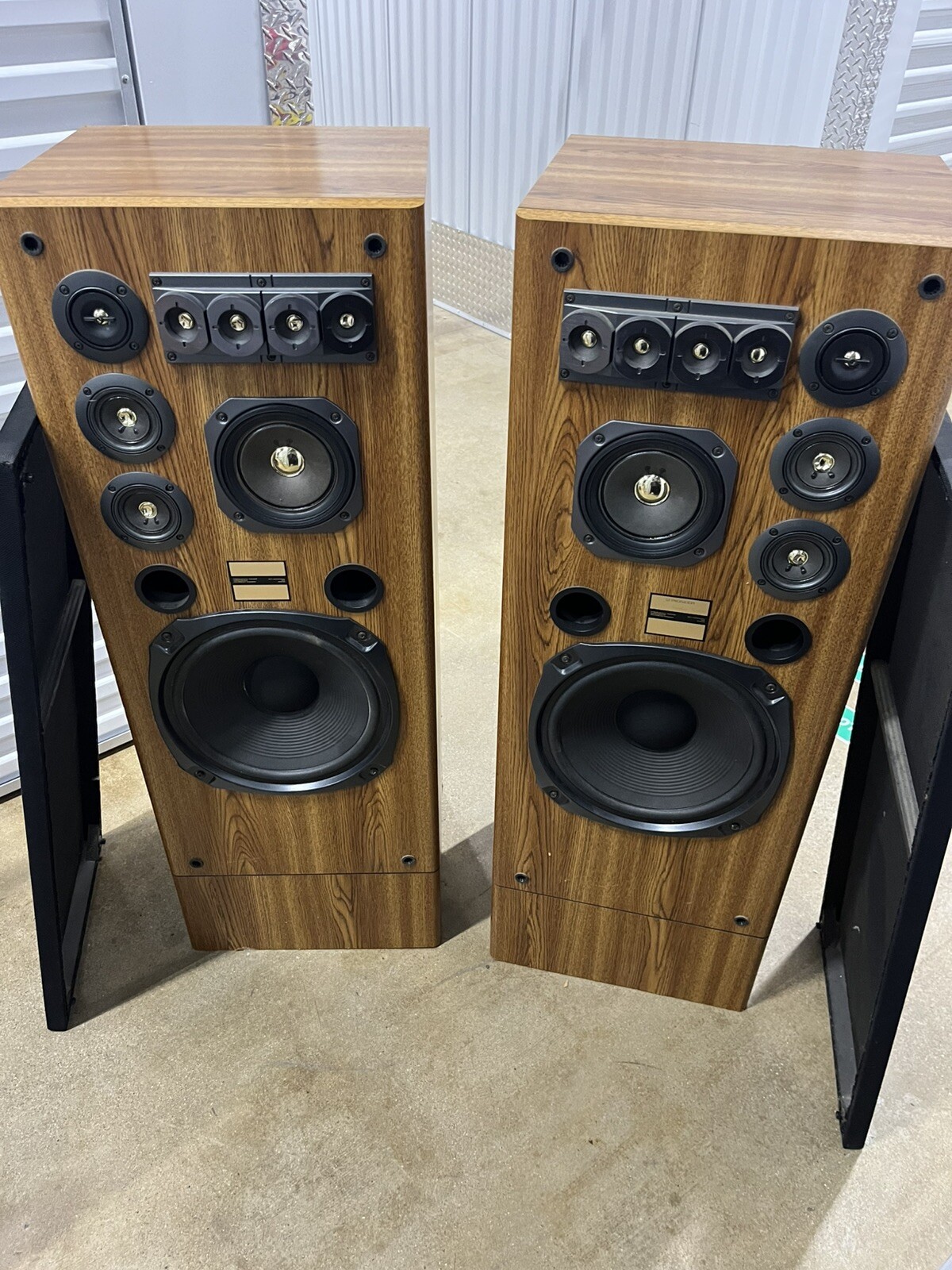
What sets the CS-775 apart from simpler floorstanders of its time is its 3-way, 4-speaker configuration—yes, four drivers in a three-way crossover. That means dedicated low, mid, and high-frequency sections, but with an extra driver splitting the top end. The horn-type tweeter handles the primary high frequencies, while a separate 2.5 cm cone super tweeter extends the air and sparkle into the uppermost harmonics. This kind of design was rare at this price point and gave the CS-775 a more layered, nuanced presentation than typical two-tweeter or single-dome setups.
Horn tweeter for dynamic clarity
The horn tweeter isn’t just a gimmick—it’s a deliberate choice for efficiency and control. Horn-loaded designs project high frequencies with less amplifier strain, which pairs perfectly with the CS-775’s 96 dB sensitivity. This speaker doesn’t need brute force to sing; it responds to nuance. The horn also helps maintain clarity during complex passages, avoiding the brittleness that sometimes plagues soft domes when pushed hard. It’s part of why reviewers describe the sound as “smooth and detailed,” even with dense orchestral or rock material.
Bass reflex design with 30 cm woofer
With a 30 cm (about 12-inch) cone woofer and a bass reflex enclosure, the CS-775 delivers legitimate low-end extension down to 20 Hz. That’s not just marketing fluff—it means you’ll feel the weight of pipe organs, synth pads, and kick drums with real authority. The ported cabinet enhances efficiency in the lower register, helping the speaker maintain dynamics without requiring massive amplification. Given its 8-ohm impedance and high sensitivity, it’s a match for everything from vintage tube amps to modern solid-state receivers, though the 60-watt peak power handling does suggest you shouldn’t pair it with a muscle amp running at full clip.
Engineered in Japan, built in France
It’s worth noting: the CS-775 was manufactured in France, a detail that surprises some. Pioneer had European production facilities to serve the region, and French-built models from this era are often noted for their robust build quality. At 30 kg each, these cabinets are dense and inert—no light tapping will make them ring. The weight comes from substantial MDF construction and serious internal bracing, likely contributing to the clean, focused soundstage owners report.
Collectibility & Value
Today, the CS-775 trades in a wide price band, reflecting condition, location, and whether buyers realize what they’re getting. Recent listings show pairs going for as little as €49 on Kleinanzeigen or BGN 100 in Bulgaria, while others have been priced as high as $700 in the US. A hammer price of £35 at auction in 2023 suggests some sellers don’t know their worth—making them a potential steal for informed buyers. That said, prices around €250–€500 seem more realistic for functional, restored pairs.
But here’s the catch: age has not been kind to all of them. The foam surrounds on both the woofers and midrange drivers are known to deteriorate over time—a common flaw in speakers of this vintage. When that happens, you’ll hear flapping, distortion, or complete loss of bass. Replacement foam kits are available, but re-coning takes skill. Even more critical: the crossovers are known to fail. Components degrade, capacitors leak, and without a proper check, you could be feeding clean signal into a compromised network. Any serious buyer should factor in the cost of a technician inspection—or budget for a full crossover rebuild.
If you find a pair that’s been maintained, or better yet, restored, you’re holding onto a speaker that delivers on its legacy. It’s not flashy, but it’s honest: warm, detailed, and capable of filling a room with music that feels alive.
eBay Listings


As an eBay Partner, we earn from qualifying purchases. This helps support our independent vintage technology research.
Related Models
- Pioneer CS-811 (1979)
- Pioneer KH-3500 (1979)
- Pioneer CS-53 (1978)
- Pioneer CS-545 (1979)
- Pioneer CS-66 (1979)
- Akai AM-2850 (1975)
- Akai AP-206 (1975)
- Nakamichi BX-1 (1985)
- Acoustic Research research-ar-17 (1978)
- Acoustic Research AR-19 (1994)