Pioneer PL-7 (1974)
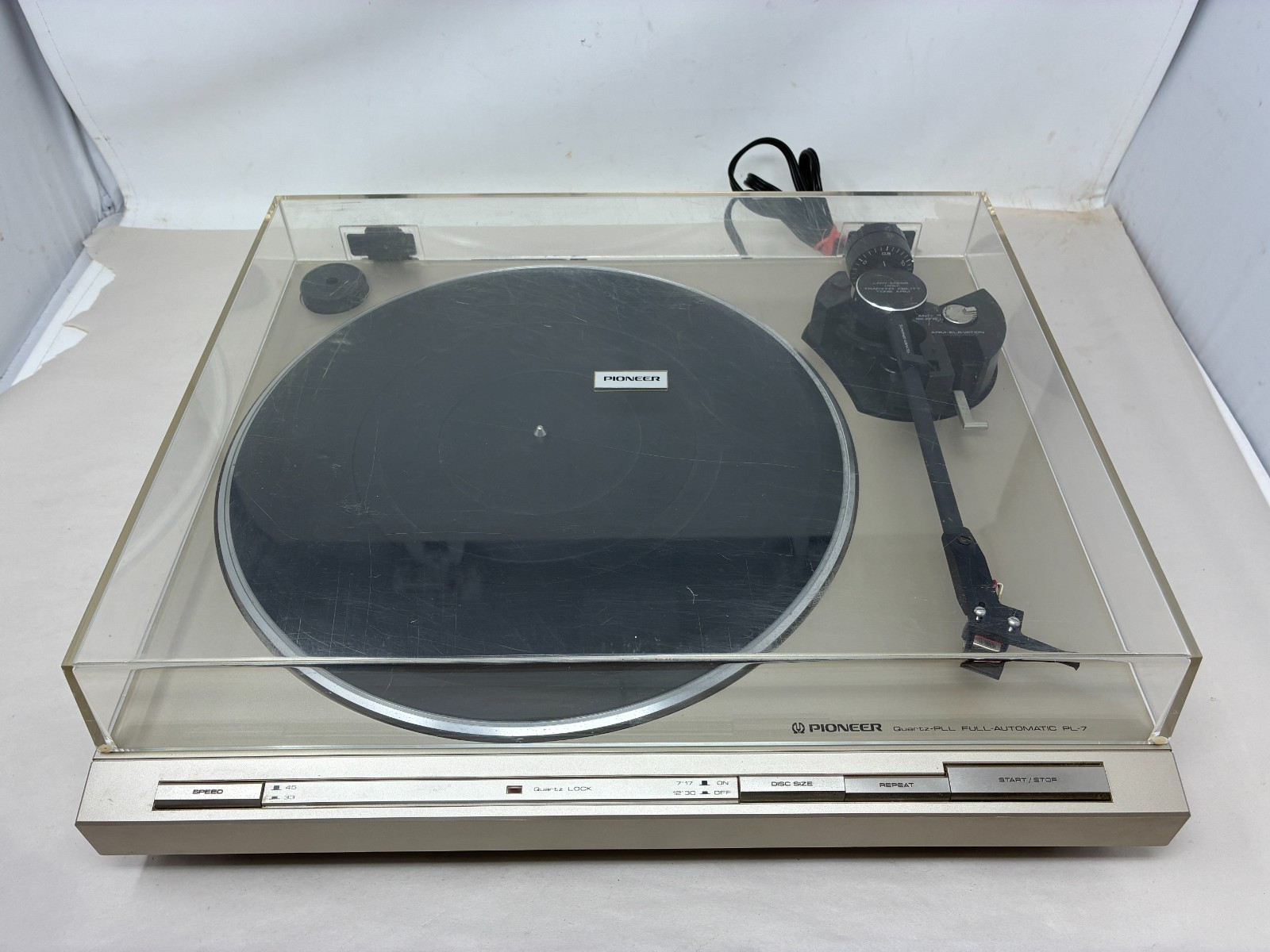
The Pioneer PL-7 is a vintage belt-drive turntable introduced in 1974 as part of Pioneer's growing line of high-fidelity audio equipment during the golden era of analog sound. Though not as widely recognized as some of its contemporaries from brands like Technics or Denon, the PL-7 stands out for its thoughtful engineering, reliable performance, and clean aesthetic design typical of mid-1970s Japanese audio gear.
Design and Build Quality
The Pioneer PL-7 features a minimalist, functional design with a matte black finish and a sleek aluminum platter. It was built with a focus on stability and vibration damping, utilizing a heavy die-cast aluminum platter supported by a low-resonance MDF plinth. The turntable’s chassis is mounted on three adjustable rubber-damped feet, allowing users to level the unit precisely—an important feature for maintaining consistent tracking and minimizing record wear.
One of the standout aspects of the PL-7 is its fully manual operation. Unlike later models with auto-start or auto-return functions, the PL-7 requires the user to manually lift and place the tonearm, offering a more tactile and engaging listening experience. This manual approach is appreciated by purists who value direct control over their playback process.
The tonearm is a straight, static-balanced design made of aluminum, with a effective length of approximately 230 mm. It features adjustable tracking force and anti-skate controls, allowing for fine-tuning based on the cartridge used. While not a gimbal or advanced gimbal design, the arm provides stable tracking with low resonance, making it suitable for a wide range of moving magnet (MM) cartridges.
Drive System and Speed Accuracy
The PL-7 uses a belt-drive system powered by a high-torque DC motor, which is decoupled from the main chassis to reduce vibration transmission. The belt drives a sub-platter connected to the main platter, ensuring smooth rotation with minimal wow and flutter. According to Pioneer’s original specifications, the wow and flutter are rated at less than 0.15%, which was competitive for its time and ensures stable pitch during playback.
The turntable supports two standard speeds: 33⅓ and 45 RPM. Speed selection is done manually via a mechanical switch on the front panel, with no electronic speed control or quartz lock system—features that would appear in later models like the PL-510 or PL-990. However, the PL-7 does include a precision strobe disc on the platter's edge, which works in conjunction with a small neon lamp on the chassis to allow users to visually verify and adjust rotational speed using a standard 60 Hz light source.
Cartridge and Tracking Performance
The PL-7 was typically shipped without a cartridge, allowing users to select their preferred model based on budget and performance goals. It was commonly paired with mid-tier moving magnet cartridges of the era, such as the Shure M97xE, Audio-Technica AT-12E, or even Pioneer’s own ceramic or magnetic offerings. The tonearm’s tracking force is adjustable from 0 to 5 grams, accommodating a wide range of cartridge requirements.
With a recommended tracking force of 2.5 to 3.0 grams and a vertical tracking angle (VTA) that can be adjusted manually by shimming the plinth or tonearm base, the PL-7 offers a degree of customization that enhances its compatibility with various record conditions and stylus profiles. The anti-skate mechanism, while basic, is effective in maintaining balanced lateral force during playback, reducing inner groove distortion.
Audio Performance and User Experience
In terms of sonic performance, the PL-7 delivers a warm, balanced sound typical of well-engineered Japanese turntables from the 1970s. The belt-drive system contributes to a low noise floor, resulting in a clean background that allows musical detail to emerge clearly. Bass response is tight and well-controlled, while midrange clarity makes it particularly well-suited for vocal and acoustic recordings.
Users often praise the PL-7 for its reliability and ease of maintenance. The belt, while subject to aging over decades, is easily replaceable with modern equivalents. The motor and bearing assembly are robust, and with regular cleaning and lubrication, many PL-7 units continue to operate smoothly more than 45 years after their manufacture.
Market Position and Legacy
Released in 1974, the PL-7 occupied a mid-tier position in Pioneer’s turntable lineup. It sat above entry-level models like the PL-3 and PL-5 but below high-end offerings such as the PL-1000 or later PL-990. Its target audience was the serious audiophile who wanted a no-frills, high-performance turntable without the complexity or cost of fully automatic or direct-drive systems.
At the time, Pioneer was establishing itself as a major player in the global hi-fi market, competing with brands like Sony, Yamaha, and Sansui. The PL-7 reflected the company’s commitment to quality engineering and value, offering performance that rivaled more expensive models from European and American manufacturers.
Today, the PL-7 is a sought-after unit among collectors and analog enthusiasts who appreciate vintage gear with solid build quality and analog charm. While it lacks the high-tech features of later turntables, its simplicity and reliability make it an excellent choice for those building a classic stereo system or restoring period-correct audio setups.
Restoration and Modern Use
For those looking to bring a vintage PL-7 back to life, the process is generally straightforward. The most common issues are belt degradation, dried lubricants in the motor or platter bearing, and dust accumulation in the tonearm wiring. Replacing the belt with a high-quality silicone or rubber equivalent is essential, and many online vendors offer exact-fit replacements.
Cleaning the platter and bearing spindle with isopropyl alcohol and applying a small amount of lightweight oil can restore smooth rotation. Checking the tonearm wiring for cracks or breaks—especially near the headshell—is also recommended, as these can lead to channel dropouts or intermittent sound.
Once restored, the PL-7 integrates well with modern phono preamps and receivers. Its output level and compatibility with standard MM cartridges make it a plug-and-play option in most contemporary setups. When paired with a quality cartridge and proper alignment, the PL-7 can deliver listening enjoyment that rivals many modern entry-level turntables.
Conclusion
The Pioneer PL-7 is a testament to the craftsmanship and engineering standards of 1970s Japanese audio manufacturing. Though overshadowed by more famous models, it remains a capable and reliable turntable that delivers excellent sound with minimal fuss. Its combination of solid construction, precise speed control, and user-friendly design makes it a worthy addition to any vintage audio collection.
Whether you're a seasoned collector or a newcomer to analog sound, the PL-7 offers a rewarding listening experience and a tangible connection to the history of high-fidelity audio. With proper care and maintenance, it continues to spin records with the same quiet confidence it had when first introduced in 1974.
eBay Listings


As an eBay Partner, we earn from qualifying purchases. This helps support our independent vintage technology research.
Related Models
- Pioneer PL-15R (1975)
- Pioneer PL-250 (1979)
- Pioneer PL-40 (1977)
- Pioneer PL-514 (1978)
- Pioneer PL-516 (1978)
- Luxman PD-272 (1983)
- Garrard 2025tc (1968)
- Onkyo CP-1010 (1976)
- Pioneer PL-61 (1973)
- Pioneer PL-6A (1977)