Pioneer PL-55 (1973)
The Pioneer PL-55 is a vintage belt-drive turntable introduced in 1973 by Japanese audio manufacturer Pioneer, during a golden era of analog audio equipment. Though not as widely documented as some of its more famous contemporaries, the PL-55 occupies a respected niche among audiophiles and collectors who appreciate its understated design, reliable performance, and mechanical precision. As part of Pioneer’s PL series of turntables, the PL-55 reflects the company’s commitment to high-fidelity sound reproduction and robust engineering during the 1970s.
Design and Build Quality
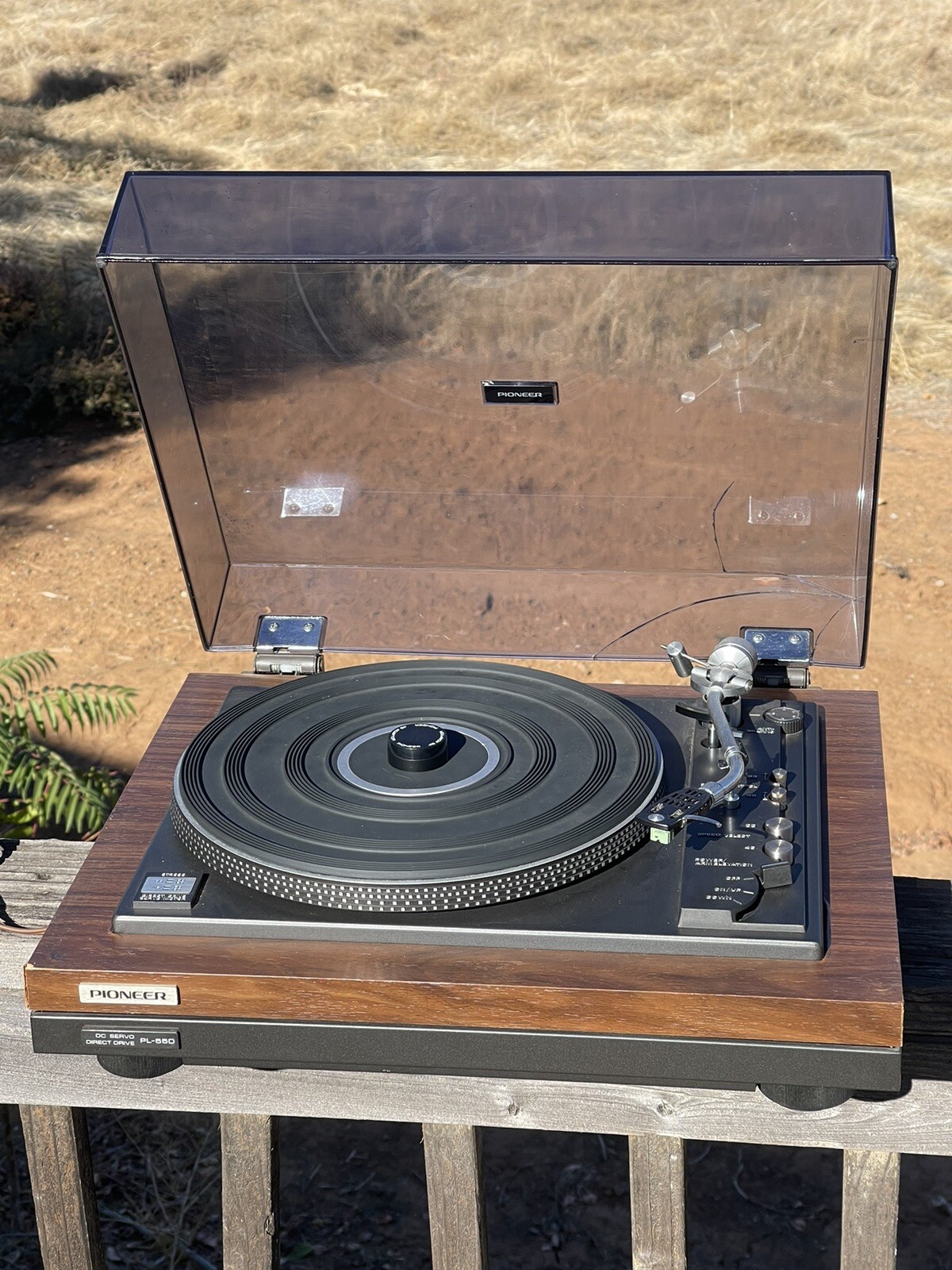
The PL-55 features a minimalist yet functional design typical of mid-tier to high-end turntables of the early 1970s. It is constructed with a heavy MDF (medium-density fiberboard) plinth, finished in a wood-grain vinyl wrap, lending it both aesthetic warmth and structural stability. The plinth helps dampen unwanted vibrations, contributing to cleaner audio playback. A removable dust cover is included, hinged at the back, allowing full access to the turntable while protecting the components when not in use.
The platter is made of die-cast aluminum, providing consistent mass and rotational inertia for stable speed performance. It rides on a precision spindle and ball bearing assembly, minimizing friction and wow/flutter. The belt-drive system, powered by a quiet AC motor, isolates motor vibrations from the platter, a key factor in reducing noise and maintaining signal purity.
Tonearm and Cartridge Compatibility
The PL-55 is equipped with a straight, static-balance tonearm made of aluminum alloy. The tonearm features manual cueing and a height-adjustable headshell, allowing users to fine-tune vertical tracking angle (VTA) for optimal cartridge alignment. While not as advanced as the gimbal or linear-tracking arms found on higher-end models, the tonearm on the PL-55 is well-damped and offers smooth movement across the record surface.
The turntable does not come with a factory-mounted cartridge. Instead, it is designed to accommodate a wide range of replaceable phono cartridges via a standard ½-inch mounting system. This modularity was a hallmark of quality turntables at the time, allowing users to upgrade or customize their cartridge based on preference and budget. Common compatible cartridges include models from Shure, Audio-Technica, and Stanton, with recommended tracking forces typically ranging from 1.5 to 2.5 grams.
Users are required to manually balance the tonearm and set anti-skate force, which is adjusted via a calibrated dial on the tonearm base. While this may seem daunting to beginners, it offers experienced listeners greater control over setup and sound quality.
Speeds and Drive System
The Pioneer PL-55 supports two standard playback speeds: 33⅓ and 45 RPM. Speed selection is done manually by physically moving the drive belt between two pulley steps on the motor shaft—a process that requires lifting the platter and repositioning the belt. While less convenient than electronic speed switching, this method ensures mechanical accuracy and eliminates potential electronic interference.
The belt-drive mechanism uses a high-quality rubber belt that couples the motor to the platter. Over time, this belt may degrade and require replacement, a common maintenance task for vintage turntables. Replacement belts are still available from specialty audio restoration suppliers.
Speed accuracy is generally excellent when the turntable is properly maintained. Independent tests from the era reported wow and flutter levels below 0.1%, which was competitive for its class. The motor is mounted off-center and isolated from the plinth to further reduce vibration transmission.
Audio Performance
In terms of sonic characteristics, the PL-55 delivers a balanced, detailed sound profile typical of well-engineered analog playback systems from the 1970s. The combination of a stable platter, low-resonance tonearm, and isolation-focused design results in a clean, dynamic presentation with good stereo imaging and low background noise.
When paired with a quality MM (moving magnet) cartridge, the PL-55 excels at reproducing midrange clarity and natural tonality, making it particularly well-suited for vocal recordings, jazz, and acoustic music. Bass response is tight and controlled, while high frequencies remain smooth without harshness—characteristics that align with the warm, analog sound many vinyl enthusiasts seek.
Connectivity and Integration
As a turntable, the PL-55 outputs a low-level phono signal and requires connection to a phono preamplifier before being fed into a line-level input on a receiver or amplifier. It does not have a built-in preamp. The signal is transmitted via color-coded RCA output cables (red for right channel, white for left), which are permanently attached and exit from the rear of the unit.
Grounding is provided through a separate terminal on the base, which must be connected to the grounding post on a receiver or preamp to prevent hum and static buildup. This is a standard requirement for most turntables of this era.
Market Position and Legacy
The PL-55 was positioned as a mid-to-upper-tier model in Pioneer’s turntable lineup during the early 1970s, sitting below flagship models like the PL-700 but above entry-level units such as the PL-30. It competed with similar offerings from brands like Technics (SL-1200 precursor models), Sony, and Kenwood. While not as mechanically advanced as some of its rivals, the PL-55 earned a reputation for durability, consistency, and value.
Today, the PL-55 is considered a solid choice for vintage audio enthusiasts looking for a reliable analog playback system without the premium price tag of more iconic models. It is not as commonly found on the secondhand market as Technics or Dual turntables, which adds to its appeal among collectors.
Restoration and Maintenance
For those restoring a PL-55, common maintenance tasks include replacing the drive belt, cleaning the platter and spindle, and inspecting the tonearm bearings for smooth operation. Lubrication of internal components should be performed sparingly and with appropriate oils to avoid attracting dust.
Cartridge alignment is best achieved using a protractor tool, and tracking force should be set with a precision scale. Given its age, checking the integrity of the internal wiring and RCA cables is also recommended, especially if the unit has been in storage for years.
Conclusion
The Pioneer PL-55 stands as a testament to the quality and craftsmanship of early 1970s Japanese audio engineering. While overshadowed in popularity by more famous models, it delivers excellent performance for its era and remains a capable analog source for vintage hi-fi systems. Its straightforward design, compatibility with a wide range of cartridges, and solid build make it a worthy addition to any record lover’s collection. For those who appreciate the tactile experience of manual operation and the warmth of analog sound, the PL-55 offers a rewarding listening experience that continues to resonate decades after its release.
eBay Listings


As an eBay Partner, we earn from qualifying purchases. This helps support our independent vintage technology research.
Related Models
- Pioneer PL-15R (1975)
- Pioneer PL-250 (1979)
- Pioneer PL-40 (1977)
- Pioneer PL-514 (1978)
- Pioneer PL-516 (1978)
- Luxman PD-272 (1983)
- Garrard 2025tc (1968)
- Onkyo CP-1010 (1976)
- Pioneer PL-61 (1973)
- Pioneer PL-6A (1977)