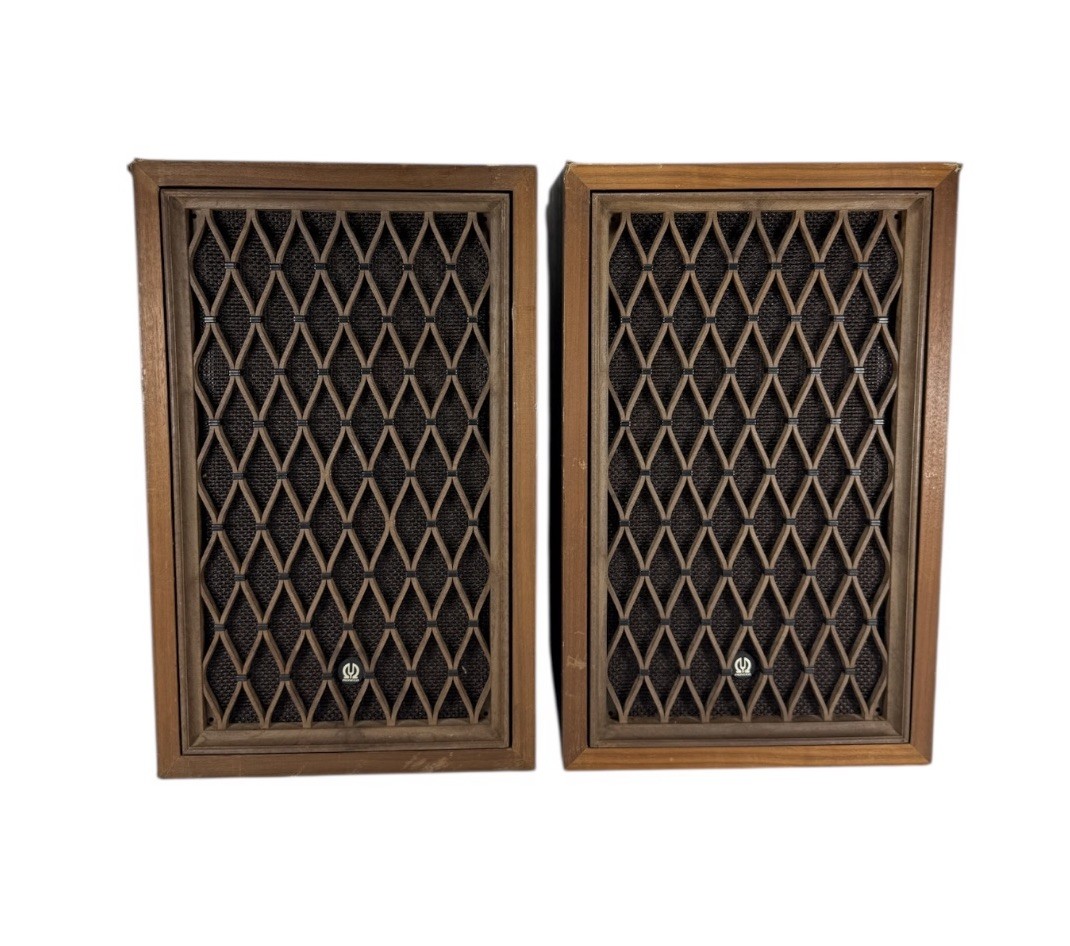
These speakers were designed during a golden era of audio equipment, when manufacturers emphasized both sonic performance and aesthetic craftsmanship. The CS-53 exemplifies this philosophy, offering a warm, natural sound signature and a classic woodgrain vinyl finish that made it a favorite among audiophiles and casual listeners alike.
Design and Build Quality
The CS-53 features a compact two-way speaker design, making it ideal for smaller rooms or as part of a secondary audio system. Its cabinet is constructed from medium-density fiberboard (MDF) with a woodgrain vinyl wrap, available primarily in a walnut or rosewood finish, giving it a timeless appearance that blends well with vintage and retro interiors. The front baffle is slightly angled, which not only adds to its visual appeal but also contributes to improved sound staging by directing sound toward the listener.
The cabinet is front-ported, with a single bass reflex port located at the bottom of the front baffle, aiding in low-frequency extension and efficiency.
The crossover network, located inside the cabinet, is a passive 2nd-order design, typically set around 3.5 kHz, ensuring a smooth transition between the woofer and tweeter.
Acoustic Performance
The Pioneer CS-53 has a nominal impedance of 8 ohms, making it compatible with a wide range of vintage and modern amplifiers, including tube amps and solid-state receivers from the 1970s and 1980s. It has a sensitivity rating of 94 dB (1W/1m), which is moderate for its class—meaning it performs best when paired with amplifiers delivering between 20 and 70 watts per channel. While not extremely efficient, the CS-53 responds well to quality amplification and can deliver a surprisingly dynamic and detailed sound.
Frequency response is rated from 45 Hz to 20 kHz, which was quite respectable for a bookshelf speaker of its size and era. The bass response is tight and well-controlled, though it naturally rolls off below 60 Hz due to the physical limitations of the cabinet size. The midrange is clear and articulate, making the CS-53 particularly well-suited for vocal and acoustic music. The tweeter delivers smooth highs without harshness, avoiding the "brittle" sound that plagued some speakers of the period.
One of the standout qualities of the CS-53 is its soundstage. When properly positioned and paired with a quality amplifier, it produces a wide and well-defined stereo image, with good instrument separation and depth. This makes it an excellent choice for critical listening, especially for jazz, classical, and vocal recordings.
Historical Context and Place in Pioneer’s Lineup
The CS-53 was part of Pioneer’s broader CS series, which included a range of speakers from compact bookshelf models to larger floor-standing units. This series was marketed as a high-fidelity line, emphasizing accurate sound reproduction and solid construction. During the 1970s, Pioneer was rapidly expanding its presence in the global audio market, competing with brands like Yamaha, Sony, and Technics. The CS series helped establish Pioneer as a serious contender in the hi-fi space.
While not positioned as a flagship model (that honor went to larger models like the CS-99A or CS-100A), the CS-53 offered a compelling balance of performance and affordability. It was often sold as part of matched stereo pairs and sometimes included in console systems or bundled with Pioneer receivers such as the SA-530 or SX-1980.
Compatibility and Modern Use
Today, the Pioneer CS-53 remains a sought-after speaker among vintage audio enthusiasts. Its 8-ohm impedance and moderate sensitivity make it compatible with many classic receivers and integrated amplifiers from the 1970s and 1980s. It pairs particularly well with tube amplifiers, which complement its warm tonal character.
For modern setups, the CS-53 can be used with contemporary amplifiers, though care should be taken not to overdrive them, as the original components may degrade with age. Many owners choose to re-foam the woofers or replace the tweeters to restore performance, as the foam surrounds can dry out and disintegrate after decades of use.
While not ideal for home theater or bass-heavy modern music, the CS-53 excels in two-channel stereo listening. It is well-suited for genres like acoustic folk, jazz, classical, and classic rock. When set up correctly—ideally on sturdy speaker stands and positioned with some toe-in—the CS-53 can deliver a listening experience that rivals much more expensive modern speakers in its size class.
Legacy and Collectibility
Though not as widely documented as some of Pioneer’s flagship models, the CS-53 has developed a quiet cult following. Its combination of solid build, attractive design, and musical sound makes it a rewarding find for collectors and audiophiles on a budget. Complete pairs in good condition, especially those with original grilles and undamaged cabinets, can fetch between $150 and $300 on the secondary market, depending on condition and location.
The CS-53 also represents an important period in audio history—the transition from the early stereo era to the high-fidelity boom of the late 1970s. It reflects the design priorities of the time: natural sound, durability, and aesthetic integration into the home.
Conclusion
The Pioneer CS-53 is a quintessential vintage bookshelf speaker that delivers more than its modest size and price point might suggest. With its warm, balanced sound, elegant woodgrain finish, and solid construction, it remains a compelling option for anyone exploring classic audio gear. Whether used as part of a period-correct stereo setup or as a nostalgic addition to a modern system, the CS-53 continues to offer a listening experience rooted in the golden age of hi-fi. For those who appreciate the craftsmanship and sonic character of 1970s audio, the Pioneer CS-53 is a worthy and enduring choice.
eBay Listings



As an eBay Partner, we earn from qualifying purchases. This helps support our independent vintage technology research.
Related Models
- Pioneer CS-811 (1979)
- Pioneer KH-3500 (1979)
- Pioneer CS-545 (1979)
- Pioneer CS-66 (1979)
- Pioneer CS-775 (1979)
- Akai AM-2850 (1975)
- Akai AP-206 (1975)
- Nakamichi BX-1 (1985)
- Acoustic Research research-ar-17 (1978)
- Acoustic Research AR-19 (1994)