Pioneer PL-512 (1978)
The Pioneer PL-512 is a belt-drive turntable introduced in 1978 as part of Pioneer’s mid-to-high-end audio equipment offerings during the golden era of analog sound. Though not as widely recognized as some of its contemporaries from brands like Technics or Denon, the PL-512 represents a well-engineered, no-nonsense approach to vinyl playback, emphasizing reliability, low wow and flutter, and accurate speed stability. It was designed for audiophiles and serious listeners who valued consistent performance and durable construction in their turntables.
Design and Build Quality
The PL-512 features a minimalist yet functional design typical of late 1970s Japanese audio equipment. It has a solid MDF (medium-density fiberboard) plinth with a matte black finish, providing excellent damping characteristics to minimize resonance and vibration. The turntable sits on three adjustable rubber-damped feet, allowing users to level the unit on uneven surfaces and further isolate it from external vibrations.
One of the standout features of the PL-512 is its full-sized 300 mm (11.8 in) aluminum platter, which contributes to excellent rotational inertia and stable speed performance. The belt-drive system uses a high-quality rubber belt to connect the platter to a low-vibration DC motor, reducing the transmission of motor noise to the stylus and improving overall sound clarity.
The turntable’s dust cover is a two-piece hinged design, typical of the era, allowing it to fold flat when open and fully enclose the platter and tonearm when closed. While not acoustically inert, the cover helps protect the delicate components from dust and accidental damage.
Tonearm and Cartridge
The PL-512 is equipped with a straight, static-balanced tonearm approximately 9 inches in length, constructed from lightweight aluminum tubing. The tonearm features precision ball bearings for smooth azimuth and vertical movement, and it includes adjustable counterweight and anti-skating controls for proper tracking force calibration. While not a gimbal or advanced bearing design, the tonearm offers sufficient rigidity and low friction for accurate groove tracking.
Pioneer did not include a cartridge with the PL-512 as standard; it was sold as a turntable-only component, allowing users to pair it with their preferred phono cartridge. However, many units were bundled with mid-tier moving magnet (MM) cartridges in retail packages. Compatible cartridges typically fall in the 1.0 to 2.5 gram tracking force range, and the tonearm’s effective mass makes it well-suited for a wide range of MM cartridges available during the late 1970s and early 1980s.
The tonearm also features a removable headshell with a standard SME-style mounting interface, making cartridge installation and replacement straightforward. This modular design was a hallmark of higher-end turntables at the time and allowed for easy upgrades.
Speed Control and Motor System
The PL-512 supports two standard playback speeds: 33⅓ and 45 RPM. Speed selection is handled via a mechanical switch on the front panel, which physically moves the belt between two pulley steps on the motor shaft. This dual-pulley system ensures precise speed calibration and minimizes slippage.
The turntable uses a low-rotation DC motor with electronic speed stabilization. While not quartz-locked like some higher-end models (e.g., the Pioneer PL-530 or PL-990), the PL-512 maintains excellent speed consistency, with wow and flutter measurements typically below 0.15%, well within acceptable limits for high-fidelity playback.
A manual start/stop button is located on the front right edge of the plinth, allowing for quick operation. The platter takes approximately 2–3 seconds to reach full speed, and braking is passive, relying on natural friction and motor resistance.
Technical Specifications
- Turntable Type: Belt-drive, manual
- Platter: 300 mm aluminum, 1.8 kg
- Motor: Low-noise DC motor with dual-step pulley
- Speeds: 33⅓, 45 RPM
- Wow and Flutter: < 0.15% (WRMS)
- Tonearm: 9-inch straight aluminum, pivoted
- Effective Arm Length: 229 mm
- Overhang: 18 mm
- Tracking Force Range: 1.0 – 2.5 grams
- Anti-Skating: Adjustable (calibrated dial)
- Cartridge Compatibility: Moving Magnet (MM), user-installed
- Signal-to-Noise Ratio: > 60 dB (typical with MM cartridge)
- Dimensions: 450 mm (W) × 360 mm (D) × 145 mm (H)
- Weight: 6.8 kg (15 lbs)
- Power Supply: 120V AC, 60 Hz (North American version)
Performance and Sound Characteristics
The PL-512 delivers a balanced and neutral sound signature, characteristic of well-designed Japanese turntables from the late 1970s. Its belt-drive system ensures low background noise, allowing subtle details in recordings to emerge clearly. The substantial platter contributes to excellent speed stability, minimizing pitch fluctuations and enhancing rhythmic precision.
Users often report a clean midrange, extended highs without harshness, and a tight, controlled bass response—particularly when paired with a high-compliance MM cartridge. The turntable’s rigid construction and effective damping help reduce resonance, resulting in a focused soundstage and good instrument separation.
While not as sonically refined as flagship models with suspended subchassis or advanced isolation systems, the PL-512 holds its own against competitors in its class, such as the Sony PS-LX3 or the Yamaha GT-500. It lacks the wow-and-flutter correction of quartz-locked models but remains a reliable and musically satisfying performer.
Market Position and Legacy
Released during a period of intense innovation in turntable design, the PL-512 occupied a mid-tier position in Pioneer’s turntable lineup. It was positioned above entry-level models like the PL-300 but below high-end offerings such as the PL-530 and PL-990. Its straightforward design and lack of automation (e.g., no auto-lift or tonearm return) reflect its focus on manual operation and audiophile-grade performance.
Today, the PL-512 is considered a solid vintage turntable for collectors and vinyl enthusiasts on a budget. While not rare, it is less commonly found than other Pioneer models, partly due to its niche positioning. Replacement parts—especially the drive belt—are still available from specialty audio restoration suppliers, and the turntable is relatively easy to service.
Conclusion
The Pioneer PL-512 is a testament to the engineering standards of late 1970s Japanese audio manufacturing. It combines thoughtful design, robust construction, and accurate performance in a package that remains functional and enjoyable decades later. While it may not boast the advanced features of Pioneer’s flagship models, it delivers excellent value for those seeking a no-frills, reliable turntable for everyday vinyl listening.
For vintage audio enthusiasts, the PL-512 offers a window into a pivotal era in analog playback technology. With proper maintenance—particularly belt replacement and bearing lubrication—it can continue to provide high-quality sound for years to come. Whether used as a secondary turntable, a restoration project, or a nostalgic addition to a classic stereo setup, the Pioneer PL-512 remains a worthy representative of its time.
eBay Listings



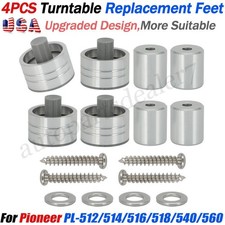
As an eBay Partner, we earn from qualifying purchases. This helps support our independent vintage technology research.
Related Models
- Pioneer PL-15R (1975)
- Pioneer PL-250 (1979)
- Pioneer PL-40 (1977)
- Pioneer PL-514 (1978)
- Pioneer PL-516 (1978)
- Luxman PD-272 (1983)
- Garrard 2025tc (1968)
- Onkyo CP-1010 (1976)
- Pioneer PL-61 (1973)
- Pioneer PL-6A (1977)