Phase Linear 400 (1972)
There is a hypnotic rhythm to the LED bar graphs dancing across the faceplate, pulsing in sync with the music's dynamic peaks.
Overview
In the landscape of 1972 high-power amplifiers, the Phase Linear 400 stood as a beacon of accessible muscle. While the flagship Model 700 commanded prices that strained household budgets, the 400 offered nearly identical architectural philosophy at a list price just under $500. This positioning made it the sweet spot for enthusiasts who demanded the company's signature brushed aluminum aesthetic and massive power reserves without the financial burden of the top-tier unit. Owners report that the unit exudes a particular kind of confidence, not merely through its wattage ratings but through the visual feedback of the output display.
The engineering team leveraged 16 bi-polar transistors in the output stage, running a quasi-complementary configuration that allowed for robust current delivery. Documentation shows the amp measures more than 270 watts per channel into an 8 ohm load, exceeding its marketed 200 watts per channel rating. This excess headroom was a hallmark of the era's "muscle amp" competition, where manufacturers sought to prove solid-state technology could match or surpass the dynamic capability of tube counterparts. The 400 became Phase Linear's most popular amplifier due to this adequate power and a price tag roughly two-thirds that of the 700.
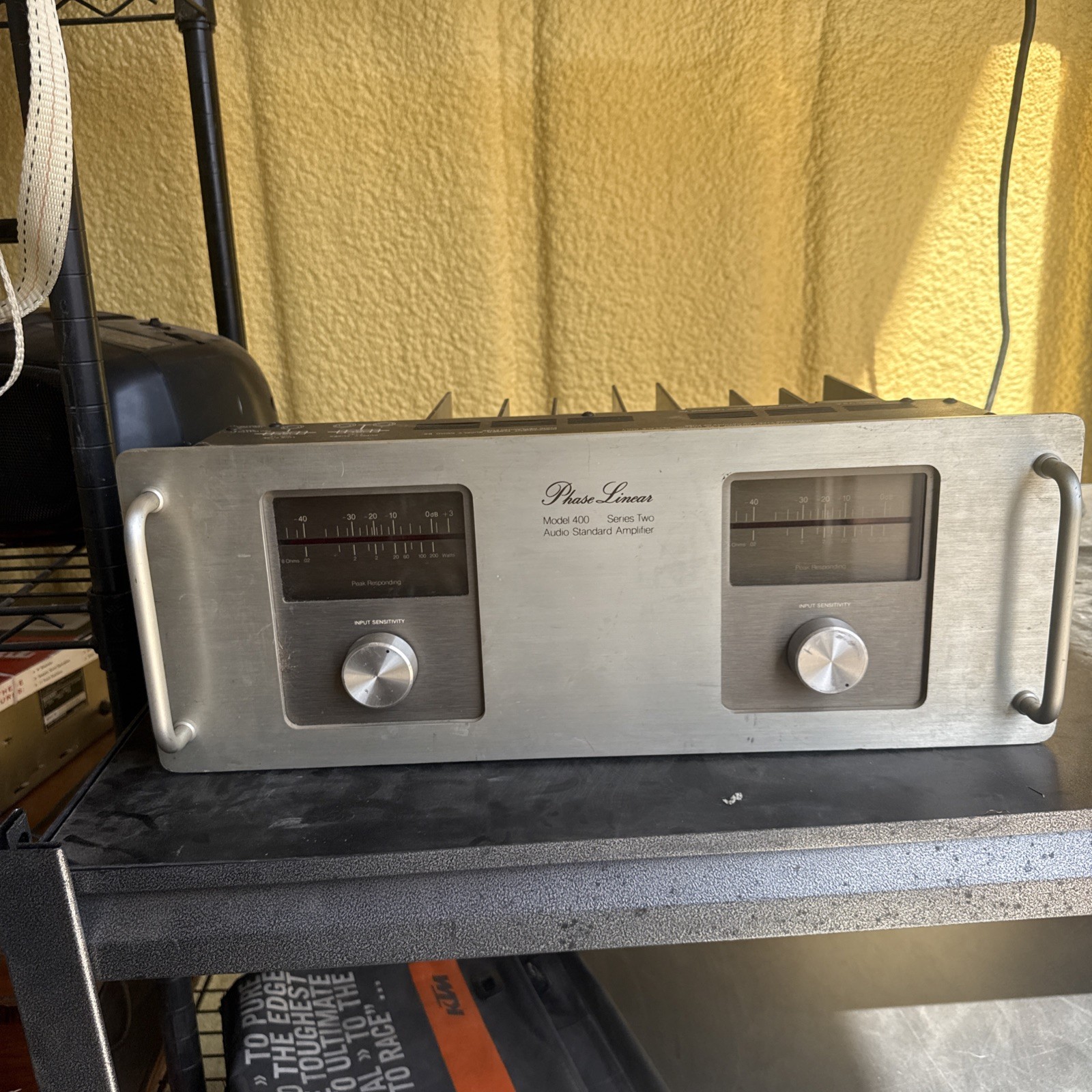
Visually, the unit shares the distinctive brushed aluminum front panel style as the 700, yet distinguishes itself with fast LED displays for wattage output rather than traditional analog VU meters. This digital visualization of power consumption became a bonding point for owners, turning the listening experience into a visual performance. However, the design lacked proper protection circuitry, leading to frequent failures under heavy use. Service technicians observe that the nickname "Flame Linear" is well earned, as the amps have been known to overheat dramatically when driven continuously without thermal safeguards.
Specifications
| Manufacturer | Phase Linear (Edmonds, WA) |
| Production Years | 1972 - 1978 (Series II updates) |
| Original List Price | Just under $500 (1972) |
| Channel Configuration | Sterbo Power Amplifier |
| Power Output (8 ohms) | Greater than 200 watts/channel RMS |
| Power Output (4 ohms) | 400 watts/channel RMS |
| Power Output (16 ohms) | 125 watts/channel |
| Power at Clipping (8 ohms) | Typically 250 watts/channel RMS |
| Measured Output (8 ohms) | More than 270 watts/channel |
| Frequency Response | 12 Hz to 40 kHz (+0 -1 dB) |
| Total Harmonic Distortion | 0.09% @ rated power (1000 Hz) |
| Intermodulation Distortion | Less than 0.09% (60 Hz : 7 kHz = 4 : 1) |
| Signal to Noise Ratio | 110 dB (IHF A-weighted) |
| Residual Noise | 120 microvolts (IHF A-weighted) |
| Damping Factor | 1000:1 @ 1000 Hz |
| Input Sensitivity | 1.0 Volt RMS @ rated power |
| Input Impedance | 33K ohms minimum |
| Speaker Load Impedance | 4 ohm or greater |
| Slew Rate | Better than 18 Volts/microseconds |
| Rise Time (Small Signal) | Less than 4.0 microseconds |
| Power Consumption | 1200 watts (10 Amps) maximum |
| Dimensions | 483 x 178 x 254 mm (19 x 7 x 10 inch) |
| Weight | 16 kg (35 lb) |
| Output Stage | 16 Bi-polar Transistors (Quasi-complementary) |
Key Features
LED Wattage Display
The front panel features multi-LED output meters that provide real-time visualization of power delivery. Unlike the analog VU meters found on the Model 700, these solid-state indicators react instantly to transient peaks. Collectors note that this feature transforms the amplifier from a passive component into an active participant in the room's ambiance. The lights pulse with the music's dynamics, offering a visual confirmation of the unit's massive headroom. While some modern enthusiasts prefer the nostalgia of mechanical needles, the LED array remains a defining characteristic of the 400's identity.
Quasi-Complementary Output
The output stage utilizes 16 bi-polar transistors arranged in a quasi-complementary configuration. This architecture was chosen to deliver high current without the complexity of fully complementary pairs, which were cost-prohibitive at the time. Documentation shows this design contributes to the damping factor of 1000, ensuring tight control over speaker drivers. The sheer transistor count allows the amp to measure more than 270 watts per channel into an 8 ohm load, often surpassing competitors rated at similar wattages. Owners report that the 400 sounds louder and more powerful than most other amps rated at 200 watts per channel, suggesting the power supply and output stage efficiency were optimized beyond typical industry standards.
Thermal Design and Risks
The original design lacked protection circuitry, a decision made to preserve signal purity but one that invited reliability issues. Service technicians observe that under heavy use, the amps have been known to catch fire, earning the nickname "Flame Linear." The chassis relies on passive cooling through the large aluminum faceplate and rear heatsinks, but continuous high-power drive can exceed thermal limits. This vulnerability is a critical consideration for collectors, as the absence of protection means a single DC offset failure can destroy expensive speakers. The severity of this flaw drives the restoration market, where modern upgrades are often deemed necessary before regular operation.
Historical Context
The Phase Linear 400 emerged during the "muscle amp" era of the early 1970s, a period when manufacturers competed to prove solid-state technology could deliver unprecedented power levels. Competitors like Crown and Kenwood were pushing wattage ratings to attract enthusiasts who had previously relied on tube amplifiers for dynamic range. Phase Linear positioned itself as a premium alternative, offering high power with a distinctive industrial aesthetic. The 400 was introduced in 1972 with a list price just under $500, making it accessible to serious audiophiles who might have balked at the flagship 700's cost.
This model represented Phase Linear's second amplifier release, following the establishment of their brand identity with high-power designs. The industry moment was defined by a shift toward high-current capability, driven by the popularity of low-efficiency speakers that demanded robust amplification. The 400's frequency response of 12 Hz to 40 kHz catered to the emerging interest in deep bass extension and high-frequency detail, specifications that were considered aggressive for the time. While competitors treated 30 watts as luxury, Phase Linear treated 200 watts as the baseline for professional performance.
The 4000 Series Auto-correlation Pre-Amplifier followed this product, creating a matched system that leveraged the power amp's capabilities. However, the 400 remained the most popular amplifier due to its balance of performance and price. It solidified Phase Linear's reputation as a builder of high-power amps, known for their powerful performance and unique design. The historical significance lies in its role as one of the first commercially available high-power amplifiers, setting a benchmark for what solid-state gear could achieve in a home setting.
Collectibility & Value
Phase Linear amplifiers are highly regarded and can be quite valuable, especially if they are in excellent condition and come with original components. Market insights suggest checking completed auctions for current values, as listings vary widely based on restoration status. A tested unit with original box recently transacted around $595, but untested or faulty examples drop significantly due to the known reliability risks. The value is tied directly to the operational safety of the unit, not merely its cosmetic appeal.
Common failures include weak or distorted channels, often ending up being the bias transistor for that channel. Owners report that rebuilding these amplifiers using modern components yields positive experiences, though it raises the question of whether the restored unit remains a Phase Linear product. The White Oak Audio kit is highly praised for restoring and upgrading Phase Linear amplifiers, addressing the infamous reliability issues. This kit adds protection circuits and replaces key components, mitigating the risk of thermal failure. Collectors note that a rebuilt unit with protection circuitry is more desirable than an original unmodified example, despite the deviation from factory specification.
Buying advice dictates a thorough inspection before purchase. Bring a flashlight and examine the faceplate at a raking angle to check for scratches or pitting in the brushed aluminum, as refinishing is difficult. Listen for distortion at low volumes, which may indicate bias issues. Verify the LED display functionality, as replacement parts for the visual metering are scarce. Maintenance budgets should include the cost of a restoration kit if the unit is unmodified, as running a raw 400 without protection is a gamble. Service technicians recommend reading technical design handbooks before attempting reinvention of the wheel, suggesting professional modification is safer than DIY experimentation for those unfamiliar with high-voltage audio circuits.
eBay Listings



As an eBay Partner, we earn from qualifying purchases. This helps support our independent vintage technology research.
Related Models
- Luxman L-530 (1975)
- Luxman R-404 (1975)
- Luxman RV-371 (1975)
- Luxman SQ-38U (1975)
- Luxman T-14 (1972)
- Luxman T-530 (1975)
- Luxman TX-101 (1975)
- Denon DRA-800 (1985)
- Denon PMA-350Z (1980)
- Denon POA-1500 (1979)