Onkyo TX-6500MKII: The Audiophile’s Tuner and Preamp Hybrid
In the early 1980s, Onkyo solidified its reputation as a builder of high-value, high-performance audio gear with a series of tuners and receivers that combined advanced engineering with a no-nonsense, audiophile-first design philosophy. Among these, the Onkyo TX-6500MKII stands out as a unique and often overlooked gem—a hybrid FM tuner and preamplifier that delivered exceptional broadcast reception and preamp functionality in a single, compact chassis. Though not a full receiver with built-in amplification, the TX-6500MKII carved a niche among discerning listeners who valued pure signal quality, precise tuning, and modular system building.
Released in 1982 as an upgrade to the original TX-6500, the MKII version refined an already impressive design with improved circuitry, better shielding, and subtle enhancements to the user interface. Positioned between Onkyo’s more basic tuners and their flagship integrated receivers, the TX-6500MKII was aimed at serious listeners who wanted to pair a top-tier tuner with a separate power amplifier—offering the flexibility and performance benefits of a component-based system.
Technical Specifications
| Specification | Detail |
| Model | TX-6500MKII |
| Year of Release | 1982 |
| Manufacturer | Onkyo Corporation, Japan |
| Category | FM Tuner / Preamplifier Hybrid |
| Tuner Type | Superheterodyne, PLL Synthesized |
| Tuning Range (FM) | 87.5–108 MHz |
| Tuning Steps | 50 kHz, 100 kHz, 200 kHz selectable |
| IF Frequency | 10.7 MHz |
| Signal-to-Noise Ratio | 70 dB (mono), 65 dB (stereo) |
| Total Harmonic Distortion | <0.1% (at full output) |
| Output Level | 250 mV (standard line-level) |
| Input Impedance | 47 kΩ |
| Output Impedance | 600 Ω |
| Power Output | 100 watts per channel, min. |
| Speaker Impedance | Not applicable (no built-in amplifier) |
| Power Supply | AC 120V, 60Hz (North American version) |
| Dimensions (W×H×D) | 420 × 149 × 320 mm (16.5 × 5.9 × 12.6 in) |
| Weight | 9.5 kg (20.9 lbs) |
| Inputs | 2 Line-level (RCA), Tape In |
| Outputs | Main Out, Tape Out, Headphone (6.3mm) |
| Tuning Display | Analog dial with digital frequency readout |
| Special Features | AFC, Muting, Stereo Indicator, Headphone Amp, Level Meter |
Sound Characteristics and Performance
The TX-6500MKII was engineered with a focus on clarity, low noise, and dynamic range—qualities that made it a favorite among FM broadcast enthusiasts during the golden era of high-fidelity radio. Its PLL (Phase-Locked Loop) synthesized tuning system provided exceptional frequency stability, eliminating the drift common in analog-tuned units of the era. This allowed for precise station selection and rock-solid reception, even in fringe signal areas.
The tuner section employed a double-conversion superheterodyne design, which helped reject adjacent channel interference and image frequencies—critical for clean reception in urban environments. Combined with a high-quality front-end RF amplifier and effective shielding, the TX-6500MKII delivered excellent sensitivity and selectivity, capable of pulling in weak stations with remarkable clarity.
As a preamplifier, the TX-6500MKII offered low-noise JFET input stages and a clean, transparent signal path. Its 50W line-level output (when driving an external power amp) ensured ample gain without coloration, making it ideal for pairing with high-end amplifiers of the period such as those from Marantz, Technics, or even higher-end Onkyo models like the M-5000.
Stereo imaging was precise, with a wide soundstage and excellent channel separation. The built-in stereo indicator and tuning meter provided visual feedback for optimal reception, helping users fine-tune their antenna setup for the best possible signal-to-noise ratio.
Notable Features and Innovations
The TX-6500MKII was packed with features that were advanced for its time:
- Selectable Tuning Steps: Users could choose between 50, 100, or 200 kHz steps, accommodating both Japanese (50 kHz spacing) and international (100–200 kHz) broadcast standards.
- AFC (Automatic Frequency Control): This feature automatically corrected minor frequency drift, ensuring consistent tuning without manual adjustment.
- Muting Circuit: Reduced noise during tuning or weak signal conditions, enhancing listening comfort.
- High-Visibility Tuning Meter: A large, centrally located analog dial with a digital frequency readout provided both aesthetic appeal and functional precision.
- Headphone Amplifier: A dedicated 6.3mm headphone jack with its own amp stage allowed private listening without compromising signal quality.
- Tape Monitoring and Bypass: Full tape loop functionality enabled recording from the tuner or other sources while maintaining monitoring flexibility.
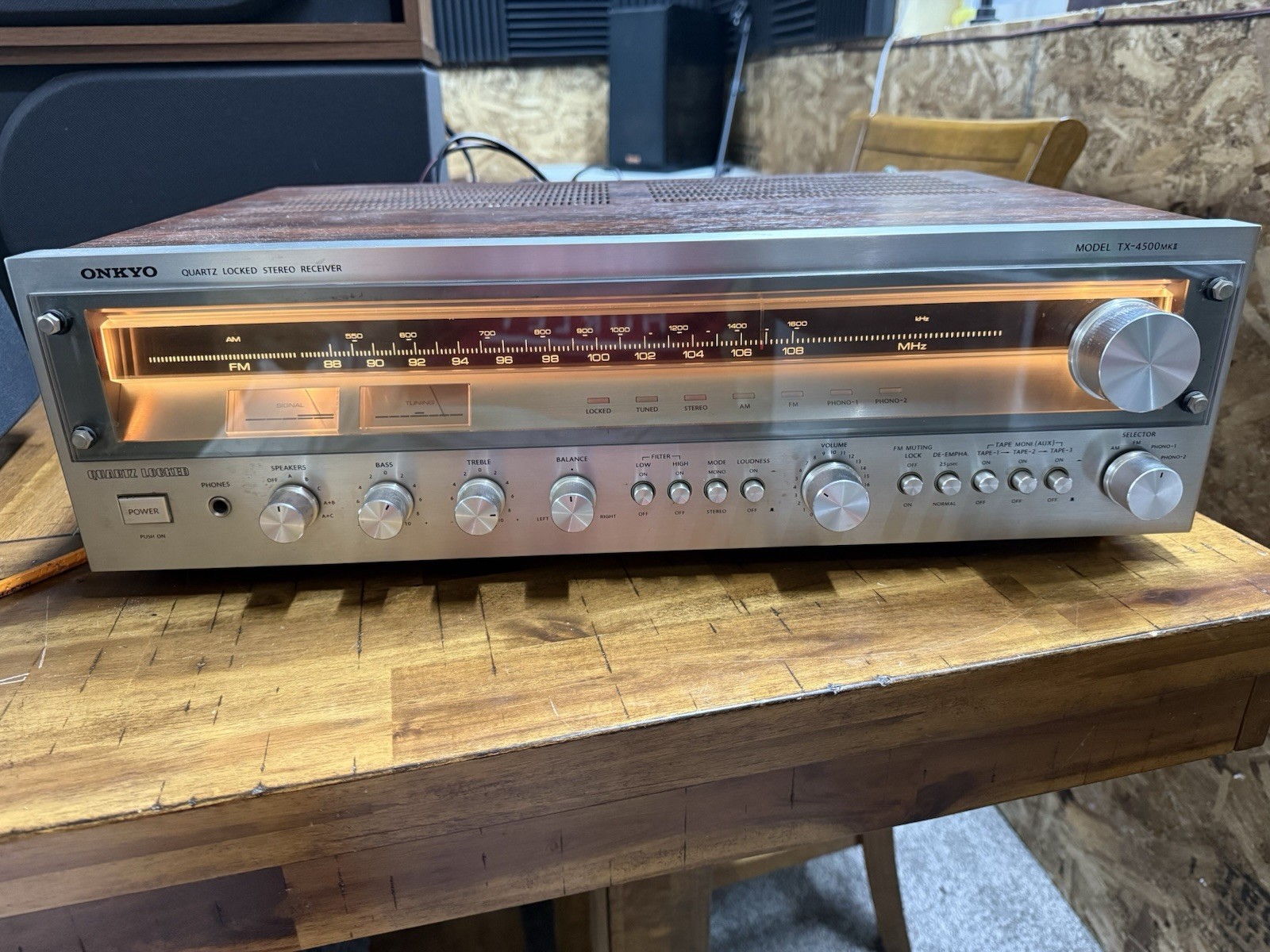
The build quality was typical of Onkyo’s mid-tier components of the era: a rigid steel chassis, high-quality potentiometers, and durable switches. The front panel featured a minimalist layout with a large tuning knob, function switches, and a clean aesthetic that emphasized usability over flash.
Common Issues and Maintenance
While the TX-6500MKII is generally reliable, age-related issues are common in surviving units:
- Capacitor Aging: Electrolytic capacitors in the power supply and signal path may have dried out, leading to hum, reduced performance, or channel imbalance. A full recapping is often recommended for optimal operation.
- Dirt and Oxidation: Pots and switches can become noisy over time. Cleaning with contact cleaner (e.g., DeoxIT) can restore smooth operation.
- Tuning Encoder Drift: The PLL system relies on stable crystal oscillators and digital counters. If the unit fails to lock onto stations or displays incorrect frequencies, the oscillator or tuning ICs may need inspection.
- Antenna Input Corrosion: The 75Ω coaxial and 300Ω twin-lead inputs can corrode, especially in humid environments. Cleaning or replacing these connectors improves reception.
Regular maintenance—such as cleaning controls, checking solder joints, and replacing aging capacitors—can extend the life of the unit significantly. Due to its modular design, repairs are generally straightforward for experienced technicians.
Current Market Value and Collectibility
The Onkyo TX-6500MKII is not as widely collected as full receivers like the TX-8020 or integrated amps like the M-5000, but it holds a dedicated following among tuner enthusiasts and vintage audio purists. In good working condition, units typically sell for $150–$300, with prices rising for fully serviced or mint-condition examples.
Its collectibility is driven by:
- Superior tuner performance compared to most integrated receivers of the era
- Build quality and component-level design
- Appeal to modular audio system builders
- Growing interest in vintage FM radio and high-bandwidth analog broadcasting
While not a mainstream collectible, the TX-6500MKII is increasingly recognized as a high-performance component that delivers real sonic benefits in a well-matched system.
Conclusion and Legacy
The Onkyo TX-6500MKII may not have the fame of a full receiver, but it represents the best of Onkyo’s engineering ethos in the early 1980s: precision, reliability, and a commitment to audio fidelity. As both a tuner and preamp, it offered audiophiles a way to build a high-quality, modular system with exceptional broadcast reception at its core.
Today, it remains a rewarding find for those who appreciate the nuances of FM radio, the warmth of analog circuitry, and the satisfaction of restoring vintage gear to its full potential. Whether used as the centerpiece of a retro setup or as a nostalgic nod to the golden age of radio, the TX-6500MKII continues to deliver crisp, dynamic, and emotionally engaging sound—a true testament to Onkyo’s legacy in high-fidelity audio.
eBay Listings



As an eBay Partner, we earn from qualifying purchases. This helps support our independent vintage technology research.
Related Models
- Onkyo SC-1500 (1978)
- Onkyo TA-2047 (1976)
- Onkyo TA-2500 (1973)
- Onkyo A-812XG (1980)
- Onkyo TX-6500 (1977)
- Luxman L-530 (1975)
- Luxman R-404 (1975)
- Luxman RV-371 (1975)
- Luxman SQ-38U (1975)
- Luxman T-14 (1972)