Onkyo TX-4500: The Forgotten Audiophile Gem of the 1970s
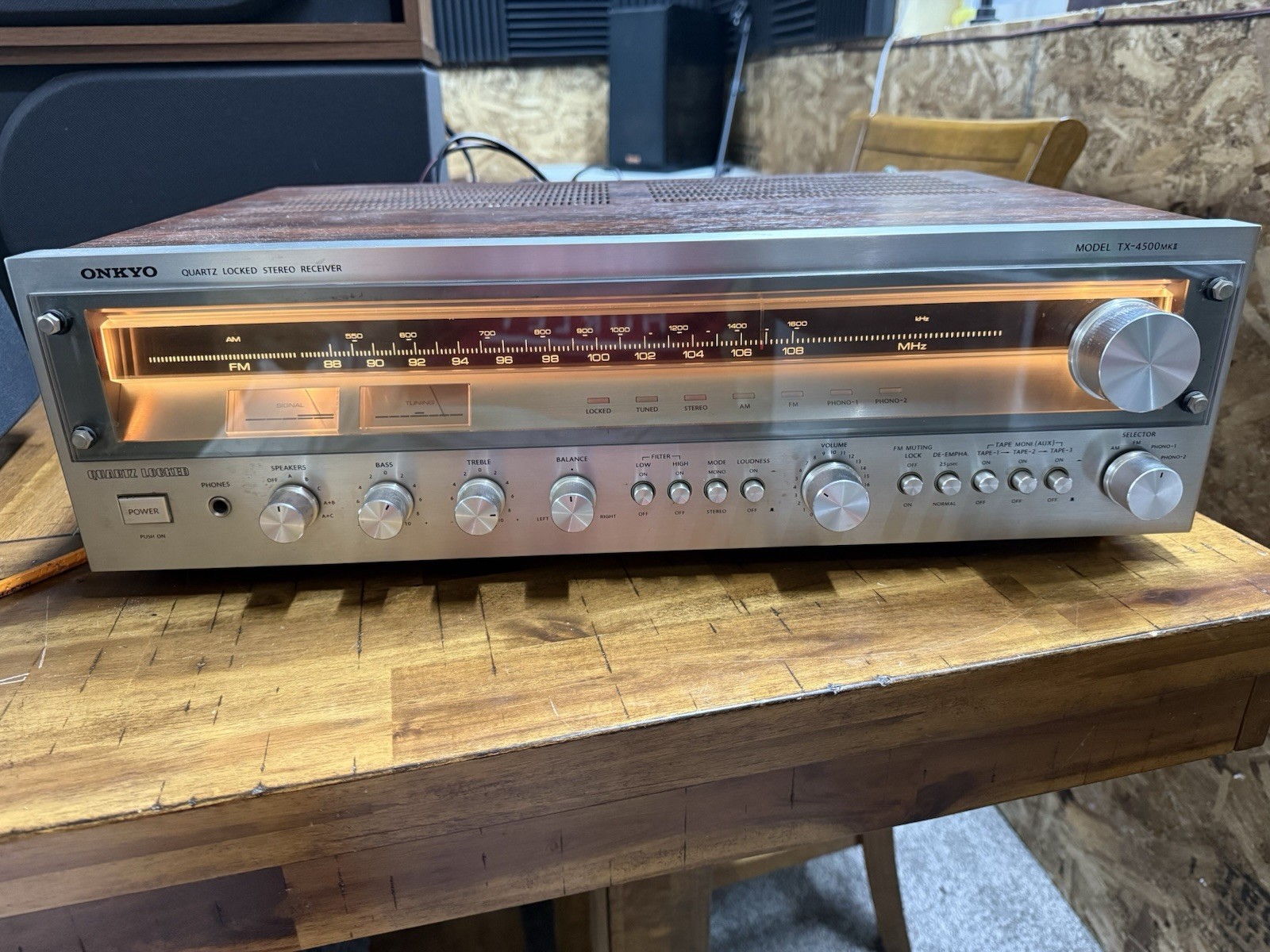
In the golden age of analog audio, when Japanese manufacturers were rapidly ascending the ranks of high-fidelity engineering, Onkyo stood out for its commitment to precision, durability, and sonic excellence. Among its lineup of receivers, amplifiers, and tuners from the 1970s, the Onkyo TX-4500 occupies a unique and somewhat underappreciated niche. Not quite a receiver, not quite a standalone amplifier, the TX-4500 is best understood as a high-performance FM/AM tuner with integrated preamplifier functionality—a hybrid design that catered to discerning listeners who wanted exceptional broadcast reception paired with refined signal control.
Released in 1974, the TX-4500 arrived during a period of intense innovation in consumer audio. FM broadcasting was gaining popularity, offering stereo sound and higher fidelity than AM, and manufacturers were racing to produce tuners with superior selectivity, sensitivity, and signal-to-noise ratios. Onkyo, already known for its meticulous engineering and conservative design philosophy, responded with the TX-4500—a unit that prioritized tuner performance above all else, while still offering enough preamp features to serve as the centerpiece of a high-end system.
Though it lacks the raw power output of a full receiver, the TX-4500 was never intended to drive speakers directly. Instead, it was designed to feed a separate power amplifier, making it a favorite among audiophiles who valued modular system building and the separation of signal and power stages. Its build quality, heavy steel chassis, precision-tuned front-end circuitry, and elegant brushed aluminum faceplate reflect Onkyo’s dedication to both form and function.
Technical Specifications
| Specification | Detail |
| Model | Onkyo TX-4500 |
| Year of Release | 1974 |
| Category | FM/AM Tuner with Preamplifier |
| Tuner Bands | FM, AM (MW) |
| FM Tuning Range | 87.5–108 MHz |
| FM Sensitivity | Approx. 1.8 µV for 26 dB SNR |
| FM Selectivity | High (exact spec: ~75 dB @ ±200 kHz) |
| AM Sensitivity | Approx. 30 µV for usable reception |
| Signal-to-Noise Ratio | >70 dB (A-weighted, FM) |
| Total Harmonic Distortion | <0.1% (preamp section) |
| Output Power | Not applicable (preamplifier only) |
| Impedance | 8Ω (output impedance compatible) |
| Inputs | 2 Line-level (RCA), Tape In |
| Outputs | Main Out (RCA), Tape Out, Headphone |
| Tone Controls | Bass, Treble, Loudness (defeatable) |
| Power Supply | Linear transformer, regulated circuits |
| Dimensions (W×H×D) | 430 × 146 × 335 mm |
| Weight | Approx. 10.5 kg (23 lbs) |
| Finish | Silver or Black (brushed aluminum) |
Sound Characteristics and Performance
The Onkyo TX-4500 shines brightest in its FM tuner section, where it delivers a level of clarity, stereo separation, and dynamic range that rivals far more expensive units of its era. Its dual-gate MOSFET front-end design (a hallmark of high-end Onkyo tuners) ensures low noise and excellent rejection of adjacent channel interference. Once tuned to a strong station, the sound is open, detailed, and remarkably stable, with a wide soundstage and precise imaging.
The integrated preamplifier section, while not as celebrated as the tuner, is no afterthought. With a clean gain stage, low output impedance, and high input sensitivity, it pairs beautifully with tube or solid-state power amplifiers. The tone controls are smooth and musical—especially when the loudest contour (loudness) function is engaged at lower volumes—though purists will appreciate that they can be bypassed entirely for a straight wire signal path.
One of the TX-4500’s most satisfying qualities is its tactile user experience. The large, detented tuning knob offers precise manual control, while the illuminated analog meter provides clear feedback on signal strength and tuning accuracy. The AM band, though less refined than FM, still performs admirably for a unit of this vintage, thanks to a well-shielded ferrite rod antenna and effective IF filtering.
Notable Features and Innovations
- Dual-Gate MOSFET RF Amplifier: This technology, relatively advanced for 1974, reduced noise and improved weak-signal handling, giving the TX-4500 an edge in urban and fringe reception areas.
- High-Selectivity IF Filters: Engineered to reject adjacent channel interference, crucial during the crowded FM band expansion of the 1970s.
- Sturdy Chassis Design: A heavy steel frame minimizes microphonics and electromagnetic interference, contributing to a quiet noise floor.
- Defeatable Tone Controls and Loudness: Allows audiophiles to switch to a pure, flat-response mode when desired.
- Headphone Amplifier: A rare inclusion in a tuner/preamp of this class, with a dedicated output and volume control.
Common Issues and Maintenance
Like all vintage electronics, the Onkyo TX-4500 benefits from periodic maintenance. Over time, the most common issues include:
- Deteriorating Electrolytic Capacitors: The power supply and audio coupling caps may dry out, leading to hum, reduced output, or channel imbalance. A full recapping is recommended for long-term reliability.
- Worn Potentiometers and Switches: The volume, balance, and tone controls can develop crackling noises. Cleaning with contact cleaner often helps, but replacement may be necessary.
- Tuning Gang Alignment: The FM tuning capacitor may drift out of alignment, causing inaccurate station tracking. This requires careful realignment with a signal generator and oscilloscope.
- Rubber Drive Belt (if equipped with auto-scan): Some variants included a motorized tuning system with a rubber belt that may have perished. Replacement belts are available from specialty vendors.
Despite these age-related concerns, the TX-4500 is generally robust and repairable, thanks to its modular construction and widespread use of through-hole components. Schematics and service manuals are available through vintage audio archives, making it a favorite among DIY restorers.
Current Market Value and Collectibility
The Onkyo TX-4500 remains a sleeper classic in the vintage audio world. It doesn’t command the sky-high prices of a Marantz 2270 or a Sansui G-3300, but its value has been steadily rising among tuner enthusiasts and FM purists. As of 2024, a fully functional, well-maintained TX-4500 typically sells for $250–$400, with mint-condition units in original packaging fetching closer to $500.
Its collectibility is driven by several factors:
- Strong reputation among FM DXers (long-distance FM reception hobbyists)
- Growing interest in modular vintage systems
- Onkyo’s respected engineering pedigree from the 1970s
While not as flashy as some of its contemporaries, the TX-4500 is increasingly recognized as a no-compromise tuner with audiophile-grade performance.
Conclusion and Legacy
The Onkyo TX-4500 may not be the most famous piece of vintage audio gear, but for those who appreciate the art of FM tuning and clean signal management, it represents a quiet triumph of 1970s Japanese engineering. It embodies a time when manufacturers built equipment to last, prioritized measurable performance, and catered to listeners who valued accuracy and musicality over convenience.
Today, the TX-4500 serves as both a functional component and a historical artifact—a reminder that high fidelity isn’t just about power and features, but about the purity of the signal path. Whether you're building a vintage modular system, chasing distant FM stations, or simply admire the craftsmanship of a bygone era, the Onkyo TX-4500 deserves a place on your rack.
For the audiophile who believes that tuning in is an art, the TX-4500 is a masterpiece.
eBay Listings


As an eBay Partner, we earn from qualifying purchases. This helps support our independent vintage technology research.
Service Manuals & Schematics
- Service Manual — archive.org
Related Models
- Onkyo SC-1500 (1978)
- Onkyo TA-2047 (1976)
- Onkyo TA-2500 (1973)
- Onkyo A-812XG (1980)
- Onkyo TX-6500 (1977)
- Luxman L-530 (1975)
- Luxman R-404 (1975)
- Luxman RV-371 (1975)
- Luxman SQ-38U (1975)
- Luxman T-14 (1972)