Onkyo TX-1500: The Pinnacle of Early 1970s FM Tuner Engineering
In the golden era of high-fidelity audio—the early 1970s—Japanese manufacturers like Onkyo, Pioneer, and Sansui were pushing the boundaries of analog performance, delivering components that combined cutting-edge engineering with luxurious build quality. Among these, the Onkyo TX-1500 stands out as a rare and highly respected FM tuner that exemplifies the peak of discrete-component analog design before the digital revolution.
Released in 1972, the TX-1500 was not a receiver or amplifier, but a standalone FM tuner—a component dedicated solely to extracting the purest possible sound from FM radio broadcasts. At a time when FM was emerging as a serious medium for high-fidelity music transmission, audiophiles sought tuners that could deliver low noise, high selectivity, and exceptional stereo separation. The TX-1500 was engineered to meet and exceed those demands.
Though not as widely known as some of its contemporaries from Sansui or Sony, the TX-1500 has developed a quiet but passionate following among vintage audio enthusiasts. Its combination of meticulous circuit design, premium construction, and musicality places it among the elite tuners of its era.
Technical Specifications
The Onkyo TX-1500 was built during a transitional period in audio electronics—still firmly rooted in discrete transistor and analog circuitry, yet incorporating innovations that would define the next decade of tuner performance.
| Specification | Detail |
| Model | TX-1500 |
| Year of Release | 1972 |
| Type | FM Tuner (Standalone) |
| Tuning Method | Analog Dial with Mechanical Counter |
| Frequency Range | 87.5–108 MHz |
| Tuning Steps | Continuous analog tuning |
| Intermediate Frequencies | 10.7 MHz (Double Conversion) |
| Sensitivity | 1.8 µV for 30 dB SNR (Mono) |
| Selectivity | 75 dB at ±400 kHz |
| Signal-to-Noise Ratio | 70 dB (Mono), 65 dB (Stereo) |
| Stereo Separation | 40 dB at 1 kHz |
| Output Level | 250 mV (1.8 µV input) |
| Output Impedance | 1 kΩ |
| Audio Outputs | RCA (L/R), Fixed Level |
| Power Requirement | 110–120V AC, 50/60 Hz |
| Power Consumption | 25 watts |
| Dimensions (W×H×D) | 430 × 145 × 335 mm (17 × 5.7 × 13.2 in) |
| Weight | 11.5 kg (25.3 lbs) |
| Construction | Steel chassis, aluminum faceplate, heavy-duty knobs |
One of the TX-1500’s standout features is its double-conversion superheterodyne circuit, a design typically reserved for high-end communications receivers. This architecture significantly improves image rejection and selectivity, making the tuner exceptionally resistant to interference—a critical advantage in urban environments or areas with strong adjacent-channel signals.
The tuner also features a quartz-locked AFC (Automatic Frequency Control) system, which stabilizes the tuning and prevents drift during extended listening sessions. This was a notable innovation at the time, ensuring that stations remained locked in with precision.
Sound Characteristics and Performance
The Onkyo TX-1500 is revered not just for its technical prowess, but for its musical and natural sound reproduction. Unlike many tuners of the era that emphasized clinical precision, the TX-1500 delivers a warm, balanced presentation that complements high-end analog systems.
Its stereo imaging is remarkably stable, with a wide and deep soundstage that brings FM broadcasts to life. The high separation and low crosstalk ensure that instruments and vocals are clearly delineated, while the low noise floor allows quiet passages to remain clean and detailed.
Even by today’s standards, the TX-1500 holds up remarkably well. With a strong FM signal and a good outdoor antenna, it can extract nuances from broadcasts that modern digital tuners often discard. Audiophiles who use it today often pair it with vintage preamps and tube amplifiers to preserve its analog character.
Notable Features and Innovations
Several design elements set the TX-1500 apart from its contemporaries:
- Double Conversion Circuitry: Enhances selectivity and reduces interference, a feature uncommon in consumer tuners at the time.
- Mechanical Digital Frequency Counter: A rare and elegant feature for 1972, the TX-1500 includes a mechanical counter that displays the tuned frequency with high precision—no LEDs or digital readouts, just finely engineered rotating numerals.
- High-Quality RF Front-End: Designed for maximum sensitivity and minimal distortion, the input stage uses carefully selected transistors and shielding to preserve signal integrity.
- Heavy-Duty Construction: The massive steel chassis and thick aluminum front panel not only give the unit a luxurious feel but also provide excellent shielding against electromagnetic interference.
- Dual Audio Outputs: Allows connection to both a primary system and a tape recorder or secondary amplifier, a thoughtful touch for the era.
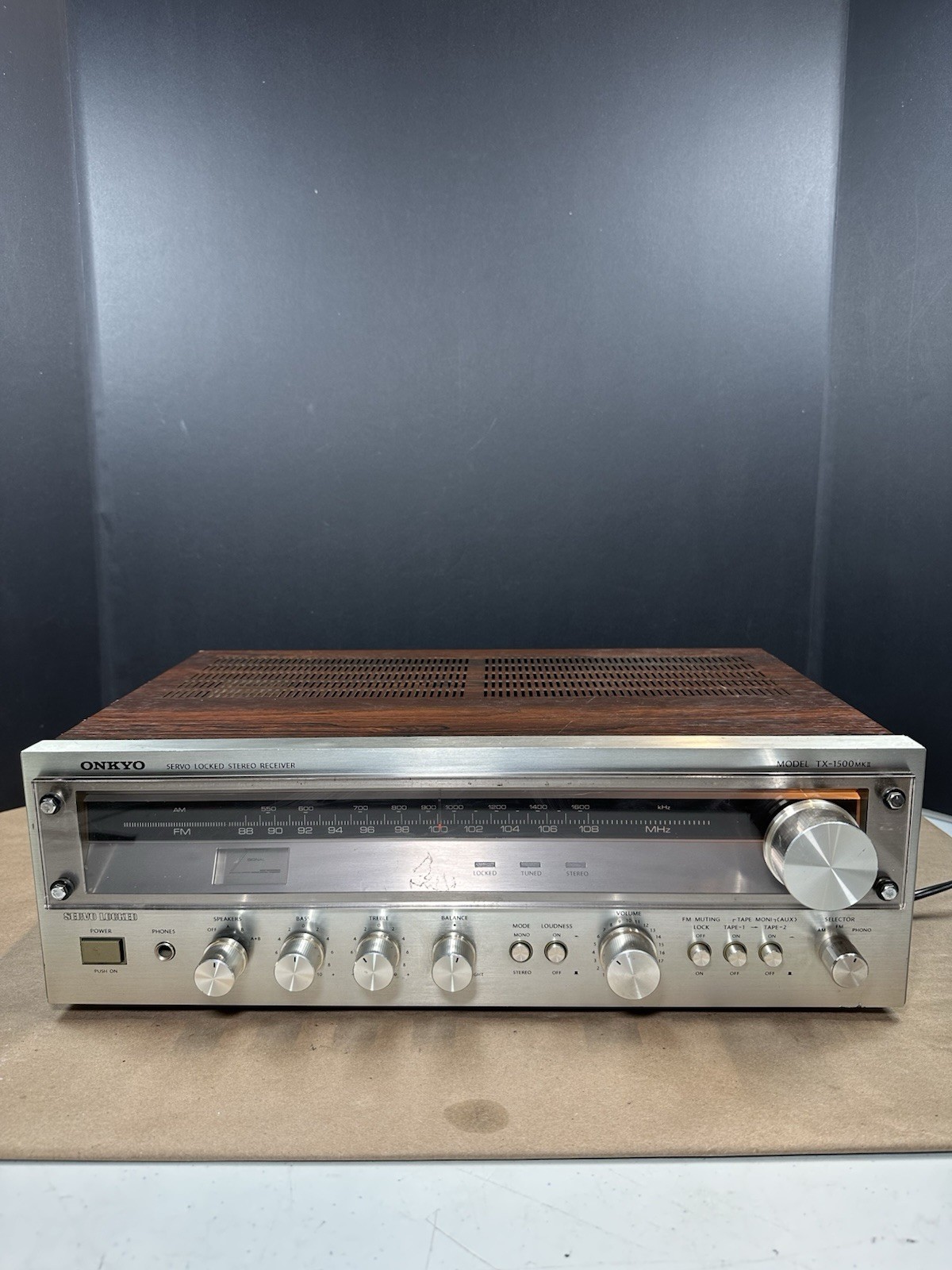
The front panel layout is clean and functional, with large, knurled aluminum knobs for tuning and volume (though volume control is passive, as it’s a tuner-only unit). The VU-style signal strength meter is both practical and visually striking, adding to the unit’s vintage charm.
Common Issues and Maintenance
As with any 50-year-old electronic equipment, the Onkyo TX-1500 requires careful attention to ensure reliable operation. Common issues include:
- Deteriorated Electrolytic Capacitors: The power supply and audio coupling capacitors may have dried out. A full recap is highly recommended before powering the unit if it has been dormant.
- Tuning Dial Stiffness: The mechanical tuning mechanism can become stiff over time. Cleaning and lubrication of the tuning capacitor and counter gears are essential.
- Worn Potentiometers: The volume and balance controls (if equipped) may develop crackling. Contact cleaner or replacement is advised.
- Antenna Terminal Corrosion: Check and clean the 75Ω and 300Ω antenna terminals to ensure optimal signal reception.
Due to its complex mechanical counter and precision alignment requirements, the TX-1500 is not a beginner-friendly restoration project. It’s best serviced by a technician experienced in vintage Japanese audio gear.
Current Market Value and Collectibility
The Onkyo TX-1500 is a rare find on the vintage market. Few units were produced compared to mass-market receivers, and even fewer have survived in working condition. As of 2024, a fully functional and well-maintained TX-1500 can command $600–$1,000, depending on condition, provenance, and completeness (including original packaging and manuals).
Collectors value the TX-1500 not only for its performance but as a historical artifact of Japan’s golden age of audio engineering. Its combination of advanced circuitry, mechanical elegance, and sonic excellence makes it a centerpiece in any vintage audio collection.
Units with the original mechanical counter in perfect working order are especially prized. Because of its niche appeal, it doesn’t attract the same attention as receivers like the Sansui AU-919, but among tuner enthusiasts, the TX-1500 is spoken of with reverence.
Conclusion and Legacy
The Onkyo TX-1500 is more than just a tuner—it’s a testament to a time when audio components were built to last, designed with care, and engineered for performance above all else. In an age when FM radio was becoming a legitimate high-fidelity medium, Onkyo answered the call with a machine that blended precision, durability, and musicality.
Though overshadowed by more famous models, the TX-1500 deserves recognition as one of the finest FM tuners ever made. For the audiophile who appreciates the subtleties of analog reception, the weight of solid construction, and the beauty of mechanical engineering, the Onkyo TX-1500 remains a hidden gem—quiet, refined, and utterly captivating.
If you’re lucky enough to find one in good condition, consider it not just a purchase, but an investment in audio history.
eBay Listings


As an eBay Partner, we earn from qualifying purchases. This helps support our independent vintage technology research.
Related Models
- Onkyo T-4090 (1975)
- Onkyo T-4050 (1975)
- Onkyo CP-1057F (1975)
- Onkyo T-4060 (1975)
- Onkyo T-4070 (1975)
- Aiwa CS-250 (1978)
- Denon TU-1500RD (1995)
- Denon TU-280 (1976)
- Denon TU-501 (1977)
- Denon TU-550 (1978)