Onkyo TA-2800 (1988–1989)
That moment when you hit record and the tape counter clicks forward with quiet authority—you’re not just making a copy, you’re committing to analog.
Overview
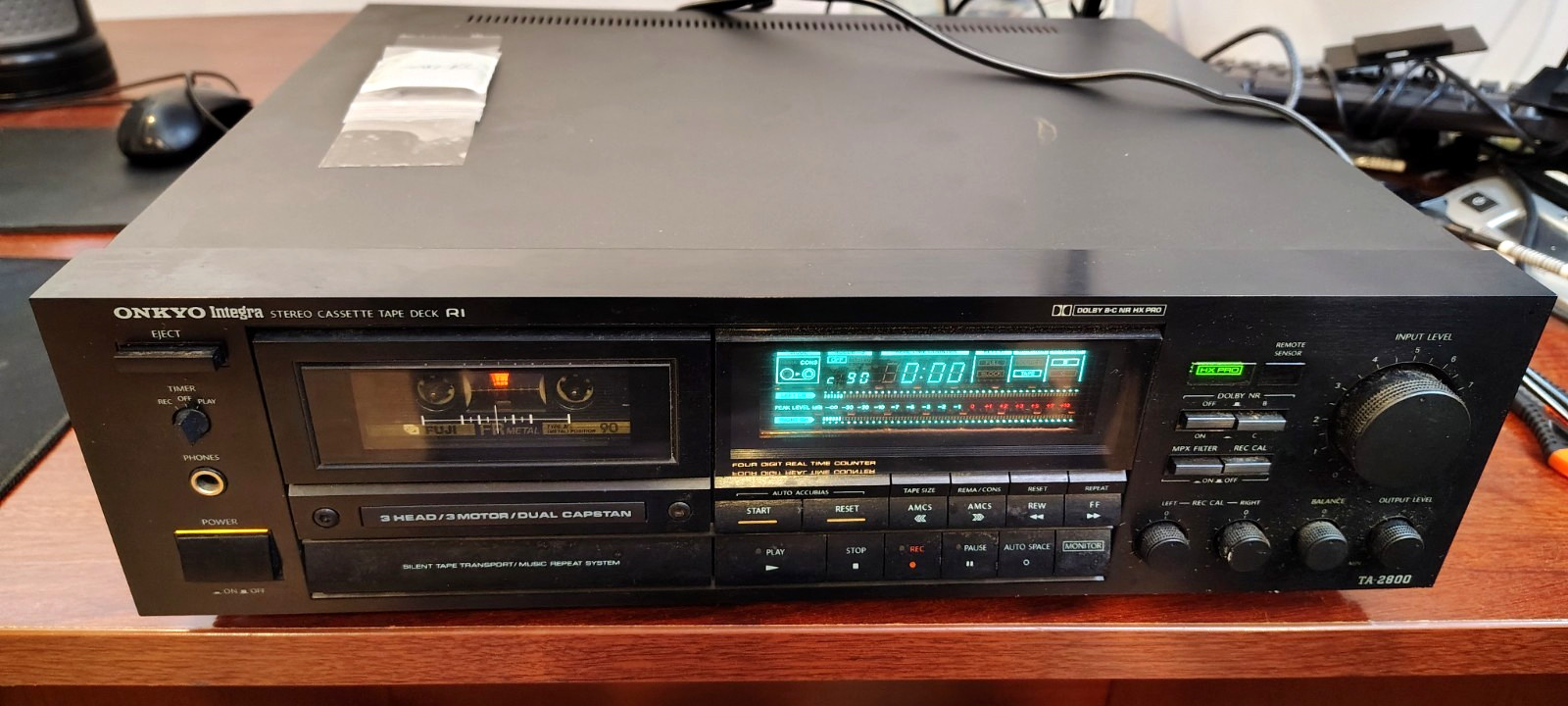
The Onkyo TA-2800 isn’t flashy, but it doesn’t need to be. This was a serious cassette deck built for people who cared about getting it right—the kind of machine that sat in a rack next to a Revox or a Nakamichi and didn’t flinch. Made in Japan between 1988 and 1989, it was positioned as a near-top-of-the-line model in Onkyo’s lineup, second only to the TA-2900. For a company known more for receivers than high-end tape, that’s no small claim.
It’s a stereo cassette tape deck engineered with precision, not hype. Owners report that it handles metal, chrome, and normal tapes with ease, thanks to automatic tape type selection and an intelligent bias system. It wasn’t just about convenience—it was about ensuring every tape was recorded with the right equalization, minimizing distortion and maximizing fidelity. If you were building a reference archive of your vinyl collection or making high-grade dubs of CDs in the late '80s, this was the kind of machine you’d trust.
And trust matters. The TA-2800 doesn’t shout. It doesn’t have Dolby S—some might see that as a flaw, but it’s not a flaw so much as a choice. Instead, it leans on its strengths: a clean signal path, solid build, and a transport system that keeps things stable. It was designed to disappear into a high-end system, doing its job without fanfare. That’s exactly why it’s starting to get noticed again.
Specifications
| Manufacturer | Onkyo |
| Model | TA-2800 |
| Type | Stereo cassette tape deck |
| Years of manufacture | 1988 - 1989 |
| Compatible cassette tape types | Normal, High (CrO2), and Metal |
| Noise reduction support | Dolby B NR and Dolby C NR |
| Frequency response with metal tape | 20-20k +/- 3dB |
| Wow and flutter | .04% |
| Signal to Noise Ratio | 80dB (dolby C) |
| Input | 60mV (line) |
| Output | 1.1V (line) |
| Dimensions | 435 x 132 x 366mm |
| Weight | 6.2kg |
| Accessories | remote control |
Key Features
Three-Head Design with Off-Tape Monitoring
One of the TA-2800’s standout features is its three-head configuration—separate record, playback, and erase heads—allowing true off-tape monitoring. That means you’re not listening to a pre-recorded signal from the record head; you’re hearing exactly what’s being laid down on the tape in real time. This is critical for accurate dubbing and editing, and it’s a feature usually reserved for decks well above consumer grade.
Dolby HX Pro and Auto Biasing
The inclusion of Dolby HX Pro isn’t just a checkbox. It dynamically adjusts the record bias based on the audio signal, reducing distortion and improving linearity in the high-frequency range. Combined with an auto biasing system, it ensures optimal recording levels across all tape types. Whether you’re using a budget ferric tape or a premium metal formulation, the deck adapts—no manual tweaking required.
Dual-Capstan Belt-Driven Transport
The transport uses a belt-driven dual-capstan system, which helps maintain consistent tape-to-head contact and reduces wow and flutter to a remarkably low .04%. That’s studio-grade stability. Owners report smooth operation and excellent tape handling, though—like all belt-driven decks from this era—the rubber components are now 35 years old and prone to failure.
Full Logic Control and Digital Interface
It’s got a microcomputer inside, which powers its Full Logic Control system. That means fully automatic operation: the deck stops, ejects, and prevents double-recording with precision. The digital linear tape counter has four digits and advances steadily, giving you a reliable sense of where you are on the tape. There’s also a switchable MPX filter to block the 19kHz pilot signal from FM broadcasts, a small but thoughtful touch for those taping from radio.
Remote Control and Variable Headphone Output
The included remote control lets you operate the deck from your listening position—rare for a cassette deck at this level. And if you’re monitoring through headphones, the variable output lets you adjust the level independently, so you’re not disturbing anyone else in the room.
Historical Context
The TA-2800 arrived in 1988, just as the cassette was reaching its technical peak. Digital formats like CD were gaining ground, but high-end tape decks were still being refined—this was the last generation where manufacturers poured real engineering into analog. Onkyo, already respected for its amplifiers and tuners, used this model to prove it could compete in the upper echelon of cassette technology.
It wasn’t alone. Models like the Onkyo TA-2120 shared the same family tree, but the TA-2800 stood near the top. A professor quoted in The Asahi Shimbun later noted that Onkyo’s obsession with manufacturing quality may have hindered its ability to adapt to changing markets—particularly as smartphones and streaming dismantled the mid-tier hi-fi business. But in 1988, none of that mattered. The TA-2800 was built for a world where a well-made cassette copy was a legitimate alternative to the original.
Collectibility & Value
Original MSRP was $650— In Germany, it sold for approximately DM 1,298. That obscurity might be its saving grace. A forum user once wrote: “They are indeed sleepers and it’s probably just a matter of time before enough people discover them and prices start climbing.” The TA-2900 gets more attention for being rarer and Onkyo’s ultimate deck, but the TA-2800 is right on its heels in performance.
Common issues are predictable for a machine this age. Belts degrade and turn into “melted goo”—a $10 replacement fixes it, but it’s a necessary maintenance step. More concerning is the “blinking play” issue: the play button lights flash, and the deck won’t engage. This is often caused by a worn or drifting capstan belt. Realigning it can help temporarily, but a full replacement is the real fix.
Another known failure point is resistor R905 (2.2ohm, 1/2watt) on the main board. If the unit doesn’t power on but the button lights up, this resistor is a likely culprit. The service manual on HiFi Engine actually circles it—strong evidence it was a recurring issue. The fact that it’s clearly marked on both sides of the board makes it an accessible repair for DIYers.
There are no current market prices in the fact sheet, so we can’t quote values. But given its build, features, and the growing appreciation for late-era high-end cassette decks, it’s safe to say a fully serviced TA-2800 would command serious interest.
eBay Listings


As an eBay Partner, we earn from qualifying purchases. This helps support our independent vintage technology research.
Related Models
- Onkyo SC-1500 (1978)
- Onkyo TA-2047 (1976)
- Onkyo TA-2500 (1973)
- Onkyo A-812XG (1980)
- Onkyo TX-6500 (1977)
- Luxman L-530 (1975)
- Luxman R-404 (1975)
- Luxman RV-371 (1975)
- Luxman SQ-38U (1975)
- Luxman T-14 (1972)