Onkyo TA-2500 (1984–1986)
It looks like a spaceship landed on your rack—and it just might be the slickest cassette deck of the mid-80s.
Overview
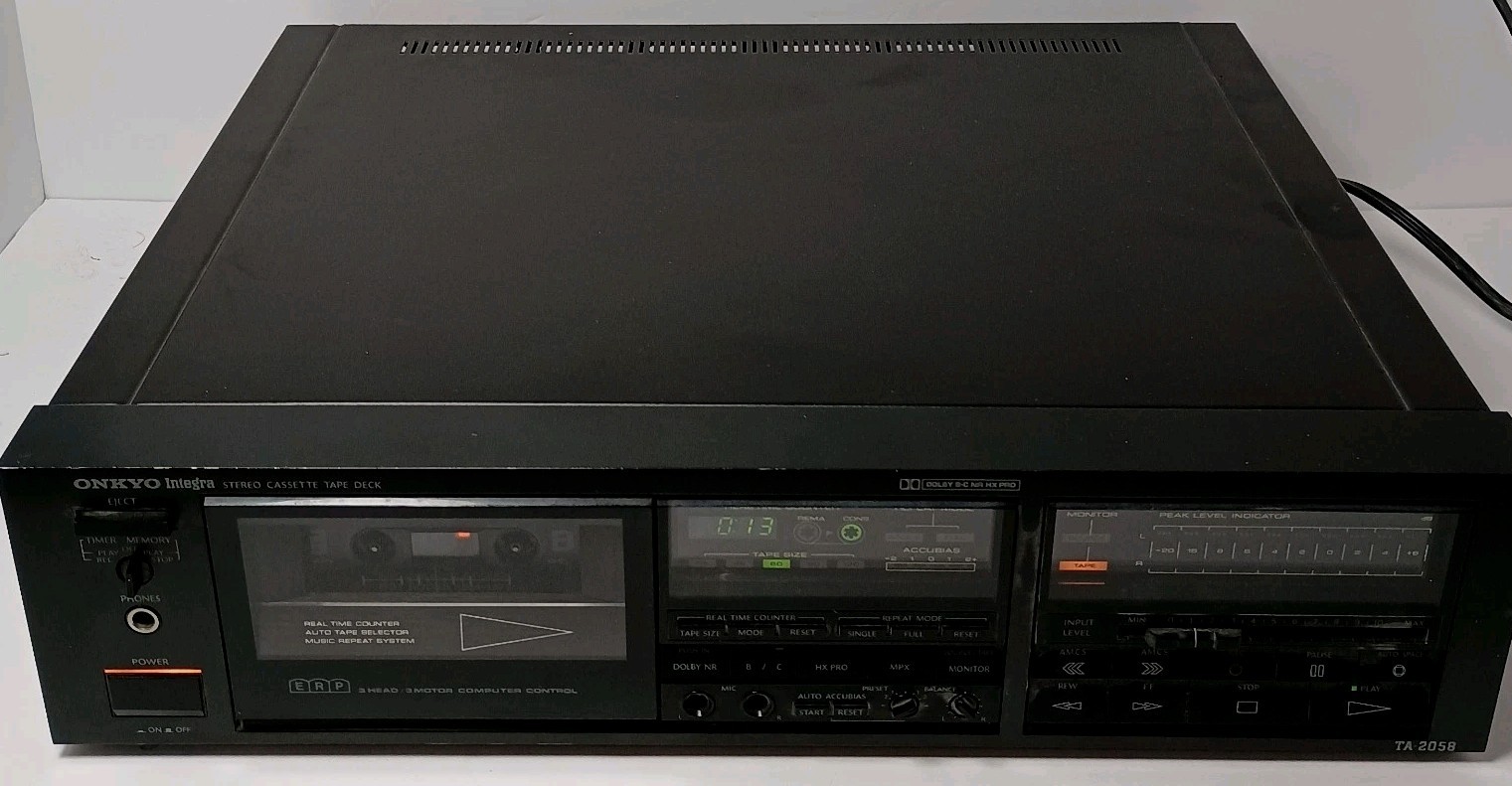
The Onkyo TA-2500 isn’t just another cassette deck from the golden age of tape—it’s a statement. Part of Onkyo’s Integra Series, this stereo cassette tape deck was built in Japan between 1984 and 1986, a time when high-end audio gear was pushing the limits of analog precision while flirting with digital control. The TA-2500 lands right in that sweet spot: packed with advanced features, wrapped in a sleek silver/black chassis, and engineered around a robust Sankyo transport. It’s the kind of machine that makes you want to digitize your entire vinyl collection, not because it’s convenient, but because it feels like an event.
Owners report it’s “very good tapedeck,” and one even said they’re eager to get it running “if nothing else it is really pretty.” And they’re not wrong—the TA-2500 has presence. With digital meters, full logic control, and a minimalist front panel that looks like it was designed by a Swiss watchmaker, it stands out even among its high-end peers. It’s not rare because it’s flashy, but because it actually delivered on the promise of high-fidelity cassette recording during an era when many were already looking ahead to CDs.
Specifications
| Manufacturer | ONKYO |
| Model | TA-2500 |
| Production Years | 1984 to 1986 |
| Type | 3-head, single compact cassette deck |
| Track System | 4-track, 2-channel stereo |
| Tape Speed | 4.8 cm/s |
| Heads | 1 x combination record/playback, 1 x erase |
| Motor | 1 x DC servo, 2 x DC |
| Tape Types | Type I (standard), Type II (high), Type IV (metal) |
| Noise Reduction | B, C |
| Frequency Response | 20Hz to 19kHz (Metal tape) |
| Signal to Noise Ratio | 80dB (Dolby C) |
| Wow and Flutter | 0.045% |
| Input | 60mV (line), 0.3mV (mic) |
| Output | 0.5V (line) |
| Dimensions (W×H×D) | 435 × 112 × 371 mm |
| Weight | 6.5kg |
| Power Consumption | 34 watts |
| Color | Silver / Black |
| Semiconductors | 91 x transistors, 27 x diodes, 18 x IC, 24 x LED |
Key Features
Sankyo Transport with Single Capstan
At the heart of the TA-2500 is a Sankyo transport mechanism—renowned in the tape world for its durability and precision. Paired with a single capstan design, it ensures consistent tape-to-head contact, which is critical for minimizing wow and flutter (and this one nails it at just 0.045%). The transport is fully logic-controlled, meaning tape functions operate with the push of a button and without the need for manual intervention. It’s smooth, fast, and feels like the deck knows what it’s doing before you do.
Dolby B & C Noise Reduction
The inclusion of Dolby C is a big deal. Unlike Dolby B, which offers about 10 dB of noise reduction, Dolby C delivers up to 20 dB above 1,000 Hz—making it especially effective on metal tapes where high-frequency hiss can be an issue. Combined with a frequency response that stretches to 19kHz on metal tape and a signal-to-noise ratio of 80dB (with Dolby C), the TA-2500 was built to extract every last bit of fidelity from the cassette format.
Digital Meters and Full Logic Control
Those glowing digital meters aren’t just for show—they give you real-time feedback on recording levels with precision that analog VU meters often struggle to match. And with full logic control, everything from tape loading to rewind is automated and reliable. No more hunting for the eject button in the dark.
Switchable MPX Filter
A small but meaningful touch: the switchable MPX filter. When recording from FM sources, this filter removes the 19kHz pilot tone that can interfere with high-frequency response and cause distortion. It’s the kind of feature that tells you Onkyo was thinking about real-world use, not just spec-sheet bragging rights.
Collectibility & Value
The Onkyo TA-2500 trades today around €180 for a working unit, according to recent listings. That’s a fair price for a deck this capable, especially considering its build quality and feature set. A service manual is available for €35, though collectors note it can be found under the reference TA-2056—handy since the TA-2500 shares design elements with other models in the line.
But let’s talk about the elephant in the room: reliability. Like many Onkyo decks of this era, the TA-2500 is prone to “the usual Onkyo disease”—bad potmeters. And when they go, replacements are hard to find. Then there’s the belts. Most units never had them changed, especially the idler belts, which tend to disintegrate and gum up over time. That’s often the “knock out” for otherwise functional decks. The good news? A belt set (Riemenset) is available, so restoration is possible.
Still, owners are fond of it. One says, “I have Onkyo TA-2500 very good tapedeck.” Another admits, “sound from ta-2500 is better is only my opinion.” It might not be the absolute king of its class—Tapeheads.net notes the TEAC V-7010 has superior calibration controls and edges it out in performance—but the Onkyo wins on looks, logic control, and that intoxicating 80s high-tech vibe.
If you’re hunting one down, power it up carefully. Check the belts, listen for smooth operation, and test the pots for crackling. A clean, recapped, and calibrated TA-2500 is a joy to use—not just as a nostalgia piece, but as a genuinely capable analog recorder in a world that forgot how good tape could sound.
eBay Listings



As an eBay Partner, we earn from qualifying purchases. This helps support our independent vintage technology research.
Related Models
- Onkyo SC-1500 (1978)
- Onkyo TA-2047 (1976)
- Onkyo A-812XG (1980)
- Onkyo TX-6500 (1977)
- Onkyo TX-6500MKII (1982)
- Luxman L-530 (1975)
- Luxman R-404 (1975)
- Luxman RV-371 (1975)
- Luxman SQ-38U (1975)
- Luxman T-14 (1972)