Onkyo TA-2080 (1979–1981)
The first cassette deck to think for itself—thanks to a tiny analog brain that recalibrated bias on the fly.
Overview
You press “Accu-Bias,” drop in a blank metal tape, and step back. Seconds later, the Onkyo TA-2080 finishes its silent calculation, rewinds, and blinks ready—no technician, no guesswork, no test tones. In 1979, that wasn’t just smart; it was borderline sorcery. While other decks made you trust factory presets or fiddle with trim pots using pink noise and a spl meter, the TA-2080 did the measuring itself, tailoring the record bias to the exact magnetic personality of your tape. It wasn’t perfect, but it was the first production cassette deck with a legitimate closed-loop calibration system—and it turned the recording chain from a ritual into a one-button operation. This wasn’t Onkyo chasing specs; it was Onkyo redefining what a cassette deck could *do*.
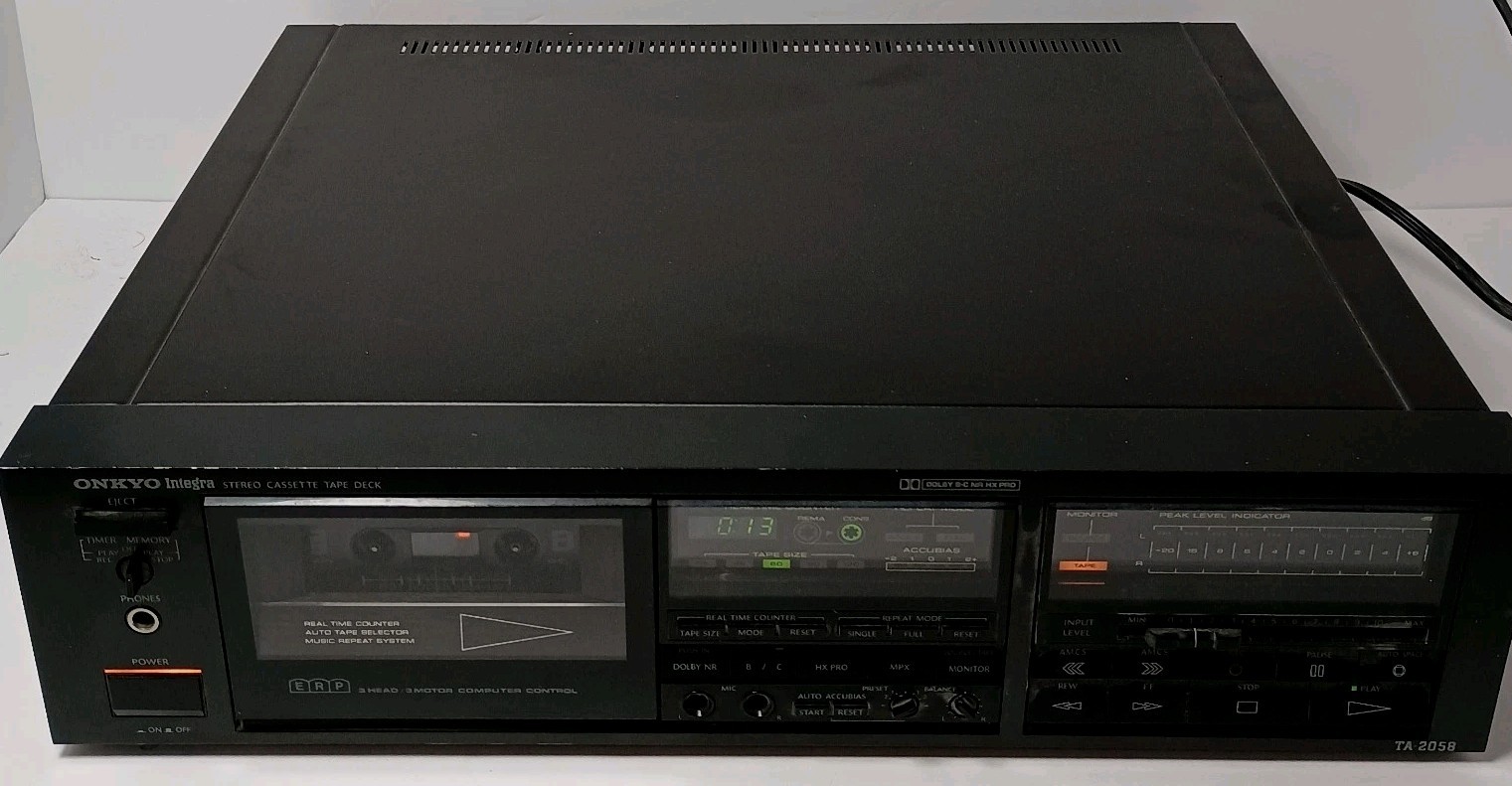
Positioned near the top of Onkyo’s cassette hierarchy—just below the exotic TA-2150 and ahead of the TA-2050—the TA-2080 wasn’t just a recorder. It was a statement: that cassette could be serious, repeatable, and even scientific. With a full 3-head configuration, dual capstans, DC servo motors, and a discrete logic circuit to run the Accu-Bias magic, it targeted the upper tier of home audiophiles and semi-pro users who wanted reel-to-reel levels of control without the bulk or cost. It didn’t skimp on the experience either—twin VU meters flanked a column of 10-segment LED peak indicators, and the transport responded with the soft, decisive thump of solenoid-driven mechanics. It looked like a lab instrument dressed for a hi-fi show, all brushed silver and recessed knobs, with none of the flashy chrome or smoked glass that made other decks feel like disco relics.
Specifications
| Manufacturer | Onkyo Corporation, Japan |
| Production Years | 1979–1981 |
| Original Price | Approx. 2,000 DM (West Germany) |
| Type | 3-head, single compact cassette deck |
| Track System | 4-track, 2-channel stereo |
| Tape Speed | 4.8 cm/s (1 7/8 ips) |
| Heads | 1 x Sendust alloy combination record/playback, 1 x Sendust alloy playback, 1 x laminated erase |
| Motor | Direct-drive capstan motor, DC servo reel motors (dual) |
| Transport | Belt-driven dual-capstan with PLL-controlled DC servo system |
| Wow and Flutter | 0.045% (weighted RMS) |
| Frequency Response | 20 Hz – 20 kHz (with metal tape, Dolby B off) |
| Signal-to-Noise Ratio | 62 dB (Dolby B off, metal tape) |
| Dolby Noise Reduction | B |
| Headroom Extension | Yes |
| Tape Type Selection | Manual: Type I (Normal), Type II (CrO₂), Type IV (Metal) |
| Recording Bias Calibration | Automatic Accu-Bias (logic-controlled) |
| Inputs | Line In (RCA), Mic In (¼”) |
| Outputs | Line Out (RCA), Monitor Out (to amp), Headphones (¼”) |
| Special Features | Off-tape monitoring, 3-digit mechanical tape counter, Fadeout editing function, Line/Mic mixer |
| Power Consumption | 45 W |
| Dimensions (W×H×D) | 438 × 160 × 365 mm (17.2 × 6.3 × 14.4 in) |
| Weight | 10.2 kg (22.5 lbs) |
Key Features
The Accu-Bias Revolution
Forget “set it and forget it.” Accu-Bias was a feedback loop disguised as a feature. You’d select your tape type (Normal, CrO₂, or Metal), hit the dedicated button, and the deck would record a short burst of 1 kHz tone, then play it back to measure output level and distortion. Based on that reading, internal circuitry adjusted the record bias to maximize output and minimize THD—then locked it in. No other consumer deck offered real-time, closed-loop calibration. Sure, some had manual bias pots, and a few high-end Nakamichi models used fixed optimized settings, but Onkyo was the only one that *measured* and *adjusted* dynamically. It didn’t eliminate the need for good tapes, but it eliminated the guesswork—and for metal tapes, which were still exotic and inconsistent in the early '80s, that was huge. Service technicians observe that the system relies on stable reference voltages and clean head relays; if those drift, Accu-Bias can misfire, leading to dull or distorted recordings.
Triple-Head Precision & Dual Capstans
The TA-2080 uses three discrete heads: separate record, playback, and erase. That means no compromise in alignment—each head is optimized for its job. The record and playback heads are made of Sendust, a durable, high-saturation alloy that handles metal tapes better than standard ferrite. The erase head is laminated to prevent overheating during extended use, a nod to the higher coercivity of metal tapes. Paired with dual capstans (one before and one after the head stack), the tape rides in a near-perfect straight line, minimizing modulation noise and ensuring stable speed. The capstan is direct-drive with a PLL (phase-locked loop) servo, meaning it locks precisely to a crystal reference—no rubber belts to stretch or slip near the critical speed control point. Reel motors are DC servo-controlled, adjusting torque based on tape pack diameter. The result? Wow and flutter figures that rival some open-reel decks of the era.
Editing and Monitoring Flexibility
This wasn’t just a set-and-forget recorder. The “Fadeout” function lets you gradually erase a section during playback while monitoring the result—ideal for trimming silences or splicing live recordings. Off-tape monitoring means you hear exactly what’s being recorded, not a pre-record signal, so you can catch dropouts or distortion in real time. The 10-segment LED column between the VU meters gives a faster, more detailed view of peaks than needles alone, and the line/mic mixer allows blending an external mic with a line source—handy for commentary over music. It’s a deck built for people who *used* tape, not just collected it.
Historical Context
The late 1970s were a turning point for cassette. Once dismissed as a toy format, it was gaining legitimacy thanks to better tapes (especially the arrival of metal formulations), Dolby C on the horizon, and decks from Nakamichi, Revox, and Tandberg pushing performance boundaries. Onkyo, already respected for amplifiers and tuners, saw an opening: make a deck that wasn’t just accurate, but *intelligent*. The TA-2080 launched just as metal tape hype peaked—before Sony’s ECM-1 and Maxell’s UD-XL had settled the market—and Accu-Bias was a direct response to the chaos of inconsistent bias requirements. Competitors like Pioneer (RT-707) and TEAC (A-3340S) offered manual calibration, but none automated it. Even Sony’s top decks relied on user-set trim pots. Onkyo wasn’t just competing on specs; it was selling confidence. And in an era when recording a tape “right” could take hours of tweaking, that was worth the premium.
Collectibility & Value
The TA-2080 isn’t a unicorn, but it’s not common either. It sits in that sweet spot of being advanced enough to impress, but not so rare that prices go insane. As of 2026, working units in good cosmetic condition sell for $250–$400. Fully serviced examples with verified Accu-Bias function and fresh belts can reach $500, especially if they include original test reports or packaging. The real value lies in functionality—this is a deck you can *use*, not just display.
But ownership comes with responsibilities. Belts will need replacement—especially the capstan and reel belts—due to age-related hardening. The rubber idler wheels in the counter mechanism can also degrade, causing the tape counter to stick. More critically, the Accu-Bias system depends on stable voltages and clean relay contacts; if the logic board’s capacitors dry out, the calibration routine may fail or produce inconsistent results. Replacing the electrolytics (recapping) is highly recommended, as is demagnetizing the heads and guides before serious use. The Sendust heads are tough, but not immune to wear—especially if previous owners recorded on dirty or warped tapes. When buying, insist on a demonstration of Accu-Bias and off-tape monitoring. If it doesn’t calibrate, it’s not a TA-2080 in spirit.
eBay Listings



As an eBay Partner, we earn from qualifying purchases. This helps support our independent vintage technology research.
Related Models
- Onkyo SC-1500 (1978)
- Onkyo TA-2047 (1976)
- Onkyo TA-2500 (1973)
- Onkyo A-812XG (1980)
- Onkyo TX-6500 (1977)
- Luxman L-530 (1975)
- Luxman R-404 (1975)
- Luxman RV-371 (1975)
- Luxman SQ-38U (1975)
- Luxman T-14 (1972)