Onkyo TA-2048 (1985–1987)
A 3-head cassette deck that hums to life with microcomputer precision—quiet, capable, and built like a vault.
Overview
The Onkyo TA-2048 isn’t the flashiest name in vintage cassette decks, but if you know what to look for, it’s one of those quiet overachievers that makes you wonder why it didn’t get more attention. Released between 1985 and 1987, this stereo cassette tape deck was built for people who wanted serious tape performance without stepping into exotic price territory. It’s not a one-off luxury item or a mass-market plastic wonder—it’s a precision tool from Onkyo’s golden era of analog engineering.
Positioned just below the flagship TA-2090 in Onkyo’s lineup, the TA-2048 carries the DNA of a high-end machine with a more accessible footprint. It was part of the MC-5000 complete system, which tells you something about its intended role: not just a standalone deck, but a core component in a thoughtfully engineered audio chain. And while it doesn’t shout about its capabilities, it delivers them quietly and consistently—especially if you’re working with metal tapes or demand tight speed control.
What sets the TA-2048 apart isn’t just its specs, but how they’re implemented. A true 3-head design means separate record and playback heads, each crafted from special hard permalloy for durability and optimized performance with metal tapes. That’s not a gimmick—it’s a real engineering choice that improves head life and high-frequency response, especially when you’re pushing the limits of what cassette tape can do. Combined with a servo-controlled capstan and a 3-motor system, this deck runs like a Swiss watch: stable, accurate, and built to last.
Specifications
| Manufacturer | Onkyo |
| Model | TA-2048 |
| Product type | Stereo Cassette Tape Deck; 3-head, single compact cassette deck |
| Track Format | 4-tracks, 2-channels |
| Tape Speed | 4.8 cm/s |
| Erase System | AC erase |
| Heads | Rec/Pb Special hard permalloy x 1; Erase, Ferrite x 1 |
| Wow and Flutter | 0.045% (WRMS) |
| Frequency Response | Metal Tape : 20 - 19,000 Hz (30 - 18,000 Hz ±3 dB); High Position Tape : 20 - 18,000 Hz (30 - 17,000 Hz ±3 dB); Normal Tape : 20 - 17,000 Hz (30 - 16,000 Hz ±3 dB) |
| Signal-to-Noise Ratio | 60 dB (Metal, Dolby NR Out); 80 dB (Dolby C) |
| Total Harmonic Distortion | 1.5% |
| Tape Type | Type I, CrO2, Metal |
| Inputs [Sensitivity/Impedance] | Line In Jacks : [2] 60 mV/50 k Ω; Microphone Jacks : [2] 0,6 mV(600 Ω) /5,6 k Ω; DIN in Jack : [1 EU models] 0,1 mV(1 k Ω) /2,7 k Ω |
| Outputs [Level/Impedance] | Line Out Jacks : [2] 500 mV (0 dB)/more than 50 k Ω; Headphone Jack : [1] -/8 - 200 Ω; DIN Out Jack : [1 EU models] 500 mV (0 dB)/more than 50 k Ω |
| FF and Rewind Time | 90 sec. (C-60) |
| Power Supply Rating | AC 120/220 V Switchable 50/60 Hz |
| Dimensions (W x H x D) | 435 x 112 x 360 mm (17-1/8" x 4-3/8" x 14-1/8") |
| Weight | 5,8 kg (12,7 lbs) |
| Transport | Belt driven single-capstan transport |
| Counter | Mechanical 3 digit tape counter |
| Motor | 3 motor system, DC servo Motor x 1 , DC motor x 2 |
Key Features
3-Head Design with Special Hard Permalloy Heads
The TA-2048 uses a true 3-head configuration: one dedicated erase head, and separate record and playback heads—each made from special hard permalloy. This material resists wear better than standard ferrite, which matters when you're running metal tapes at high bias levels. The playback head can also have a narrower gap than the record head, improving high-frequency response and detail retrieval. It’s a pro-level design choice that pays off in cleaner playback and longer head life.
3-Motor System with Servo Control
At the heart of the transport is a 3-motor system: a DC servo-controlled capstan motor for rock-solid speed accuracy, a dedicated reel table motor, and a third motor that moves the head block into position. This setup eliminates the slop and timing drift common in cheaper single-motor decks. The servo-controlled capstan ensures wow and flutter stays at an impressively low 0.045% WRMS—right in line with high-end decks of the era.
Silent Tape Transport with Micro-Computer Control
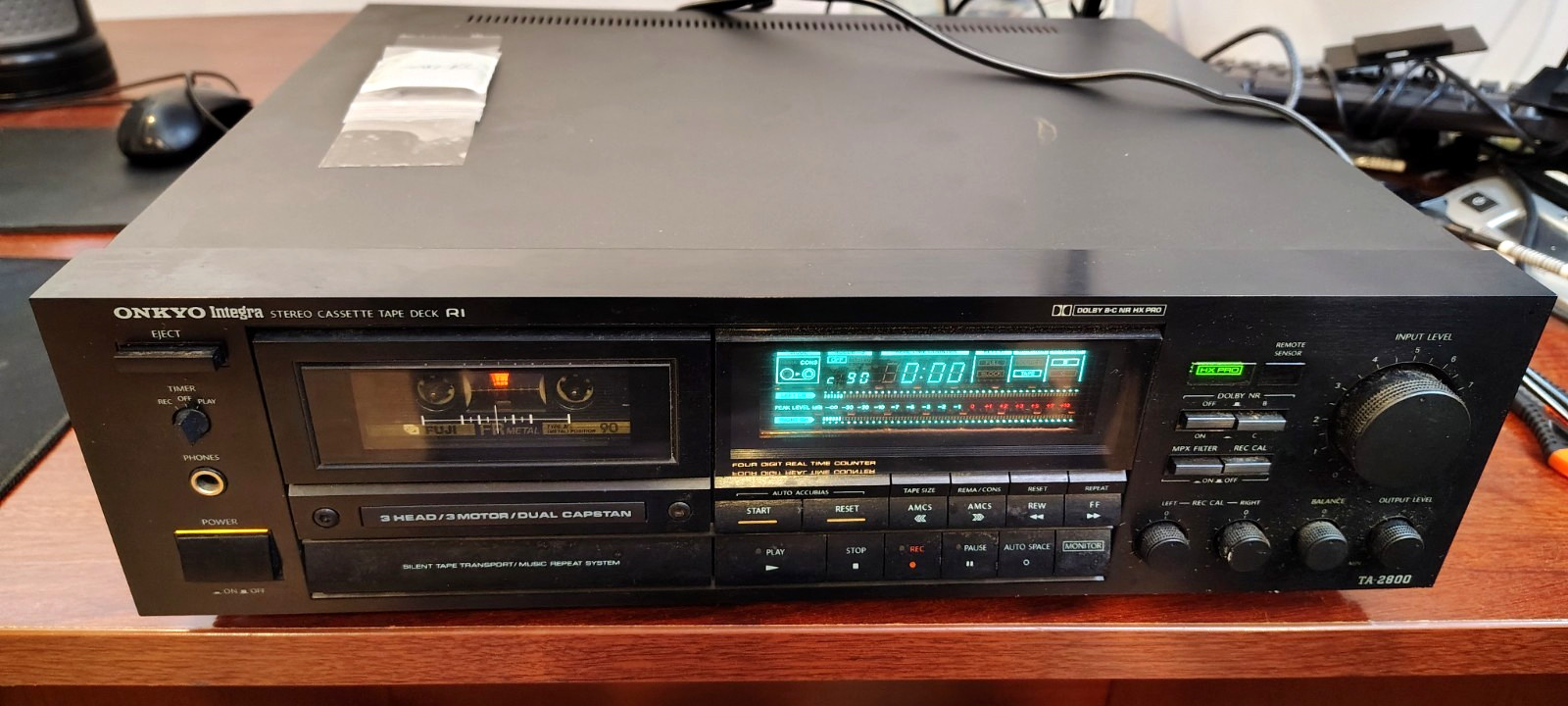
One of the most distinctive features is the “Silent Tape Transport.” When you hit play, the head block rises smoothly and silently into position, guided by microcomputer control. It’s not just a gimmick—it reduces mechanical shock, ensures precise head-to-tape alignment, and gives the whole operation a premium feel. Belt-driven and single-capstan, the transport balances durability with refinement, and users report it runs quietly even after decades.
Dolby B, C, and HX-Pro Noise Reduction
The TA-2048 supports Dolby B and C for noise reduction, plus HX-Pro (Headroom Extension) for improved high-frequency headroom during recording. HX-Pro is a subtle but important feature—it dynamically adjusts the bias to prevent saturation on metal and high-output tapes, letting you record cleaner highs without distortion. If you're serious about tape fidelity, this trio of noise management tools gives you real control over the recording chain.
Auto Space Function and AMCS
For tape editors and mixtape builders, the “Auto Space Function” automatically inserts a 5-second silent gap between recordings—useful for creating clean separations. Even more interesting is the “Automatic-Music Control System (AMCS),” which lets you skip to adjacent music sections on a tape, almost like track skipping on a CD. It’s an early attempt at making tape more navigable, and while it relies on detecting silent gaps, it works reasonably well with well-edited recordings.
Manual Tape Type Selection and Repeat Modes
The deck requires manual tape type selection—no auto-sensing—which means you have to choose Type I, CrO2, or Metal. But that also means no guesswork from the electronics; you’re in full control of bias and equalization. It also offers two repeat modes: single (repeat one side) and full repeat (play both sides continuously), making it handy for background listening or monitoring.
Collectibility & Value
The Onkyo TA-2048 doesn’t command the prices of some legendary decks, but it’s far from forgotten. Recent auction listings show a wide range: one unit drew a bid of €140 in December 2025, while another sat at just €6 in March 2026—proof that condition and functionality make all the difference. Another was listed for SEK 1,050 (roughly $100), suggesting strong European interest.
Like any 35+ year-old belt-driven deck, the most common failure point is the transport. One user reported a unit with “no play, ff or rw functions at all”—a classic symptom of worn belts or dried lubricants. The good news? Replacement belt kits are available on Amazon, and the Sankyo-derived transport (common in many Onkyo decks) is known to be repairable with basic tools. The fact that a forum member once said, “Yes! Get it back to operating condition!” says a lot—owners see this as a machine worth saving, not scrapping.
eBay Listings


As an eBay Partner, we earn from qualifying purchases. This helps support our independent vintage technology research.
Related Models
- Onkyo SC-601 (1977)
- Onkyo SCEPTER-200 (1982)
- Onkyo SCEPTER-300 (1981)
- Onkyo SCEPTER-500 (1980)
- Akai AM-2850 (1975)
- Akai AP-206 (1975)
- Nakamichi BX-1 (1985)
- Acoustic Research research-ar-17 (1978)
- Acoustic Research AR-19 (1994)
- Acoustic Research AR-1W (1954)