Onkyo TA-2035 (1982–1984)
That first hiss of tape, the soft glow of the fluorescent meters—this deck doesn’t just play cassettes, it remembers them.
Overview
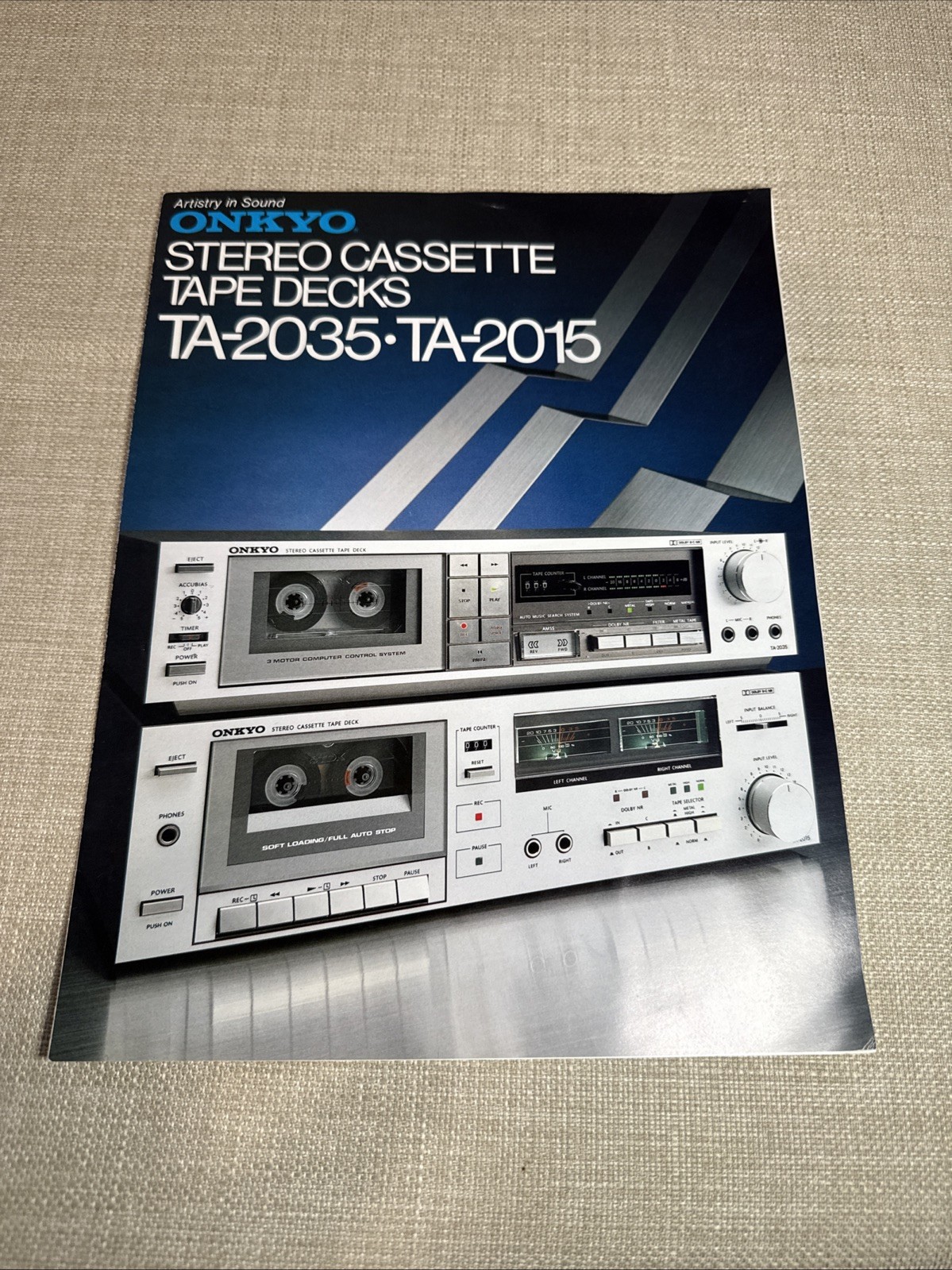
The Onkyo TA-2035 isn’t the loudest name in vintage cassette decks, but if you’ve ever spent an evening making mixtapes with surgical precision or chasing that elusive “live” sound on a chrome tape, this machine earns your respect. Built between 1982 and 1984, it arrived when cassette technology had matured—Dolby-C was the new frontier, metal tapes were gaining ground, and Japanese engineering was pushing the limits of what a modestly priced deck could achieve. And according to one contemporary reviewer, the TA-2035 stood as “a very good example of how much performance and operating ease can be built into even a quite modestly priced cassette deck today.”
This is a two-head, single-capstan cassette deck with a clean, functional layout and a feature set that balances automation with manual control. It doesn’t pretend to be a studio beast, but it’s no toy either. With Dolby-B and Dolby-C noise reduction, automatic tape-type sensing, and a microprocessor-controlled transport, it offered a level of sophistication that made tape recording feel modern in the early '80s. And while it lacks the flash of high-end Nakamichis or the cult status of certain Technics models, the TA-2035 delivers a solid, reliable performance that still holds up—if you can find one that’s been cared for.
Specifications
| Manufacturer | Onkyo Corporation |
| Type / Heads | two-head, single-capstan |
| Track System | 4-track, 2-channel stereo |
| Tape Speed | 4.8 cm/s |
| Heads | 1 x record/playback, 1 x erase; Record/playback head material: hardened permalloy |
| Noise reduction | Dolby-B and Dolby-C |
| Tape Type | type I, CrO2, Metal; automatic via cassette cutouts with manual override |
| Wow-and-flutter | 0.32% wrms and 0.45% DIN peak-weighted |
| Frequency Response (measured) | +2.5, — 2 dB between the 31.5-Hz and 18-kHz test-tape limits in the chrome/metal equalization position; with the ferric test tape response fell to — 3 dB at approximately 16 kHz ( — 6.5 dB at 18 kHz) |
| Signal to Noise Ratio | 80dB (dolby C) |
| Fast-forward/rewind time | 75 seconds for a C-60 cassette; 112 seconds for a C-90 |
| Tape counter | three-digit mechanical |
| Level meter | peak-reading fluorescent display with ten segments per channel, calibrated from -20 to +6 dB |
| Inputs | line-level inputs (rear), microphone inputs (front-panel phone jacks) |
| Outputs | line-level output jacks (rear) |
| Line input sensitivity | 0.056 volt (56 mV) for 0-dB reading |
| Line output level | 0.5 volt at 0-dB reading |
| Microphone input sensitivity | 0.26 mV for 0 dB |
| Dimensions | 16-1/2 inches wide, 4 inches high, 9-5/8 inches deep |
| Weight | approximately 10 pounds |
| Power consumption | 20 watts |
| Semiconductors | 71 x transistors, 41 x diodes, 8 x IC |
Key Features
Microprocessor Intelligence, Not Just Mechanics
The TA-2035 wasn’t just spinning tape—it was thinking about it. A built-in microprocessor handles transport functions and powers the Automatic Music Selection System (AMMS), a feature that lets you skim through a cassette by playing each silent gap for 15 seconds before skipping to the next. It works in both directions, which was rare at the time, and while it might not replace a CD player’s track search, for 1982 it was a clever way to navigate mixed tapes without fast-forward fatigue.
Smooth, Silent Transport Design
Instead of the clunky solenoids found in many decks, the TA-2035 uses a d.c. motor to move the head assembly. The result? A smoother, quieter action that reduces mechanical shock and wear over time. Combined with a belt-driven single-capstan system, this contributes to the deck’s stable tape speed and low wow-and-flutter—measured at 0.32% wrms, a solid figure for its class.
Smart Tape Handling and Calibration
Tape type selection is automatic, reading the cutouts on the cassette shell for Type I, CrO2, or Metal, but you can override it manually. The Accubias control—adjustable up to ±5 dB at 15 kHz—lets you fine-tune bias for non-metal tapes, a nod to serious tapers who wanted to optimize recordings for their favorite brands. Factory settings were reportedly tuned for Maxell UDXL-I (ferric), UDXL-II (chrome), and MX (metal) tapes, so if you’re restoring one, that’s a good starting point.
Convenient, If Limited, Connectivity
The front panel hosts two phone jacks for microphone input, which automatically disconnects the rear line-level inputs—a neat touch for voiceovers or live recording. The large dual-concentric knob controls recording levels for both line and mic sources, making adjustments intuitive. But be aware: there’s no output-level control during playback. What you record is what you get, routed straight to the line outputs.
Visual Feedback That Works
The peak-reading fluorescent display is a joy to watch—ten segments per channel, glowing green from -20 to +6 dB. It’s accurate and responsive, helping you nail levels without distortion. LED indicators keep you informed about tape type, Dolby mode, and auto/manual status, so you’re never guessing what the deck is doing.
Extras That Add Up
A pushbutton engages the FM-multiplex filter, cleaning up stereo broadcasts recorded off-air. There’s a headphone jack, a DIN socket for Onkyo’s optional RC-5T remote, and a timer switch for remote recording setups. You can even change transport modes—say, from play to rewind—without hitting stop first, a small convenience that longtime users appreciate.
Historical Context
The TA-2035 was part of a family of Onkyo cassette decks that included the TA-2015, TA-2025, TA-2055, and TA-2070, though the exact hierarchy within the lineup isn’t documented. What is clear is that Onkyo was aiming for the upper-mid tier of the consumer market—offering advanced features without the premium price tag. At $300 when new (about $900 today), it competed with models from Pioneer, Sony, and Yamaha that offered similar specs but sometimes with less thoughtful ergonomics. This was the era when cassettes were going high-fidelity, and the TA-2035 was right in the thick of it.
Collectibility & Value
The TA-2035 isn’t a blue-chip collectible, but it has a quiet following among cassette enthusiasts who value reliability and clean recording performance. A past listing on Reverb showed one selling for $149 plus $30 shipping four years ago—no guarantee of current value, but a useful reference point. These decks were built well, but time has not been kind to all of them.
The most common failure? The idler wheel. When it degrades, the deck may start to play for a few seconds before shutting down—afflicting fast-forward, rewind, and even playback. Some technicians have repaired them using JB Weld to restore the rubber surface, while others source parts decks with brass pulleys as replacements. Other aging issues—like dried lubricants or worn belts—are typical for the era, but the modular design and widespread use of standard components make repairs feasible.
If you’re hunting for one, prioritize units that have been serviced or at least stored dry and dust-free. A clean head and capstan, responsive buttons, and smooth tape handling are good signs. And if the fluorescent meter still lights up evenly? You’ve struck gold.
eBay Listings


As an eBay Partner, we earn from qualifying purchases. This helps support our independent vintage technology research.
Related Models
- Onkyo SC-1500 (1978)
- Onkyo TA-2047 (1976)
- Onkyo TA-2500 (1973)
- Onkyo A-812XG (1980)
- Onkyo TX-6500 (1977)
- Luxman L-530 (1975)
- Luxman R-404 (1975)
- Luxman RV-371 (1975)
- Luxman SQ-38U (1975)
- Luxman T-14 (1972)