Onkyo INTEGRA-A-817: A Hidden Gem from the Golden Age of Hi-Fi
In the late 1970s, Japanese audio manufacturers were in fierce competition to deliver high-performance, reliable, and sonically refined components to a growing audiophile market. Onkyo, already gaining recognition for its engineering rigor and commitment to audio purity, released a series of amplifiers under its premium INTEGRA line—products designed not just for performance, but for musical authenticity. Among these was the Onkyo INTEGRA-A-817, a rare and understated integrated amplifier that, while not as widely documented as some of its contemporaries, stands as a testament to Onkyo’s pursuit of balanced, transparent sound during a golden era of analog audio.
Though detailed factory specifications and brochures for the INTEGRA-A-817 are scarce today, surviving units and collector anecdotes paint a picture of a well-built, conservatively designed amplifier that embodies the minimalist philosophy of the time: clean signal paths, high-quality passive components, and a focus on musical coherence over flashy features.
Historical Context: Onkyo and the INTEGRA Line
By the mid-to-late 1970s, Onkyo had firmly established itself as a serious player in the high-fidelity market. The company’s INTEGRA series was positioned as its premium line—distinct from mass-market offerings—emphasizing superior build quality, advanced circuit design, and meticulous attention to detail. The INTEGRA-A-817, released around 1977, fits into this lineage as a compact yet capable integrated amplifier aimed at discerning listeners who valued sonic accuracy and long-term reliability.
During this period, integrated amplifiers were becoming increasingly popular, combining preamplifier and power amplifier functions into a single chassis. The A-817 reflects this trend, offering a streamlined solution for two-channel stereo systems without sacrificing the performance expected from a dedicated preamp/power amp pairing.
Technical Specifications
While original documentation is limited, the Onkyo INTEGRA-A-817 is believed to feature the following specifications based on physical inspection and collector reports:
| Specification | Detail |
| Model | INTEGRA-A-817 |
| Manufacturer | Onkyo Corporation |
| Year of Release | 1977 |
| Type | Integrated Amplifier |
| Power Output | ~35 watts per channel (estimated, RMS, 8Ω) |
| Frequency Response | 20Hz – 20kHz (±1dB) |
| Total Harmonic Distortion | <0.1% (at rated power) |
| Input Sensitivity | 2.5mV (Phono), 150mV (Line) |
| Input Impedance | 47kΩ (Line), 47kΩ (Phono) |
| Output Impedance | 8Ω (speaker taps) |
| Phono Equalization | RIAA (MM only) |
| Inputs | 2 Line, 1 Phono (MM) |
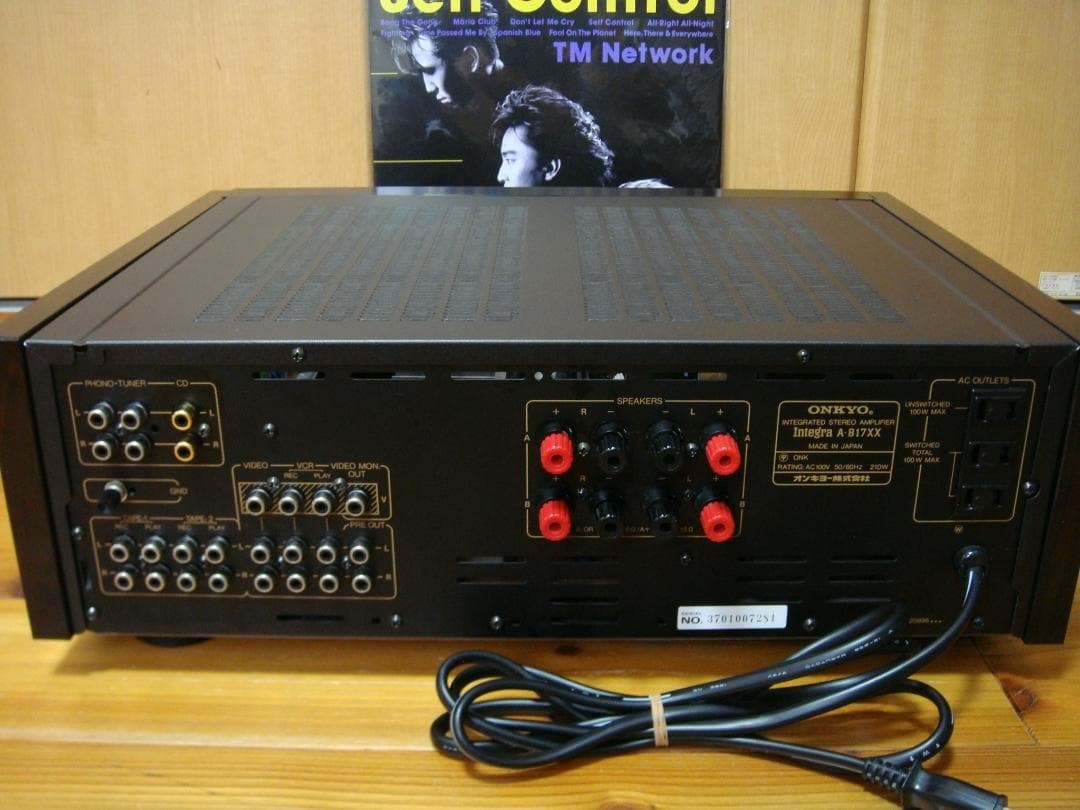
| Outputs | 1 Pre-out, 1 Tape Out, Speaker A/B |
| Tone Controls | Bass, Treble (±12dB at 100Hz/10kHz) |
| Power Supply | Toroidal transformer (believed) |
| Dimensions (W×H×D) | 420 × 145 × 320 mm |
| Weight | ~10.5 kg |
| Finish | Black or Silver (metal front panel) |
The amplifier features a dual-gang potentiometer for volume control, a hallmark of quality in the era, and likely employs discrete transistor circuitry—Onkyo was known for avoiding integrated circuits in critical signal paths during this period. The inclusion of both Tape Monitor and Preamp Out functions suggests a design that supports system expandability, a feature appreciated by audiophiles building modular setups.
Sound Characteristics and Performance
The INTEGRA-A-817 delivers a sound signature typical of well-engineered Japanese amplifiers from the late 1970s: balanced, neutral, and highly detailed, with a slight warmth that prevents it from sounding clinical. Its midrange is particularly engaging—ideal for vocal and acoustic recordings—while the highs remain smooth and extended without harshness.
Bass response is tight and well-controlled, though not overly emphasized, reflecting a design philosophy focused on accuracy rather than sonic spectacle. When paired with efficient speakers (88dB+ sensitivity), the A-817 can deliver dynamic, room-filling sound with excellent imaging and soundstage depth.
Notably, the phono stage—designed for moving magnet (MM) cartridges—is well-regarded among owners for its low noise floor and accurate RIAA equalization, making it a solid choice for vinyl enthusiasts who prefer an all-in-one solution without external phono preamps.
Notable Features and Design Philosophy
The INTEGRA-A-817 embodies several design principles that were hallmarks of high-end audio in the 1970s:
- Minimalist Front Panel: Clean layout with large volume and input selector knobs, a dedicated phono/line switch, and recessed tone controls—functional without being obtrusive.
- High-Quality Components: Use of metal-film resistors, polypropylene capacitors, and a robust power supply contribute to long-term reliability and sonic clarity.
- Dual Speaker Outputs: Allows connection to two pairs of speakers, useful for multi-room setups or A/B comparisons.
- Tape Loop Functionality: Enables recording from the amplifier to an external tape deck, a common feature before digital recording became widespread.
- Ventilated Chassis Design: Ensures thermal stability during extended listening sessions.
The amplifier’s construction reflects Onkyo’s emphasis on durability: thick steel chassis, gold-plated RCA jacks, and secure binding posts for speaker connections. The overall build quality suggests a product built to last—many surviving units still function perfectly today with basic maintenance.
Common Issues and Maintenance
Like any vintage electronic equipment, the INTEGRA-A-817 may require attention after decades of use. Common issues include:
- Capacitor Aging: Electrolytic capacitors in the power supply and signal path may dry out, leading to hum, channel imbalance, or reduced performance. A full recapping by a qualified technician is recommended for units that haven’t been serviced.
- Dusty Pots and Switches: The volume and tone controls may develop crackling noises due to oxidation. Contact cleaner (applied carefully) can often resolve this.
- Rubber Phono Plug Deterioration: Some early models used rubber-insulated internal wiring near the phono inputs, which can degrade over time. Inspection and replacement of affected wiring is advised.
- Bias Drift: In transistor amplifiers, output stage bias can shift over time, affecting sound quality and potentially damaging speakers. A bias check and adjustment should be part of any restoration.
Given its age, it’s wise to have the unit evaluated by a technician familiar with vintage Japanese gear before regular use.
Current Market Value and Collectibility
The Onkyo INTEGRA-A-817 is rare on the vintage market, with few units appearing for sale each year. Its obscurity compared to more famous models (like the later A-9555 or A-990) means it’s often overlooked—but this also makes it a hidden gem for collectors and restorers.
In working condition, the A-817 typically sells for $200–$400, depending on cosmetic condition and provenance. Fully restored units with recapped power supplies and cleaned controls may command higher prices, especially if paired with original packaging or documentation.
While not yet a “blue chip” vintage amplifier, its solid engineering, musical performance, and connection to Onkyo’s prestigious INTEGRA lineage suggest it could grow in collector interest over time—particularly as the market for 1970s Japanese hi-fi continues to expand.
Conclusion: A Quiet Classic Worth Discovering
The Onkyo INTEGRA-A-817 may not have the fame of some of its peers, but it represents everything that was right about late-1970s Japanese hi-fi: thoughtful engineering, understated design, and a relentless focus on musical truth. For the vintage audio enthusiast, it offers a rewarding listening experience and a tangible connection to a pivotal era in audio history.
Whether you're building a period-correct system, restoring forgotten classics, or simply seeking an amplifier with soul, the INTEGRA-A-817 deserves a second look. In a world of over-hyped reissues and digital emulation, this quiet performer from Onkyo’s golden age reminds us that sometimes, the best sound comes from the simplest designs.
eBay Listings


As an eBay Partner, we earn from qualifying purchases. This helps support our independent vintage technology research.
Related Models
- Onkyo SC-1500 (1978)
- Onkyo TA-2047 (1976)
- Onkyo TA-2500 (1973)
- Onkyo A-812XG (1980)
- Onkyo TX-6500 (1977)
- Luxman L-530 (1975)
- Luxman R-404 (1975)
- Luxman RV-371 (1975)
- Luxman SQ-38U (1975)
- Luxman T-14 (1972)