Neumann M147 Tube
A modern valve microphone that uses the U47's capsule lineage, and became Neumann's fastest-selling mic almost the moment it shipped.
Overview
The M147 Tube arrived in late 1998 at a $1,995 US price. The family name had been earning its keep since 1928. Neumann's own advertising billed it as the company's fastest-selling microphone ever. That sounds like marketing, but the spec backs it up: the K49 capsule from the U47 and M49, a valve impedance converter, and a transformerless output stage. Old capsule, new output topology. That combination is the whole story of the mic, and it explains why engineers took to it quickly and why it sits where it does in the Neumann line.
The capsule question needs sorting out, because the period coverage wasn't consistent. Neumann's own brochure copy calls it the K49, drawn from the U47 and M49. The earliest announcement in Studio Sound (November 1998, p.29) instead called it the K47 made famous in the U47 and U47 FET. Either way, it points at the same family of one-inch dual-diaphragm designs, and the marketing made sure buyers knew it. The electrical architecture is not in dispute. A specially selected triode gives roughly 10dB of gain to the capsule signal, and that feeds a transformerless solid-state output stage. Studio Sound (February 1999) noted that because the TLM-style output stage is effectively transparent, the sonic character of the M147 is determined entirely by the valve. You hear the tube, not a tube coloring a transformer.
The design has practical consequences. The transformerless output means less likelihood of core saturation and a better ability to drive long cables and capacitive loads, per Studio Sound's (February 1999) assessment. Neumann's own advertising described the result as "a more controlled, uncoloured audio signal from capsule to output." The mic is also quiet for a valve design. Neumann claimed low self-noise for a tube mic, and the brochure called it an "ultra low noise microphone." It handles a claimed 130dB SPL without distortion. That is respectable headroom for a valve condenser, and it makes the mic usable on sources that would send lesser tube mics running for the pad switch.
There is no pad switch. There is no low-frequency filter either. The M147 is cardioid only. The power supply is the N149, the same one shipped with the M149, and it is just as bare: an IEC mains connector on the back, Tuchel in and XLR out on the front alongside an illuminated power switch, and nothing else. Studio Sound (February 1999) called the supply about as basic as it is possible to be, and meant it as an observation rather than a complaint. The mic connects to it via 8-pin Tuchels on a notably lightweight cable. The review noted the cable is convenient but will need slightly more careful handling than heavier-duty wiring.
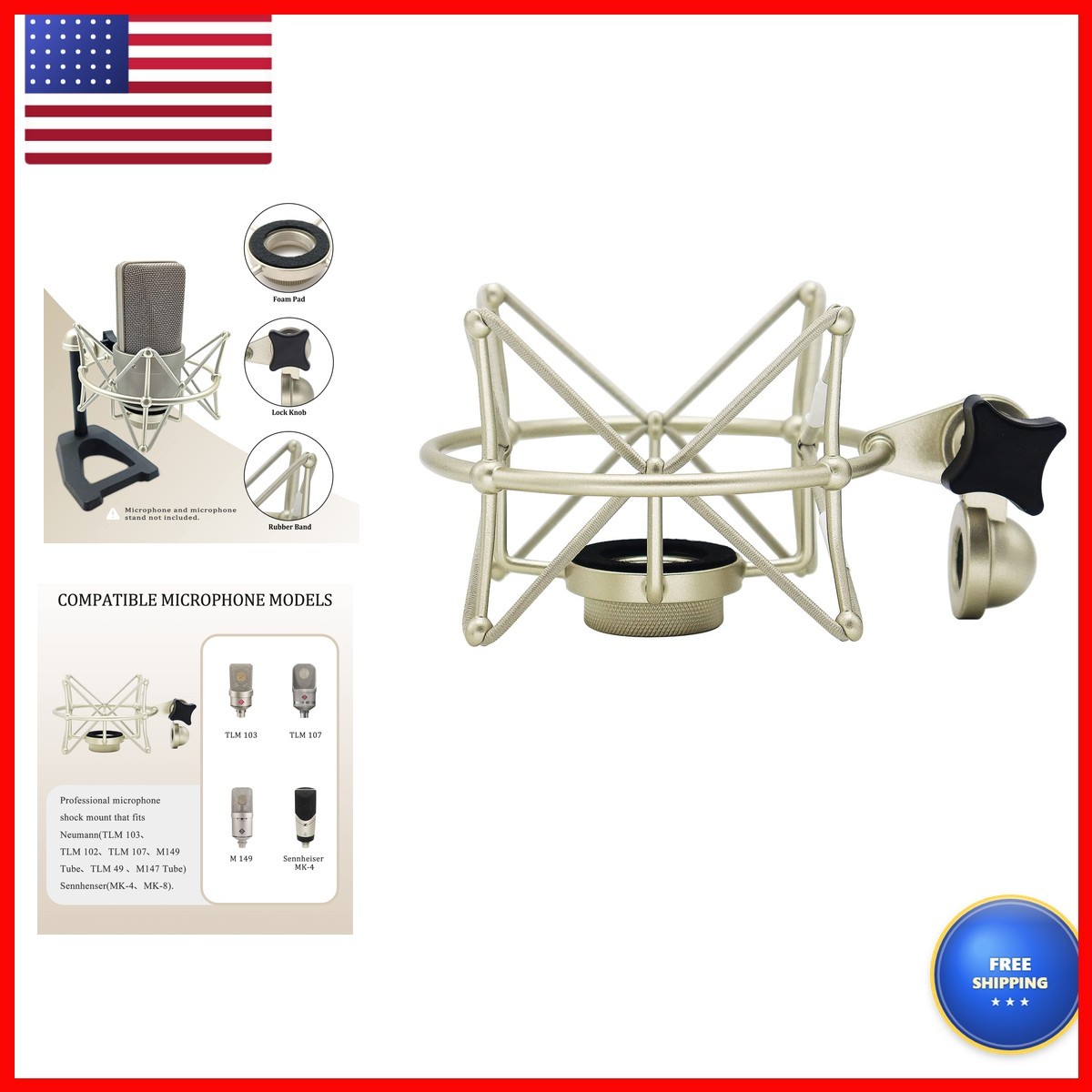
Physically, the M147 is a classically shaped matt nickel body with the grille of a U47 on the smaller overall shape of a TLM-150. In person it reads as a satin silver TLM150 with a multiway connector in its base instead of an XLR. The small size is a real asset in a valve microphone. The internal shock-mounting is effective enough that the mic can poke into places many of its kind could not reach, and the basic swivel stand-mount attaches right at the base. The kit ships in a flight case with the microphone, power supply, cables, and that mount. The suspension mount and windshield are available but not included as standard. Owners report the usual routine with any valve mic: power it up, let it warm, and leave it plugged in. EQ (March 1999, p.60) described a compensation circuit built into the N149 A supply that monitors voltage level through the length of the cable and adjusts accordingly.
On the sound, the period press was close to unanimous. Studio Sound (February 1999) described the smoothness as like silk, with the classic character shining through in its most open and versatile form, a superb spectral balance, and minimal off-axis coloration. In the reviewer's words, that confirmed a well-controlled microphone. EQ (October 2000, p.163) framed it against the vintage market directly: for years, tube Neumanns like the U47 had been high-priced, highly prized commodities, and the M147 offered a route into that character without the vintage premium or the vintage risk. That positioning is why the mic found its way into so many rooms as a spot mic, which the brochure itself pitched it as equally at home doing. It is also why Mix (December 2003, p.?) eventually listed the M147 tube alongside the U87, U89, U67, and TLM103 in the category of audio classics.
That's a remarkable arc for a microphone that was still new in the late 1990s. Mix (October 1998, p.161) covered its launch in a technology spotlight, noting the transformerless output stage's protection from RF interference and its avoidance of hysteresis, core saturation overload, and HF phase shifts that can result from transformer-based designs — the technical case for the topology in plain language. Neumann marked its 70th anniversary the same year the M147 shipped, and the mic reads as a deliberate answer to the many manufacturers who had spent the preceding decades chasing the reflected glory of old Neumanns. Rather than clone a U47 outright, Neumann took the capsule lineage, kept the valve, and wrapped it in modern output electronics.
The caveats are the ones that come with any cardioid-only valve condenser. There are no polar pattern options, no pad and no filter. If a session needs figure-eight or omni, this is the wrong tool, and the M149 exists for exactly that. The valve means warm-up time and eventual tube service, and the lightweight Tuchel cable rewards careful handling. The 1999 review described the sound as old Neumann character, presented in its most open and versatile form, at a price that undercut the vintage market.
eBay Listings


As an eBay Partner, we earn from qualifying purchases. This helps support our independent vintage technology research.