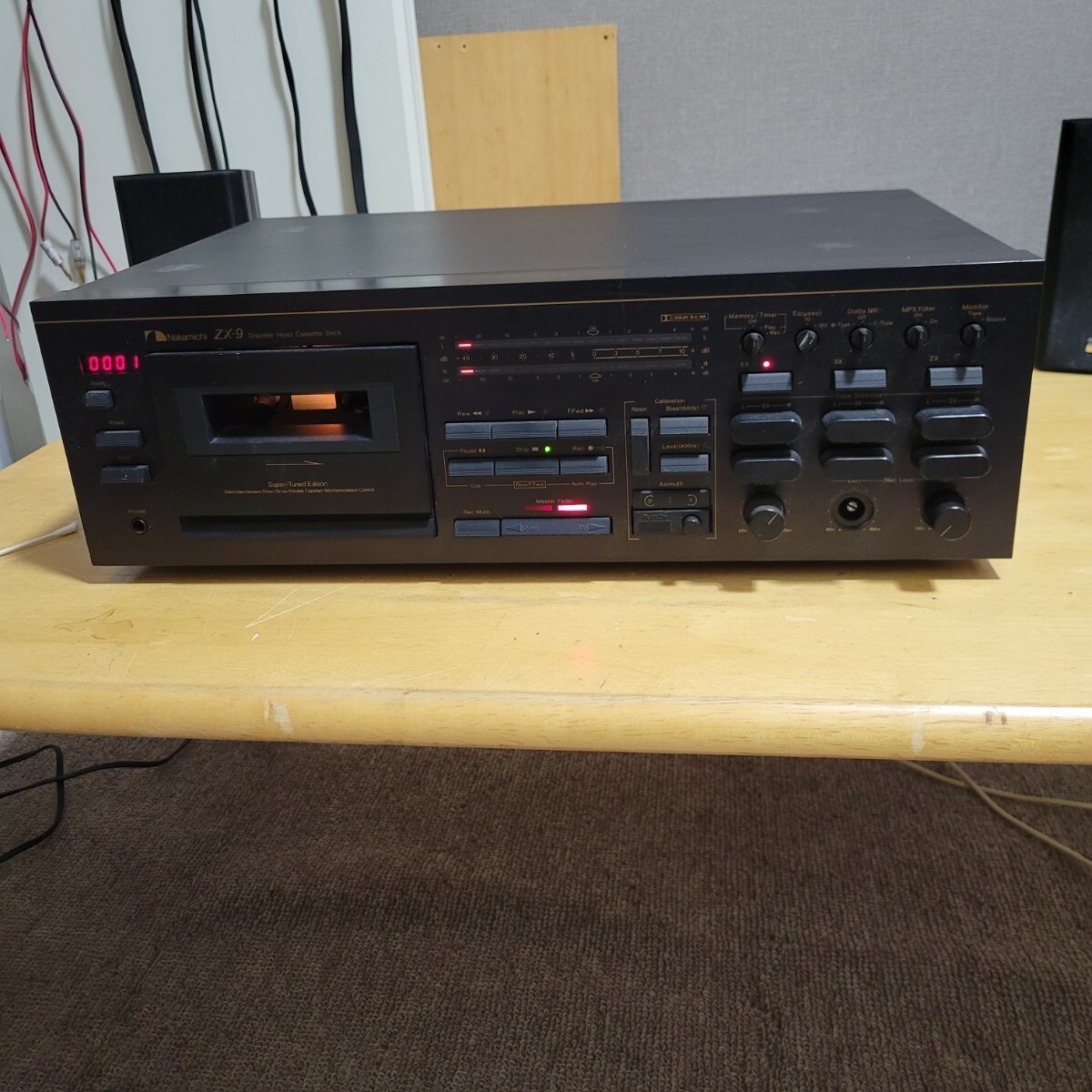
Nakamichi ZX-9: The Precision Pioneer of Cassette Fidelity
In the late 1970s and early 1980s, the cassette format was undergoing a quiet revolution. Once dismissed as a medium for voice recording and portable music, compact cassettes began to earn serious respect among audiophiles—thanks in large part to Japanese engineering excellence. At the forefront of this transformation stood Nakamichi, a company synonymous with high-fidelity tape reproduction. Among their esteemed lineup, the Nakamichi ZX-9, introduced in 1980, represented a critical step toward the pinnacle of cassette deck performance. Though it preceded the legendary Dragon, the ZX-9 laid the groundwork with its precision mechanics, advanced azimuth control, and unwavering commitment to sonic accuracy.
Technical Specifications
The ZX-9 was engineered for users who demanded more than convenience—they sought studio-grade tape playback with minimal compromise. While not as radical as later models with auto-azimuth correction, the ZX-9 incorporated many of the design philosophies that would define Nakamichi’s reputation for excellence.
| Specification | Detail |
| Year Introduced | 1980 |
| Type | 3-Head, Dual Capstan Reel-to-Reel Style |
| Tape Speed | 1⅞ ips (4.76 cm/s) |
| Heads | Separate Record, Playback, Erase |
| Motor System | Dual Direct-Drive Motors |
| Wow and Flutter | < 0.055% (Dolby On) |
| Frequency Response | 20Hz – 20kHz (with Dolby C) |
| Signal-to-Noise Ratio | 72 dB (Dolby B), 80 dB (Dolby C) |
| Total Harmonic Distortion | < 1.5% |
| Input/Output | Line In/Out (RCA), Mic In (¼") |
| Dimensions | 440 mm × 140 mm × 335 mm |
| Weight | 13.5 kg (approx. 30 lbs) |
| Power Requirement | 120V AC, 60 Hz (North America) |
The ZX-9 was built around a rigid, vibration-resistant chassis with a full metal tape transport. Its dual capstan system—featuring two precision-machined rollers—ensured exceptional tape-to-head contact and speed stability, reducing modulation noise and improving high-frequency response. The three-head configuration allowed for true independent monitoring during recording, a feature previously reserved for professional reel-to-reel decks.
Sound Characteristics and Performance
The Nakamichi ZX-9 delivered a remarkably transparent and dynamic sound signature for its era. Its separate playback head, combined with precision tape guidance, ensured excellent channel separation and frequency extension. When paired with high-quality Type II (chrome) or Type IV (metal) tapes and used with Dolby C noise reduction, the ZX-9 could reproduce music with startling clarity and detail.
Listeners often describe the ZX-9’s sonic character as neutral, articulate, and spacious—a far cry from the muffled, compressed sound associated with budget cassette players. The deck excelled at reproducing acoustic instruments and vocals with natural timbre, while maintaining tight bass control and crisp highs. Its low wow and flutter made it particularly suitable for classical and jazz recordings, where timing and pitch stability are critical.
While it lacked the automatic azimuth correction of the later Dragon, the ZX-9’s fixed but precisely aligned heads offered excellent performance when properly maintained. With careful tape selection and calibration, the ZX-9 could rival the fidelity of many open-reel systems of the time.
Notable Features and Innovations
The ZX-9 was not merely a high-end consumer product—it was a statement of engineering intent. Among its most significant features:
- Dual Direct-Drive Capstans: Unlike most cassette decks that used a single capstan and pinch roller, the ZX-9 employed two independently driven capstans. This minimized tape slippage and ensured consistent tension, reducing speed variations and head wear.
- Three-Head Configuration: Separate record, playback, and erase heads allowed for real-time monitoring without generational loss, a feature highly valued by home recordists and audiophiles.
- Precision Mechanical Design: The transport used brass and stainless steel components throughout, minimizing resonance and ensuring long-term durability. The reel tables were machined for perfect balance.
- Dolby C Compatibility: At a time when Dolby B was standard, the inclusion of Dolby C noise reduction gave the ZX-9 a significant edge in dynamic range and high-frequency clarity.
- Professional-Grade Metering: Large VU meters provided accurate level monitoring, while switchable meter functions allowed users to monitor input, output, or bias levels during recording.
- Manual Tape Selector: Users could manually select tape types (I, II, IV), allowing for optimal bias and equalization settings—a feature that appealed to advanced users and tape enthusiasts.
Common Issues and Maintenance
As with all vintage tape decks, the Nakamichi ZX-9 requires careful maintenance to perform at its best. After 40+ years, several components are prone to wear or degradation:
- Rubber Components: The pinch rollers and idler tires (if present in certain variants) can harden or crack over time. These should be replaced with modern equivalents to restore proper tape tension and speed accuracy.
- Head Alignment: While the heads are fixed, physical shock or mishandling can misalign them. A professional demagnetization and alignment service is recommended for optimal performance.
- Capstan Shafts and Bearings: Dust and dried lubricant can cause increased friction. Cleaning and relubrication with appropriate grease are essential for smooth operation.
- Capacitor Aging: The power supply and audio circuits contain electrolytic capacitors that may have dried out. A recap (capacitor replacement) by a qualified technician can prevent noise, distortion, or failure.
- Head Wear: The separate playback head, while durable, can wear down with heavy use. A head replacement or resurfacing may be necessary for decks with high usage.
Regular cleaning with isopropyl alcohol and demagnetization every 50–100 hours of use will help preserve sound quality and extend the life of the deck.
Current Market Value and Collectibility
The Nakamichi ZX-9 occupies a respected but somewhat under-the-radar position in the vintage audio market. Unlike the Dragon or CR-7A, it is not as widely celebrated, but it is increasingly sought after by cassette purists and restoration enthusiasts.
In working condition, a well-maintained ZX-9 typically sells for $400–$700, depending on cosmetic condition, included accessories, and performance. Fully restored units with new belts, cleaned heads, and recapped electronics may command higher prices, especially if paired with original packaging or documentation.
Its collectibility is enhanced by its role as a bridge between Nakamichi’s early high-end decks and the later, more automated models. It represents a time when mechanical precision and user involvement were central to the audiophile experience.
Conclusion and Legacy
The Nakamichi ZX-9 may not have the fame of its successors, but it stands as a testament to the company’s relentless pursuit of perfection in analog tape reproduction. It combined professional-grade engineering with consumer accessibility, offering a level of performance that few could match in 1980.
For today’s vintage audio enthusiasts, the ZX-9 is more than a relic—it’s a working masterpiece. Restoring and using a ZX-9 connects the listener to a golden era of analog fidelity, where every component was crafted with care and every note was reproduced with integrity.
While cassette decks have long since been eclipsed by digital formats, the ZX-9 reminds us that analog done right is timeless. For those willing to invest in its upkeep, the Nakamichi ZX-9 remains one of the finest cassette decks ever made—a quiet pioneer in the evolution of home audio.
eBay Listings



As an eBay Partner, we earn from qualifying purchases. This helps support our independent vintage technology research.
Related Models
- Nakamichi 1000ZXL (1985)
- Nakamichi BX-150 (1983)
- Nakamichi CR-4 (1969)
- Nakamichi 1000-II (1974)
- Nakamichi 1000ZXL-LIMITED (1985)
- Sony TC-2050SD (1978)
- Aiwa AD-F990 (1993)
- Kenwood KX-3060 (1982)
- Sony TC-2130A (1974)
- Sony TC-2220 (1972)