Nakamichi MR-2 (1986–1994)
A no-nonsense pro cassette deck that delivers studio-grade performance without the studio price tag—just watch out for that pesky pitch control.
Overview
The Nakamichi MR-2 isn’t flashy, but it doesn’t need to be. Built between 1986 and 1994, this 2-head professional cassette deck was designed for engineers, broadcasters, and serious home recordists who wanted Nakamichi’s legendary tape-handling precision without the premium cost of the flagship MR-1. At its original MSRP of $700, it was positioned as the more accessible sibling in Nakamichi’s professional range—still expensive by consumer standards, but a bargain for a machine that could handle daily use in semi-pro environments.
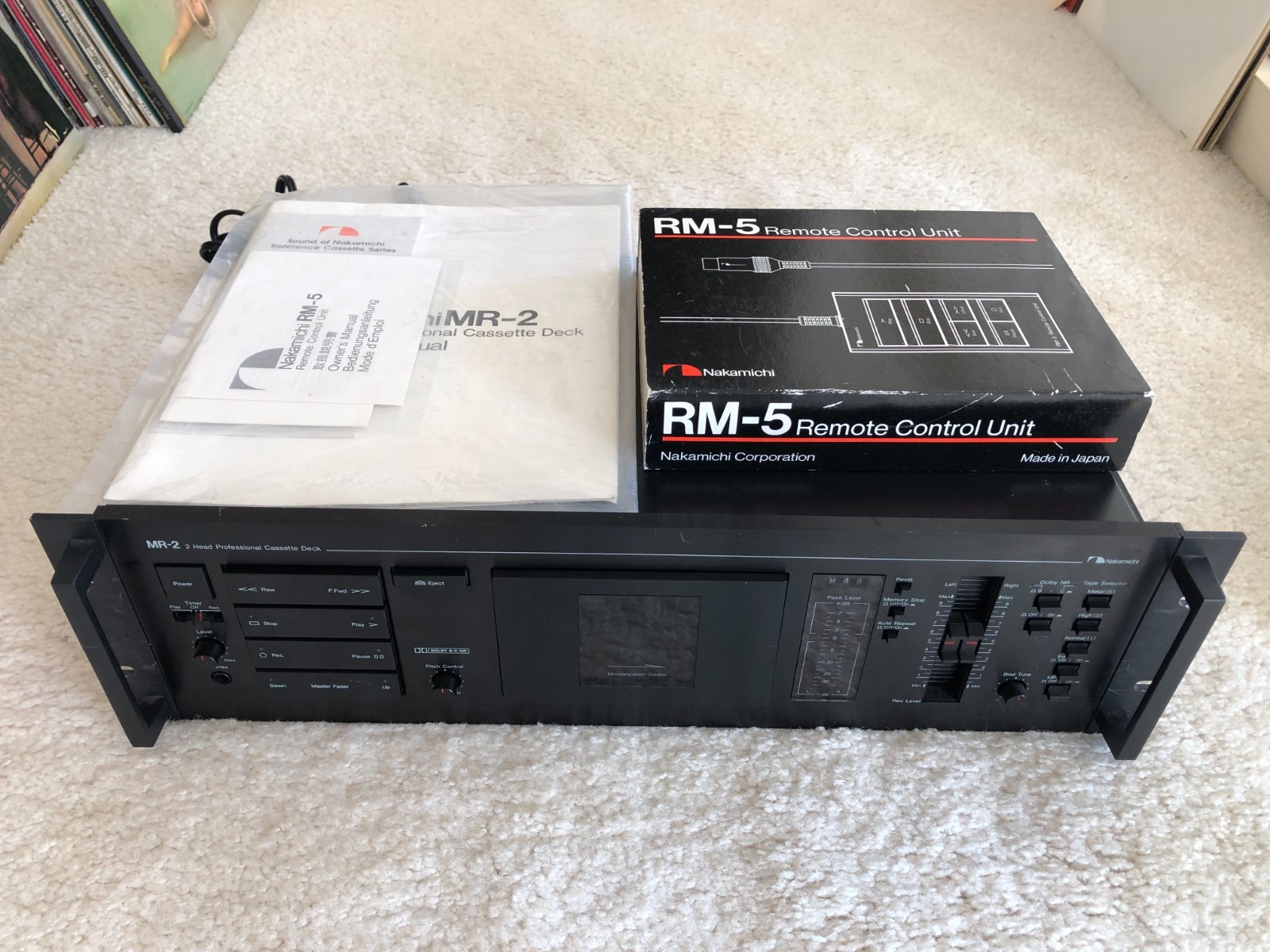
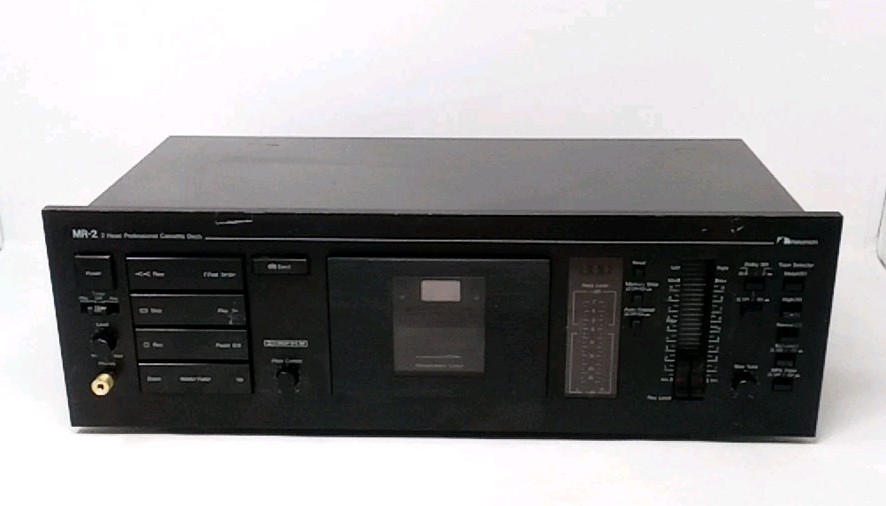
Created as a professional version with balanced ins/outs and pitch control, the MR-2 skips the consumer frills and goes straight to what matters: reliable transport, clean signal paths, and precise recording. It’s a stereo cassette deck built like a tank, with rack-mounting handles and a flat front panel that says “get to work” more than “show off.” There’s no auto-reverse, no flashy display, no gimmicks—just balanced XLR I/O, manual tape type selection, and a transport that means business.
Owners report it stands head and shoulders above 95% of tape decks out there, especially when it comes to tracking metal tapes with tight, dynamic results. While it’s not the best Nakamichi ever made, it’s undeniably part of their pro lineage. If you're looking for a workhorse that can still deliver that Nakamichi clarity—without needing a three-head, real-time monitoring setup—this is it. Just be ready to wrestle with its most notorious flaw.
Specifications
| Manufacturer | Nakamichi |
| Model | MR-2 |
| Year Introduced | 1986 |
| Years of Production | 1986–1994 |
| Product Type | 2-Head Professional Cassette Deck |
| Number of Heads | 2 head machine |
| Heads Configuration | 1 x record/playback, 1 x erase |
| Track System | 4-track, 2-channel stereo |
| Tape Speed | 4.8 cm/s |
| Motor | 1 x reel, 1 x capstan |
| Capstan System | Single capstan deck |
| Drive System | Uses a belt |
| Tape Type | type I, CrO2, Metal |
| Noise Reduction | B, C |
| Frequency Response | 30Hz to 18kHz (FeCr tape) |
| Signal to Noise Ratio | 70dB (Dolby C) |
| Wow and Flutter | 0.04% WRMS |
| Total Harmonic Distortion | 0.8% |
| Input | 50mV (line) |
| Output | 0.5V (line) |
| Dimensions | 430 x 105 x 250mm |
| Weight | 5.5kg |
Key Features
Balanced I/O and Pro Build
One of the MR-2’s defining traits is its inclusion of balanced inputs and outputs—rare on cassette decks, even in the prosumer tier. This lets it integrate cleanly into studio or broadcast setups without ground loops or signal degradation over long cable runs. Combined with its rack-mountable chassis and industrial-duty connectors, it’s clearly built for environments where reliability matters. The flat face design keeps things tidy, and the rack mounting handles make it easy to slide into a 19-inch frame—no adapters needed.
Pitch Control Circuit (and Its Problems)
The MR-2 includes a pitch control circuit mounted on a small PC board, allowing fine-tuning of tape speed—a must for syncing with other decks or correcting slight timing mismatches. The circuit uses a quad switch chip and a 2k center-tap potentiometer (VR602), with a trim pot (VR603) provided for speed calibration. The design ensures recordings are always made at correct speed—so tapes play back on other machines—while playback speed can be adjusted independently.
But here’s the catch: that VR602 pot is a known failure point. When it goes bad, playback speeds up while recording stays normal—a frustrating “speed-issue” that owners describe as pathological. The failure mode is insidious: the wiper loses contact due to wear, causing erratic speed during playback even if recording remains stable.
There are workarounds. One documented fix involves removing the broken pitch control pot (VR602) and installing a fixed 1k resistor to restore proper playback speed, sacrificing the pitch adjustment feature. Another temporary solution involves disconnecting the larger connector from the pitch board, grounding the board to the chassis, and adjusting VR603 to lock in the right speed. It’s not elegant, but it works. Either way, it’s a mod most serious owners eventually face.
Durable Heads and Manual Optimization
The heads themselves are described as very hard wearing, meaning they can last for years with proper cleaning and demagnetization—though like any tape deck, they’ll eventually need resurfacing or replacement. Given the deck’s build quality, it’s not uncommon to find units with original heads still in good shape, assuming they’ve been maintained.
Because it’s a 2-head machine, real-time record monitoring is not possible. This also makes the Bias Fine Tune function—while present—something of a “hit and miss affair.” You’re essentially setting and hoping, then checking playback—hardly ideal for critical work.
Transport Design
It uses a belt-driven, single-capstan transport system with separate motors for the capstan and reels. While not as mechanically rigid as Nakamichi’s dual-capstan flagships, it’s still well-damped and stable when maintained. The belt does stretch over time, which can affect speed accuracy—so a fresh belt is often the first step in bringing a dormant MR-2 back to life. Pinch rollers also wear out and should be checked during servicing.
Additionally, the MR-2 features a smooth operating, electronically controlled, front-loading mechanism. It’s not just about durability—it’s about precision. The transport is designed to handle constant use in professional duplication or broadcast environments, where downtime isn’t an option.
Synchronization and Dolby C
The MR-2 features synchronous operation, allowing a few units to be connected together without modification—ideal for real-time duplication setups in broadcast or duplication facilities. This isn’t a gimmick; it’s a real pro feature that reflects its intended use case.
Dolby C noise reduction delivers 20 dB of suppression above about 1,000 Hz, helping to clean up tape hiss on metal and CrO2 tapes. Combined with a frequency response that stretches cleanly to 18kHz on FeCr tape, the MR-2 can extract impressive detail from high-bias formulations—owners have noted the recording response is “actually kinda incredible” on tapes like TDK D.
Historical Context
The Nakamichi MR-1 set a new performance standard for professional cassette decks. The MR-2 proves that it's possible to design a budget-priced professional deck with sound quality that stands above the crowd. Positioned as the cheaper brother to the MR-1, it shares the same DNA but makes key compromises: a 2-head vs. 3-head design means no real-time monitoring, and a single capstan belt drive replaces the MR-1’s more advanced system.
It is part of Nakamichi's professional range, built during the cassette format’s peak as a serious tool for audio professionals. It arrived just before digital formats like DAT began to take hold, making it one of the last analog-focused statements from a company that had long championed the cassette as a legitimate high-fidelity medium.
Collectibility & Value
In 2007, owners considered anything under $200 USD a good buy for a working MR-2—though today, prices vary. A unit was listed for €217 as of March 19, 2026, suggesting the market has remained relatively stable for functional examples. Fully serviced units or those advertised with “NEW HEAD” suggest the market values reliability, especially given the known pitch control issues.
The most common problems remain the stretching belt, worn pinch rollers, and head wear—all expected with age. But the recurring failure of the 2k center-tap potentiometer (VR602) is the real Achilles’ heel. Prospective buyers should test playback speed carefully and be prepared to repair or bypass the pitch control if needed.
ESLabs (www.eslabs.com/nakamichi.htm) carries all the spares and does servicing, though owners note they “arn’t cheap.” Service manuals are available for download, which helps with DIY repairs. Despite its quirks, the MR-2 is still regarded as a solid, no-nonsense machine. As one owner put it: it’s “definitely worth a pop—as long as it’s in good working order (and these things go on pretty much indefinitely).”
eBay Listings


As an eBay Partner, we earn from qualifying purchases. This helps support our independent vintage technology research.
Related Models
- Nakamichi BX-1 (1985)
- Nakamichi 600-II (1977)
- Nakamichi BX-2 (1983)
- Nakamichi CR-3 (1971)
- Nakamichi CR-7 (1971)
- Akai AM-2850 (1975)
- Akai AP-206 (1975)
- Acoustic Research research-ar-17 (1978)
- Acoustic Research AR-19 (1994)
- Acoustic Research AR-1W (1954)